while jenny laughs, a poem

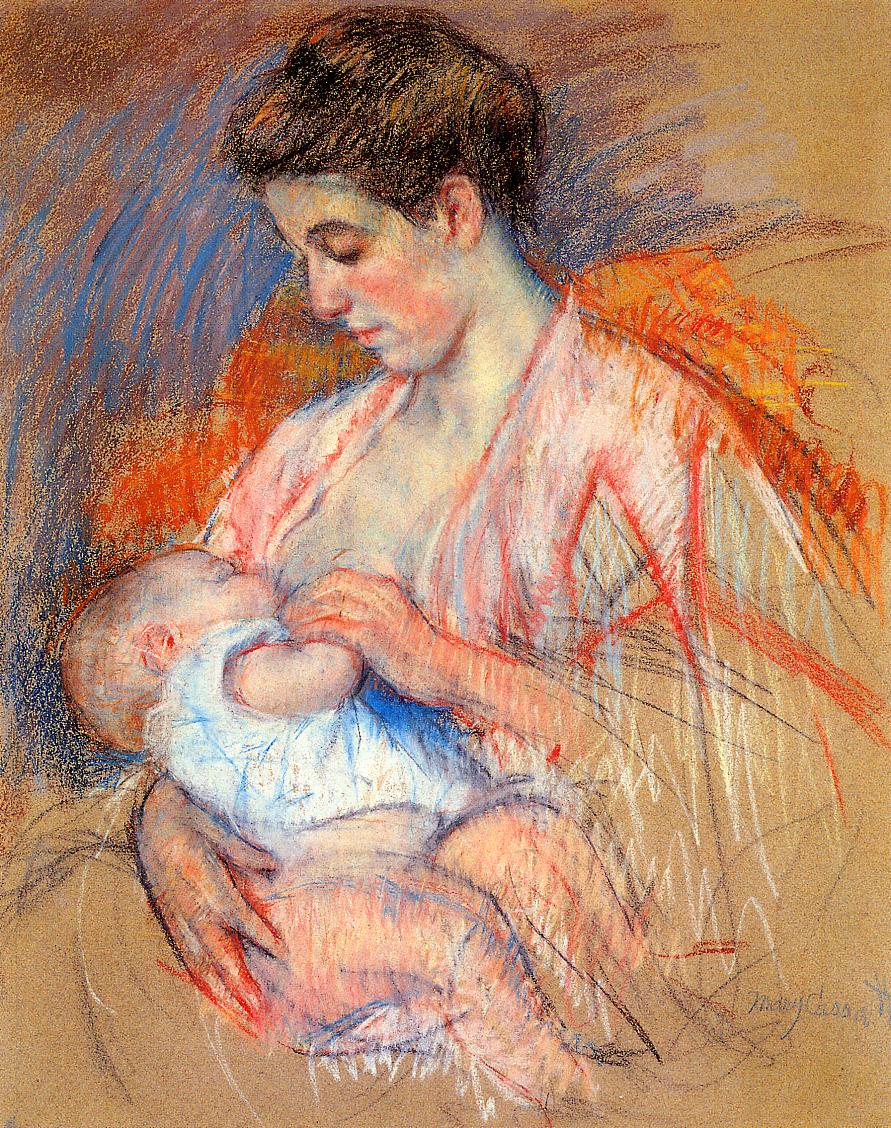
illustration while jenny laughs hawks illustration while jenny laughs nursing mother

While Jenny Laughs
(originally published in Earth’s Daughters)

 
While Jenny laughs,
two large brown hawks
ride the currents,
swirling over our heads
like the occasional
dreams we’ve had

of flying — she and I
agree on this. She
raises her blouse
to nurse her son.
His wispy curls are moving
lazily in the air, too,

his tender scalp
the color of a ripe peach,
and as he nurses she
kisses his hand.
Since I cut my hair
short, she says,

people keep mistaking me
for a man. Her smooth
face is perfectly
symmetrical, her cheekbones
high pirouettes of pale
skin, lightly flushed and

freckled by the quick
heat of early summer.
I would never, ever,
mistake you for a man,
I say, and as her milk
flows into the baby’s

mouth she laughs again,
her high voice turning
into notes of clear amber
bells. Look at the hawks
one more time, I tell her,
and so, to please me, she does.


2 Comments

Filed under poetry

where does it begin?, a poem

illustration where does it begin mossy backed florida cooters illustration where does it begin hands on shoulders

Where Does It Begin?
(originally published in The Charlotte Poetry Review)

Possibly with well-steeped tea,
gooseberry jam on raisin bread,
lots and lots of idle chatter;
later, he could try daily walks

through the woods — though she
has resolved she is finished with
nature — still he persists
in pointing out the log in the creek

holding five mossy-backed turtles;
if all else fails he could try
brushing her hair in the rough manner
of a mother, offhand, impatient fussing

to decipher knots. He could place her
in a room filled with the images
of budding spring trees, on a wide,
comfortable sofa, her stockinged feet

perched lightly upon the armrest
as she reads. The sight
of the frail new leaves will work
upon her, surely? Better yet,

he could fill a bowl with fruit,
three kinds of berries,
layering green upon yellow
upon blue upon red, teasing her

with a few squares of chocolate,
protesting all the while
that he always says the opposite
of what he means. Who lived my life

until this day? she will say. I could
ask myself the same question, he will
say by way of answer, placing his hands
lightly, lightly upon her shoulders.

Leave a comment

Filed under poetry

two summers after the divorce, a poem

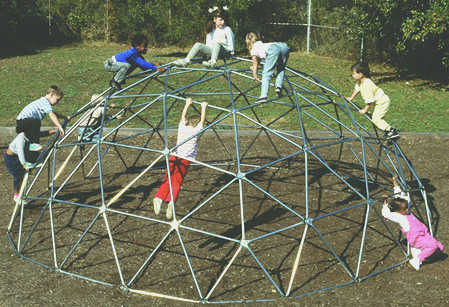
illustration merry-go-round illustration playground climber_superdome
Two Summers After the Divorce
(originally published in Snakeskin)

I. Children

The greenness, and the cars whizzing faintly by
like Central Park. Drops of water plopping
from the trees above me, cooling.
Children squeaking on the swings.
Soothing noises. A ginger-haired dog
with beautiful green eyes. A ginger-haired little girl
with yellow socks. In a blue flowered dress,
she runs past, smiling. My ex-husband
already has a new baby.

II. Privacy

My daughter’s bangs fall into her eyes,
so I ask if she wants a trim. No, she says,
her hair over her eyes gives her privacy
and makes her feel like she’s never alone.
I exchange glances with a blonde curly-headed toddler
in a black stroller with leopard print cushions,
sucking on a pacifier. She blinks knowingly.
She’s seen her own future, but will forget it
by the time she can talk. She sees colors around
people’s heads, her eyes glaze over at the beauty.

III. Expectations

Berry juice drips on my paper — a hazard of writing
outside under trees, birds and squirrels.
A granny says to her grandson,
“That’s a big spider you’re climbing on.
See his eyeballs?” They argue about letting him have his toy cars —
she wants him to climb and run and swing.
Granny has a long red braid on one side,
fading to gray at the scalp. Did she quit dyeing it abruptly
six months ago? Just gave it up, it looks like.
She’s learned exactly what you can expect from men.

IV. Desires

A young man passing is shirtless, jeans and hair wet
from riding around on his bicycle in the gentle rain.
Barefoot. Almost a man, but not there yet. He looks
furtively at women’s bodies, wanting something
but not knowing what it is. I don’t know any more, myself.
The girls on the merry-go-round scream, “Faster, faster!”
Heads tilted full back, faces to the sky, yelling.
My baby says, “This is the twisty-turny insane asylum.”
She calls to me and waves. I wave back, nod and smile.

V. Hope

A black teenager dressed in shorts and a muscle shirt,
with his baggy football jersey tucked into the waist,
draped over his thighs like an apron.
He is lean and muscular, hanging out with two fat boys.
I wonder how many times he will attempt marriage.

VI. Rational Thinking

The sky is multiple shades of grey, the breeze puffy
in medium bursts. Some little girls climb on the spider-gym
and mine says, “We’re mites. And we sit on his eyeballs.”
Redheaded lady in blue jeans and a red gingham blouse,
white wrist brace with day-glo pink straps.
The ex-husband calling me a harlot is like blaming
the broken capillaries for the bruise.

VII. The Upper Middle Classes

One impeccably dressed woman who looks just like
his new wife walks by, with two-carat stud earrings
and three small children but at least four babysitters
at all times. I’ve seen her around town for years.
She’s always pregnant or nursing.
Her feet in black sandals with bright red toenails,
professionally painted, her gray tweed suit with trousers
and her dime-store fuzzy hair-tie.

VIII. Beauty

I can smell the fragrant candy-striped amaryllis
out in the grassy circle from 20 feet away.
Fog in the hills and over the river,
branching off, banks lined with thick green trees.
Hills of crumbling shale, flowers by the road, pink,
purple, white. Plaster bunnies and fawns on lawns.
Lavender stained glass windows in the church.
Queen Anne’s lace, orange-red daylilies.
Grasshoppers flinging themselves at me,
banana spiders wait in their enormous webs.

IX. Truth

I run through the park, getting scraped by tree branches
but laughing as I run. The smell of cut grass and weeds.
Huge, opalescent night crawlers burying themselves
in leaf mulch. Character is not made in a crisis,
dear ex-husband: it is revealed.


1 Comment

Filed under poetry

twelve songs for a broken ankle, a poem

illustration twelve songs for a broken ankle x ray pinsillustration twelve songs for a broken-ankle-cast

Twelve Songs for a Broken Ankle
(originally published in Eclectica)

One

Before she even notices my leg’s
in a cast, my daughter’s friend
Eleanor, age five and a half,
stares at me and says solemnly,
your voice sounds different.
Different how? Does it sound better
or worse? I ask her, laughing.
It sounds darker, she answers with a frown,
and suddenly it’s not so funny anymore.

Two

I remember hurting myself
trying to fly. Jumping down
out of trees; sometimes my ankles
would ache for days afterward.
We ate fudgsicles up in the trees
all that summer. We liked to spy
down on the older kids, kissing
and kissing and kissing below us.
I would caress the rough bark
under my fingers and hold on tight,
never afraid of falling, only forgetting.

Three

In high school, I fell in love
with a boy on crutches. His ankle
needed a metal plate to keep it together.
Years later, after he became a priest,
he wrote, remember all those times you carried
my books up and down the staircase
for me? Did I ever say thank you?

Four

In the emergency room, Dr. Scarlett
tells me about his young daughter,
how his wife broke her ankle
just before she went into labor.
Now his beautiful daughter loves
to dance, she twirls and twirls
in her new frothy ballet skirts
in front of the triple mirrors
at the department store. I’m afraid
I don’t have any good news for you, he says,
shaking his head, patting my shoulder.

Five

All of a sudden, the laws of physics
I’ve always sneered at seem
terribly, terribly important.
Simple issues of mass, density,
velocity, and villainous gravity
loom unsolvable. As a baby, I walked
suddenly, at ten months. Lessons
I thought I’d mastered are now swept away,
each step is like that very first one.

Six

The nurse applies the fiberglass
wrap with firm, even motions.
She is made dense with fat,
and as she bends forward
to wrap my sore dangling limb,
I watch her enormous breasts
heave up and down. The heat
from the casts’ chemical hardening
feels like my leg will surely blister.
Be sure to keep your heel down, sweetie,
she murmurs, her breath brushing my ear
gently again and again and again.

Seven

When bone breaks, it bleeds. The blood
pools underneath the skin, turns
purple then green then yellow
as the liver labors to reclaim it
for the good of the body. The frayed edges
of the broken bone reach out
to one another like pale garden tendrils
reach toward the sun, and soft new cells
form, caressed in that delicate vacuum. I sit
and feel my leg healing, it is like praying.

Eight

We are skating when it happens. I have just remembered
years ago, the first boy who ever asked me to skate
with him. He was a friend’s handsome
older brother, we’d never exchanged a word
before. He knew how I was waiting for him
to come to me, he felt everything before I did.
My hands slipped against his, both our palms sweaty —
then on the turns, he pulled me close against him
so we could go even faster. We went faster than anyone.
He was a better skater than I, he wasn’t afraid.

Nine

First, I put on the skates. Orange wheels,
black laces. I tie them tight, then stand
and make a few tentative forays
with my feet. The gliding sensation,
the lack of friction and stability,
seems much scarier than it did
ten years ago, the last time
I had skates on. Who needs this? I think.
I’m too old now. Who needs
to break an ankle? I take off the skates,
pad around in my thick white socks.
For a while I just watch the other skaters,
some are little tiny kids no higher than my thigh
zipping around like they were born with wheels.
I watch my daughter and her friend
cling shakily to each other and scream
with delight. I put the skates back on.

Ten

It’s not just my ankle that breaks when I fall.
A little girl has fallen; she is afraid.
Let me show you how to lift yourself, I tell her.
I kneel, the world turns too rapidly, odd
thoughts fly past, time rushes over me
with a powerful thrill; the next moment
I know myself, I lie awkwardly
upon my twisted ankle,
which does not hurt exactly, but tells me,
in a strong, eloquent voice,
lie still, stare at the ceiling
for a little while. Forget everything but
this moment, your sudden brief flight.
Faces peer down, but I hardly see them.
When I saw you lying like that,
the girl says after a moment,
I thought you were dead.
She knows more than I.
A certain elaborate lacing, drawn and wound
tight around my heart to keep it
from expanding beyond a certain girth,
from expecting more than was practical,
from beating with too much tipsiness,
apparently gives way in that moment as well.

Eleven

The young manager is so kind, he unlaces my boot
and — oh, so carefully straightens my leg.
His fingers upon my skin as he regards me
with his dark, thickly lashed eyes
are as smooth and tender as a lover’s.
Can you move it? he asks. I try, tell him
a slight crunching sensation ensues,
but happily report there is no pain.
His handsome face falls nonetheless.
Perhaps he doesn’t get it. I, on the other hand,
feel unusually light, buoyant, unafraid.
I do not care who is sad; however unseemly,
I am glad I had a few moments in the air
before I came back down to earth.

Twelve

As moments go,
surely it’s worth repeating?
Though I didn’t know it at the time,
my life will never be the same.
The stolid laws of physics
will have their way with me,
weak as I am — bone mends stronger
for the break, while once-bound hearts
are never any better off
for being allowed out
of their wrappings; it’s too late —
old scar tissue and scary
skipped beats cloud and darken
the intricate red lace
of frantic working muscle,
obscuring and confusing the memory
of that one important moment, in free flight,
how life seemed so beautiful, so terrible,
so clear. And the darkness spreads
outward, outward from my voice.

7 Comments

Filed under poetry

the sword is a weapon of love, a poem

illustration sword is a weapon of love illustration sword is a weapon of love globe hand

The Sword is a Weapon of Love

(originally published in Stark Raving Sanity)


Brutal insight into a relationship occurs when the beloved

vomits in the bed… what can be borne, is, what cannot, dies.

Onslaughts of clarity come in the small hours like chest pains.

Can love survive endless trips to buy food?


Control your feelings — tie your hands together behind your back,

don’t pick up that stone.  Family is a genetic firestorm, shelter

yourself in a den carved out of solid rock.  Money is what creates evil.

A man I know lies whenever he can, if it will save a buck.

When you cannot decipher the callings of your heart

and soul, listen to loud music.


My grandmother left me a pair of silver goblets, which I

refuse to polish… I drank out of them on my wedding day —

they turned black instantly.  Beware of men

with black hair and dark eyes.  Beware of men who covet

objects of beauty, including you.  Their first

priority on the list of acquisitions is marriage.


When you have two opposing desires, do nothing.

Do first the one, then the other, if possible.

Take both paths simultaneously, and lie to everyone.


Beware of men who accuse you of interrupting.

If you fast for a day, you will experience quick and forceful change in your life.

The sword is a weapon of love. To be cut is to love deeply.

I know a man who hanged himself. His wife cut him down with his own sword.


In the bathroom, use lots of soap, feel emotionally cleansed.

Watch the moon, record it daily, change the color of your hair often.

Let the vines grow over the top of your roof, they will

penetrate your attic and a small wilderness will evolve over your head.


Always have a globe nearby to help you feel small.

Whenever you are embarrassed, take all your clothes off.

This will help you to remember what is really important.

Leave a comment

Filed under love, men, mysterious, poetry, relationships, sex, soul, spirit, spiritual, women

song of the hunted, a poem

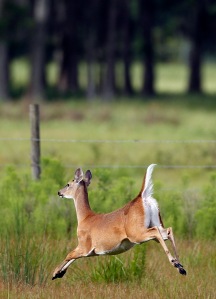
Deer Runillustration song of the hunted
Song of the Hunted

(originally published in Stark Raving Sanity)

No, birds don’t worry where their next meal
comes from. Their food is everywhere, waiting
to be grabbed, devoured. Animals never fell

from the grace of simple equations, their wants
and desires are never tortured. Antelope hesitate
for a moment at the river, moist tender nostrils

sniffing the wind, but the decision to drink
is a snap compared with my dilemma. Lately,
I have gotten phone calls where the caller

hangs up without speaking. I feel fear, anger,
amusement. I know who wants my voice so badly.
He is one who won’t ever look you in the eye,

though he’ll eagerly brush against you;
a dog scenting for trouble. He is small,
high-voiced, chin delicate and unshaven.

I suppose I’ll try to keep a sense of humor
when he comes at me with the knife. Out walking
this morning, I saw him, and I almost let go

of self-protection — we approached one another
over the death-rumbling of heavy freight trucks;
long, thin sidewalk like an assembly line

pulling us together for completion, diesel exhaust
wafting through the damp air, making me dizzy
and ill. His face was immobile, stony,

looking through and past me at some ragged old image
of satisfaction I shall never discover.
As we passed side by side, I had the urge

to place my wrists together, hand over hand
in an oblique position of surrender. My ankles
had the impulse too, I wanted to dance the graceful

steps of guilty prey, I wanted to be bound
limb to limb with bloody rawhide, hung
from a thick green sapling, carried to the altar

of his mysterious desires. I imagined twirling
my limp, curving body through the air, falling,
falling at his feet in a posture of immaculate

serenity. I wanted ask: do you hate me
or do you love me? If he had answered
yes, twice, who on earth could blame him?

Leave a comment

Filed under poetry

signs from god, a poem

illustration signs from god seagull
SIGNS FROM GOD

(originally published in the Xavier Review)

My eyes in the mirror have become
creatures unto themselves.
Still I look for some sign,

some indication, some forecasting
of the sorrow. Who could have predicted
within your final coronet of silver wisps,

you would hold an old halo of copper
rings to your pale, pale skin,
and that you would possess, too,

a luscious pair of purpled shadows
under your dying eyes: all of which
led, ultimately, to this prayer.

Adrift this way, it’s getting easier
to interpret things as signs
from God; the heavens always moan

best just before dawn… this trembling
world is more bizarre than even I,
the temporary visitor

from another planet, had imagined.
Blood-drained corpses line the path,
lightning scorches the road.

Things I once took
for granted, being lucky, vanish.
I wanted to be with you

when your soul left. The rest
without you will be forever
a near miss. On the way

to the funeral home, a seagull
sank like a stone in the ocean
of air, through the flat broad sky —

the whiteness of the feathers
(so white!) — how they blew
in the wind after it landed,

like tender fingers praying, praying.
Let me pretend one last time
you’re my mother, or my lover.


Leave a comment

Filed under poetry

the piano player, a poem

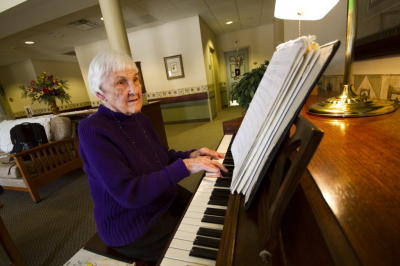
illustration the piano player

THE PIANO PLAYER

(originally published in the New Laurel Review)

She is small and curved:
like a dry snake, or a memory.
She lives in a house for unwanted ones.
This is the place of knowledge.

As her mouth opens toward me, it is like a babe’s;
tongue stuck out to be fierce —
provoking merely pity.
This is the time of changing.

The light against her skin reveals too much use;
her gown is blue and white.
She pats my arm, adjusts her jade rosary.
This is the look of eternity.

They all hated her, before —
they thought her shameless, a malingerer.
Slowly, she revealed her innocence.
This is the path to forgiveness.

She danced, she danced, she danced lightly:
on feet made of dust.
Countless boys adored her, gave her flawless jewels.
This is how she remembers.

The house, three stories, the carpet in the grand library,
now, moth-eaten, rolled to save space in the attic.
She sings row, row, row your boat, her feeble arms rotating.
This is the way of all possessions.

She sat with her sisters on the dark mahogany furniture,
waiting for the sun to cure them.
They fled — too hasty — their heritage in barrels, drowned.
This is what is meant by family.

Chocolates, bacon, a stuffed rabbit,
are all in the world she desires.
When she is happy, the dead live again.
This is the blessing of forgetfulness.

And as I rise, she purses lips,
rattles beads, plucks knitted blanket,
asks for the next interlude, hushed.
This is the harvest of love.

1 Comment

Filed under poetry

on contemplating your death, a poem

illustration on contemplating your death illustration on contemplating your death brain image

ON CONTEMPLATING YOUR DEATH


(originally published in the Panhandler Magazine)


This is not heroism, this slow

nod to absolutes, numb acquiescence

to facts.  I perform the worst


sort of cowardice: cutting the lines

free before it’s over. I can feel

the steps away from you, the slow


casting off from love, the mournful

horns, departing from this foggy

land of illness.  When you didn’t


know me, when your hands danced

above the forgotten teacup, squeezing

a lemon primly into thin air,


you had a kind of ruddy stubbornness

I was shocked to see.  After that,

your pale and knowing return was


anticlimax.  You had gone another

way, in your blue cap, your skin hot,

glossy as if with fever, the surface


papery-soft but no longer familiar.

I hoped you were angry once more,

even as you slept.  I expected to


cry more, to feel something else,

to be more like you.  Nothing here

is how I imagined it, not this slow


nod to absolutes, not this languid

overflow of salt water — aching

bones, a past no longer claimed.


5 Comments

Filed under poetry

frog sex, a poem

Mating Emerald glass frogs

Frog Sex

(originally published in the Red River Review)


We heard the air, blowing in and out of the throats

of the bullfrogs.  It made a noise like cool flesh,

like slapping, like the sounds you make when you’re

wallowing in the tub.  The croaking kept us awake

all night, and in the morning we saw the happy


pairs, hundreds and hundreds of squat pebbly bodies,

each one on top hugging the one below, bulging

jeweled eyes staring at nothing.  The mating continued

all day and night, never stopping.  The gelatin chains

draped the water-weed, black dots like peppercorns,


seasoning the salad.  The frogs seemed to love

each other, as much as we do when we hug.

They couldn’t read or write, but their eyes held blame.

We were blamed for having failed at our lives,

for having fled the scene, for not caring enough


to stand up and force air from our throats,

and make our few needs known to the world.

A few days later the tadpoles followed, squiggling

through the water, fat, helpless, smooth the way

your skin is smooth where it touches mine.


Still their mothers and fathers kept at it.  The pairs,

each holding another, staring at me from the dark pond,

webbed feet flailing to keep each body steady for as long

as the feeling lasts.  It may last forever, they don’t seem

to care whether they’re hungry or thirsty and neither do we.

2 Comments

Filed under poetry