Tag Archives: compassion

This Road I Am Traveling, a prose poem

illustration this road i am traveling

This Road I Am Traveling, a prose poem

I used to think it was possible, even desirable to order the world into alphabetic categories, though I never dared cut someone open with such a blunt knife as you.  The most I ever tried was harvesting a few drops of blood — they oozed through the cleanly raked skin underneath my claw like rare jewels.

You do not offer help.  You are scientific, curious, high on espresso, perfumed with the thick odor of fatty, fruity soap.  You tempt me to weep on your flannel jacket, though you don’t for a minute pretend to love me — or anyone.  It is all part of your elaborate theory.

You ask me what it was like to watch her body go, you say you hesitate to dredge up old muck, yet you persist in an ignorant, wheedling way, pulling the raw edges of the wound farther in your fretful passion to get at the truth.  I can’t believe a word you say.

Death is foreign to you.  Open your eyes!  See mine, clouded with the desire to cause your enlightenment.  Yes, I recall a hundred details:  the way a hand is not any longer a hand after that last breath, just a heavy piece of meat.  I remember the stiffening of flesh, the way heat emanates in nearly visible waves from the stilled body.  Though as you observe, time has continued to flow, my thoughts have not yet moved on — you are deluding yourself to think they ever will.  Shut up!  Your sympathies are worth nothing.

There are a million out there who know what I know — until you have allowed the fleeting soul of the one you love to pass through you, risking the internal injuries, the scarring from radiation, you can forget trying to follow for your own amusement.

This road I am traveling is ice — I have been skating with my silvery feet for more than ten years, and though it grows ever wider, I can see no end.  I grow tired, but there is nowhere to stop.  Living is grieving — sooner or later, only grief survives.  Once you learn to skate down memory lane, it’s something you never forget.  Though my legs ache, I have to keep them pushing.  Still, the bare trees arch gracefully overhead.  This cold air burns, yet cleanses.

10 Comments

Filed under acceptance, courage, death, forgiveness, grief, life, loss, love, poetry, prose poetry, transcendence

The First Time I Met My Father, a very, very short story

illustration the first time i met my father

The First Time I Met My Father, a very, very short story.

The first time I saw him, I was not dazzled. He was too tall and wiry, and he had too much red hair, flying off his head like an unmown hayfield. His eyes were too chilly, a piercing blue that made me feel like an insect on a pin. He was brimful of himself, but at the same time tried to project a false humility. When he found out I was trying out for cheerleading, he tried to talk me out of it. He’d only met me for the first time and hadn’t even met my friends, but somehow he’d already found them incomplete, just because they weren’t political radicals. “Why do you want to be a cheerleader?” he asked, chewing on the straw of his soda while he squinted.

“Because it’s fun,” I said. I shook my head, throwing my bangs back out of my eyes to glare at him. “Because it’s good exercise.”

“Do you know that the players will feel like it’s their right to sleep with you?” he asked.

“I’m not sleeping with anybody,” I said.

“I hope not.”

“You think anybody’s going to be able to talk me into something I don’t want to do?”

“Maybe.”

The arrogance he displayed made me want to slap him, punch him, kick him, or at least knock a couple teeth out.

3 Comments

Filed under absent father, daughters, family, fathers, fiction

Living On The Moon, a poem

illustration living on the moon

Living On The Moon, a poem

I remember all she had, stockpiled
in a child’s Easter basket.  Necklaces
of ivory, turquoise and amber beads —
hopelessly broken and tangled.  Cheap

metal pins, plastic bracelets, a dozen
stilled watches.  Dried-out jars
of skin cream, mangled greeting cards,
portraits of her sisters.  Often,

I allowed her to caress my face with
her trembling, soiled hands.  On the pillow,
my head next to hers, pretending
I was a small child, and she my beloved

mother.  Afterward, I scrubbed myself pink
with harsh soap.  In a moment captured
years ago, Brandy, her tiny poodle,
dances on his hind legs, his pink toenails

scrabbling against her tanned,
scrawny calves, a rhinestone collar
tight around his limber ashen neck.
She tempts him to please her with a bit

of bacon — herself very plump around
the middle, silver hair teased and
sprayed, a perfect bouffant.  You
would never guess then she was fated

to end up living on the surface of the moon,
by herself, without shame, without desire.
I must restring the beads, drape them over
a mirror, say a few words to her picture.

She will appear in my dreams nightly, dancing
with a small white dog, twirling her brittle
bones around and around until they catch fire.
She will sparkle like cut glass; gulping for air.

5 Comments

Filed under compassion, daughters, poetry

Things We Never Said, a short story

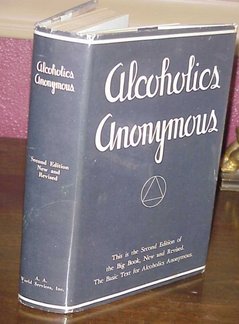
img058 alcoholics anonymous big blue book

Things We Never Said, a short story

She was beautiful, as all mothers are to their children, but it was far more than that. Total strangers told me how beautiful my mother was. She was particularly fine-boned and delicate. Her skin was the softest I’ve known, her arms and hands the most stubborn, the most lethal.

Mom was an alcoholic, of course, and the most gruesomely stubborn person I’ve ever known. She went past simple denial and created her own alternative universe. Once, some quack psychiatrist she was seeing told her she wasn’t a “true” alcoholic — that she only drank out of boredom. She clung to that unfortunate phrase of absolution, repeating it like a robot in a variety of situations, until the day she died at 44 from alcoholic pancreatitis.

The only way we ever got her into rehab was when we threatened to call the police about obtaining drugs by false pretenses. She’d call the drugstore and tell them it was Dr. So-and-so’s office, would they please fill a prescription for such-and-such, three refills, please.

She got stiff all over when she drank, not like a normal drinker who gets loose. Stiff, and with a duck-legged walk that made my flesh crawl. I can’t tell you how many times I just let her lay there on the floor where she’d stumbled in a drunken stupor. I couldn’t bring myself to touch her.

If only Mom could have been more like Charity Hope Valentine, the taxi dancer in “Sweet Charity” who, after being pinched, pawed at, fondled, ridiculed, robbed, tattooed, thrown from a bridge, trapped in an elevator, and deserted at the altar, rather meekly accepts the cheery and somehow redeeming gift of a single daisy from a group of 60s flower children, pulling herself out of her misery yet again, and living “hopefully” ever after.

My mother and I both said “I love you,” a lot, and to no avail. Neither of us believed in love. We believed only in self-preservation. Trust was unknown. I have never learned the reasons for staying with another. All I can think of, now that I’m married, is what I’m missing, giving up for the other. How short life is, and how unhappy.

I took a developmental psychology course once, while my mother was still alive. The teacher explained that no child ever actually dreams of killing the mother. Infantile rage exists, yes, murderous anger exists, yes, but the true desire to kill can never be resident in the child’s subconscious. “The instinct for preservation is too great,” she said.

When I told her, later and in private, how I’d dreamed that very act, how in my dreams I’d taken the great butcher knife out of the kitchen drawer and stabbed it viciously and repeatedly into my mother’s fine and delicately boned chest, she shook her head skeptically.

“You didn’t really dream that,” she insisted. “You only think you did.” I didn’t argue. I was still too afraid it might happen in reality to insist that it had happened in dreams.

She was never a very good mother. I was never a very good daughter. After she died, I went to confess my guilt over my record as a daughter once, to an Episcopal priest. “I let my mother down,” I told him.

“No, you didn’t,” he insisted. “You were the child. You had the right to go off and live your own life.” I was angry at him, and never went back.

I still feel guilty about the first time I knew I’d hurt her feelings. She made me a bunny rabbit salad – a scoop of cottage cheese for the bunny’s face, cut up vegetables for the bunny’s ears, eyes, nose, and whiskers. It was adorable. But I hated cottage cheese, and salad. I was four years old. “I don’t like cottage cheese,” I told her.

“Just try it,” she said.

“No.” I refused over and over again. Finally, she ran out of the kitchen, to the bathroom, and I knew she was crying. I sat in the kitchen, staring at the rabbit, not eating it. I didn’t follow her, I didn’t apologize, and I sat there until someone, probably my grandmother, covered the plate with a piece of plastic wrap and put it in the refrigerator. I knew I was never going to eat that bunny rabbit salad.

I mailed the invitations to my own daughter’s birthday party today. She’ll be four in sixteen days. Oddly enough, all I could think of as I wrote out the cards was how much my own mother would have enjoyed seeing my child, her first grandchild. I know exactly what my mother’s face would look like if she were at the party — lovely, tremulous, inevitably a little weepy. I also know half of my pleasure would come from seeing the tenderness in my mother’s wide brown eyes as together we would watch my little Katie blow out all her candles.


3 Comments

Filed under addiction, alcoholism, blood, child abuse, child neglect, childhood, children of alcoholics, compassion, daughters, death, development, fiction, forgiveness, girls, hope, life, logic, love, mama, matricide, mea culpa, mortality, mother, mothers, mourning, murder, parenting, personal responsibility, regret, relationships, short stories, soul, spirit, truth, woman, women, youth

Lilies of the Field, a short story

illustration lilies of the field

Lilies of the Field, a short story

Harry: Boy With Car

In the picture, Harry leaned back on his car, his arms crossed over his chest, tautly, the muscles bulging underneath his white T-shirt. He wore sunglasses and his hair was blown back off his forehead, as if from great speed. The car was a ‘57 Chevrolet, bright blue, brand new. He’d just left his mother’s house to live with a girlfriend, not Joanna — he didn’t meet Joanna for another 10 years. For a long time, he subsisted off a series of dead-end jobs and girlfriends while masquerading as a college student. The women he lived with all had a few things in common: uneducated but bright, a love of dogs, and perky telephone voices. They leaned against him in the front seat when he drove fast and their hair whipped his forehead. He was confident in those days, nothing had ever broken him. He had not yet been given the gift of suffering.

Joanna: The Queen of Grief

Joanna, in a state of grief and intoxication, returning from her grandmother’s funeral, sat in an automatic photo booth in Atlanta, eyes closed, lips pursed, head tilted back, her skin glowing white, her face blurred, too high to be captured on film. She met Harry in the local airport when she got home. He was intoxicated also, and was leaving to report to the Marines. She gave him her address and phone number and one of the blurry photos. He kept the picture in his wallet and called her every day, collect, from boot camp. She lay awake all night thinking about him, reciting romantic poetry into a tape recorder, then sent him the tape. She was disappointed in love before, but only by herself. She was cold and polite while others were warm and fumbling. How did one love another, anyway? She was, at heart, a hermit, but too much of a coward to live as one. It made for a tumultuous love life.

If Wishes Were Fishes

Harry sat in profile on the edge of a riverbank, his hair dripping forward over his forehead, his shoulders hunched, wearing red bathing trunks, and his black boots lying on his crumpled clothing. He refused to look at the camera. A pale straw hat had fallen off his head and lay directly behind him. The day was bright and clear. He was home from the Marines after 8 weeks, having been excused on medical grounds. He phoned Joanna upon his return. He lived in his car until he moved in with her. Harry said he despised her money and wished she were penniless. Secretly, he realized it didn’t hurt that all the bills were paid regardless of what else was happening. He took to collecting glass paperweights, and Joanna bought one for him everywhere she went. Gradually, Harry started to acquire her taste in champagne.

Woman with Drugs

Joanna stood on a wolf skin rug over a floral Persian carpet, in front of a lace curtain. Her dress reached the floor, white, with puffed sleeves, taken in at the waist by a narrow belt with a small bow. She held a sprig of marijuana in her left hand. Her hair was dark red, her lips painted scarlet. Her skin was only slightly darker than her dress and the curtain. Flowers were scattered in front of her feet on the wolf-fur. Harry was behind the lens, mocking the Impressionists. He admitted to himself for the first time that he was glad Joanna had money, though he would still love her if she were penniless.   He was the opposite of a snob — he made Joanna feel guilty that her family had taken advantage of his by accumulating more than they’d needed. The shadow of her money hung over them like a disused, rotting gallows.

Drawing the Line

Harry and Joanna were dancing. He had his arm tightly about her waist. She wore a red hat and looked away from him, over her right shoulder at the ground. He asked her to marry him, and she refused. He kept asking, and in a year she got pregnant and said yes. She didn’t believe in abortion. He began to ask her to put some part of her assets in his name, for the child’s sake. She refused. He accused her of frivolous spending and waste. She took an extended trip across the country with the baby, leaving Harry at home to care for the dogs. While she was gone, he brought a prostitute home and lived with her for a week. The prostitute wore all of Joanna’s lingerie and jewelry, but Harry didn’t let her sleep in their bed. When Joanna returned, Harry had drunk half a bottle of whiskey and vomited on the kitchen floor.

Acquisition

Joanna stood in the yard wearing a blue silk windbreaker. It was bitter cold and windy. Her hair obscured her eyes. Both she and Harry felt like he was taking her picture for a “wanted” poster. The baby screamed while Harry took the photos. In the beginning, Harry had wanted Joanna to make him feel real, rooted, and loved, to have all the accoutrements of material wealth without having to actually acquire them himself. To acquire material wealth, oneself, was such a tiresome prospect. After all, thought Harry, Joanna did not have to acquire it herself, she got it from her family. Now he’d be satisfied if she paid him with a bit of kind attention. She waited patiently for him to commit adultery, not knowing about last year’s whore. Meanwhile, their life in bed had dwindled down to almost nothing. Partly due to his drinking, partly due to her disinterest.

Disposition

Harry sat on a kitchen chair, elbows on his knees, and hands under his chin. He tried to look cute. Joanna pointed the camera at him and smiled, hoping to hide her inner revulsion. The problem was, they never fought about anything specific — they just fought. She wanted Harry to want her in a way better than the way in which she wanted him. A needier, nobler way of wanting — something that would take the whole heart, not just a sad, tacky corner of it, the way she felt wanting Harry occupied hers. Unfortunately, Harry didn’t seem capable of neediness and nobility, no more capable than she. How much money would Harry want, she wondered? She had an appointment with a lawyer in the morning. Joanna had been lonely when they met. If she expected comfort from Harry, she did not get it. It was too bad about the child, it was always too bad about that.

3 Comments

Filed under divorce, fiction, mama, marriage, relationships, short stories

Savior, a short story

illustration savior

Savior, a short story

The young man seemed so out-of-place in her mother’s living room. Maria stood in the doorway with her mother’s groceries, her purse on her shoulder, key ring dangling off one numb pinkie, clutching the heaviest bag propped on her hip, the bag that contained her mother’s supply of Diet Coke. Her mother and this man were sitting together on a Victorian loveseat on loan from Maria’s antique shop, their knees almost touching, the man’s arm draped across the ornate wooden back, his fingers curled behind her mother’s left shoulder. Her mother had a photo album spread out, one leaf resting on her lap, the other resting on his. Maria could see herself, at two, nude in the tub. Christ, she thought, what’s she showing him those for?

The young man leaped up after a few moments of uncomfortable silence, running his hand over his hair and smiling. Her mother folded the album closed, holding out her arm, and he helped her up, a gesture Maria herself had never mastered, helping old people up out of their seats. She tried too hard, using the wrong position and too much lift, until their sharp old elbows jutted out at alarming angles but their behinds hadn’t lifted an inch.

He had a medium build, wavy blonde hair, a deep tan — he was almost, but not quite, handsome. His eyes were too close together and his nose too long: as Maria met his direct gaze, she felt uneasy at his obvious affection for her mother, the implication of knowledge which came from his confident manner. He looked as though he was already sure he knew the older woman’s mind; already sure she must be lonely.

“I’d like to introduce you to my daughter, Maria,” her mother said. “Maria, this is David. He found my wallet over at the library and was kind enough to track me down. I couldn’t believe it when he called. I didn’t even know it was missing yet.”

“That is lucky,” Maria said. “Really lucky,” she continued, smiling in her mother’s direction, one eyebrow arched, whereupon her mother shook her head once, violently, and her daughter’s unspoken reprimand was expertly dismissed.

“Oh, it wasn’t luck,” said David, the sound of his voice causing the small hairs at the back of Maria’s neck to rise. “Nothing’s a matter of luck. Life is all planned for us, down to the last detail.” He nodded, smiling at Maria, his arms hanging relaxed at his sides, and the suspicion came to Maria that he was crazy. Crazy but safe, one of the harmless ones, the kind that made her want to go a little crazy too because they seemed so sure of themselves.

Most of Maria’s son Richard’s friends were the same type, that’s how she knew. Richard — she never thought of him as “Kurma-devi-dasi,” although she respected his desires and addressed him that way — was crazy but harmless too, although she knew she couldn’t see him as clearly in that way as she could a stranger. To this day she was able to discern the fuzzy cartoon of his infant features on his serene face when he smiled at her — the memory of his toothless gums clamped like a rhythmic vise on her breast would come to her, looking at his shaved head and his orange cotton robes as he chanted over his prayer beads, and she would be filled with a sorrowful rage that made her chest shrink into itself.

Not his grandmother, though — she had sat with her grandson over at the temple for hours when he first became a devotee, sitting in a rocking chair next to him as he said his prayers in front of the little richly clothed doll of Krishna. She told Maria it made her feel closer to her own idea of God just being in a place like that. In theory, Maria agreed, but the issue wasn’t whether the temple was a nice place to spend an afternoon, the issue was whether it was a good way for Richard to spend the rest of his life — sewing holy Hindu god and goddess doll clothes on an old black Singer?

“I don’t know about a plan,” Maria replied. “I’m lucky if I know where I am, half the time. If it’s Wednesday, this must be my mom’s apartment — you know?”

He said nothing at first, not seeming offended, not defensive, just staring at her with eyes so full of a giddy, knowing light — his face loomed toward her, and tension rolled through her stomach as his mouth moved into a drawn bow of compassion. It didn’t matter that he wasn’t handsome; he radiated an alarming level of charm. “Down to the last detail,” he repeated, arching his eyebrows and opening his eyes a bit wider, his pupils enlarging like a lover’s, and the sound of his voice vibrated within her ears, warm and solid like hands pressed against her temples.

“Then one of the details must be that I’ve got to put this bag down before my arms fall off,” she said, forcing a laugh. “Excuse me.” She turned away and walked up the hall to the kitchen. By the time she’d finished putting the groceries away — rearranging pantry and refrigerator shelves, purposely taking far longer than usual — he’d already gone. Great. Now their lives were stuck together like flood trash swirling down her mother’s raging river. David would be there for her mother — be there always and forever, overflowing with that sickening, confident love, and her mother would never be able to blame him, not for anything.

***

Maria was uncomfortable with the amount of time her mother was spending with David, but didn’t dare say too much. There was nothing overtly objectionable about him, other than his religious fervor — and how could she term that a fault? Her mother wouldn’t listen, anyway. Whenever Maria brought the subject up, her mother would groan, “Oh, boy, here we go again,” and she would frown, which consisted of one sharp, off-center line in the middle of her forehead. “You don’t have to like him, sweetie,” she’d say, “but I wish you did.”

Still, her mother’s interests seemed to be shifting. Odd books and papers came and went on the coffee table, crowding out the usual hodgepodge of half-finished crosswords and literary journals: treatises on wild herbs, population-density maps, computer programming manuals, military histories. Flipping through a ratty emergency-medicine textbook, Maria saw numerous large, yellow-highlighted portions and margin notes in both an unfamiliar, childish hand and her mother’s own neat back slant. “What is all this stuff?” she asked, holding the book out to her mother.

“I’m getting ready,” her mother said. She sat down opposite Maria and picked up a needlepoint pillow, arms crossed, mashing it to her tummy like a teddy bear.

“Ready for what?” asked Maria.

“The end of the world,” said her mother. “You know, Armageddon.”

***

At first, Maria’s son agreed with her concerns, not at all what she expected and a strangely intolerant position for him to take — considering his own lifestyle — his agreement only making her feel worse. They sat in the temple’s empty dining hall. “I’m with you, Mom,” Richard said. “The guy sounds like a real case.” He rubbed his hand over his prickly scalp and yawned, his left hand fumbling inside the peach-colored sack of meditation beads that hung from his neck. He scratched his nose, smearing the delicate yellow makeup lines drawn there that symbolically pointed up: up to God, up to heaven. “Have you checked Grandma’s bank accounts lately? He could be some kind of con artist.”

“No, no,” she said. “That’s not the kind of thing I’m worried about. He seems sincere enough. He’s no con artist. It’s just — your grandmother is really starting to believe what he says — how Armageddon is coming, all that stuff. You should see the books he’s got her reading.” Maria leaned on her elbows, cupping her chin. Richard closed his eyes for a moment, tilting his head to one side like a duck.

“Then again, I suppose the guy could be right on,” he said, his eyes still closed. He looked asleep, his skin pale and fragile. “Maybe that’s what bothers you. I’ve been trying to get through to you on that level for years. At least Grandma’s started thinking about her future.”

“Her future?” Maria asked, her voice louder than before, wanting to reach across the picnic table and shake him by his choke collar of tiny wooden beads. “At eighty-five? People that age should be beyond this kind of worry. It isn’t right. He’s getting her all stirred up — and for what? If all that biblical stuff happened, she’d never survive.”

“You’re just jealous,” he said. He opened his eyes and stared at her, his thick black lashes tangled and dusty-looking. His pupils were pinpricks inside the blotched hazel irises, and as he spoke he stood up too fast, banging his shins on the metal tubing of the cheap table. He grimaced and squatted for a moment, rubbing his leg. “You can’t stand it when someone believes in something you don’t. I thought you were worried this guy was some kind of sleazy fake, but now you’re telling me what freaks you out is that he’s the real thing. Make up your mind. You should be happy Grandma’s paying attention to what’s out there.” He turned and walked away, his robes ruffling out behind him, his rubber sandals slapping the bare wooden floor. “I’ve got devotions to attend to,” he said, not turning back to face her as he walked, his voice thin, echoing across the length of the long, barren room.

***

The earliest occasion Maria could remember wanting her mother’s opinion was in the seventh grade. Maria had just turned twelve, and had her first crush. She was stringy and awkward in those days, large-kneed and carrying a head of vigorous, curly hair she flattened down into a matted-looking cushion in desperation. Then the quiet boy started walking her home from the bus stop.

She remembered him still: pale blue eyes, so large and widely spaced that they gave him a somewhat doe-like expression. His jaw, however, was firm, angular, and thus saved his face from weakness. Warm hands lay against hers, trembling, stroking her fingers up and down in an hypnotic rhythm. “Do you want to go steady?” he’d asked her, unable to meet her eyes. That meant wearing a silver identification bracelet, his name engraved about her wrist for everyone to see; his property. She hoped his name was in block capitals, not that loopy script: it looked better.

“I don’t know,” she said, and went home to ask her mother’s opinion, a matter of form perhaps, but something she wanted; the camaraderie of womanhood revealed at last. This could be the common ground between them.

“Honey, I just don’t think going steady is a good idea at your age,” said her mother. They sat in the dining room, wallpapered with tiny brown pineapples. “You’re too young to get so deeply involved with a boy.”

“But lots of girls do it,” she said, knowing this was a flawed argument, but even as the shipwrecked are driven to drink seawater, her words carried a dreamlike hope.

“You asked for my opinion,” said her mother, “and I’ve given it to you. It’s up to you to make the decision. I’m not saying no, I’m just saying I wouldn’t if I were you.”

In the end, she told the boy no — and was informed that the going-steady offer had been withdrawn in the interim — and she realized by heeding her mother’s counsel she had been saved from a greater and more penetrating level of humiliation than she imagined even existed. But — that wasn’t the point. Maria knew her mother would never have said no to one of her own teenage boyfriends — that was a lie. Safe advice given as a — joke, as an experiment. Didn’t Maria have the right to be strong-willed? Didn’t she have the right to her own losses? She never stopped trying after that, but the drama was gone.

***

Then Maria found her mother in the bathtub. She entered the apartment, carrying her mother’s dry cleaning: a few sweaters, a wool suit, a pink blouse. She heard water running, a slight, far-off sound, as if from the next apartment. The bathroom door was closed. The only sound was a rolling and a swishing, as though a large fish reclining in the tub had shifted position. Alarmed, Maria opened the door. Her mother was sitting upright in the full tub, a small trickle of water dribbling from the faucet. The tub was full to overflowing. Her mother was wearing a purple shower cap embroidered with large seahorses.

“Go away,” she whispered, as Maria stood, confused. A bristling red pincushion sat on the edge of the tub, dangling a red cloth strawberry from a green cord into the water. The strawberry bobbed on the surface. In her mother’s hand was a large straight pin, on her wrist several thin scratches. She jabbed with the pearl-headed pin, her hands unsteady.

“What are you doing?” asked Maria, her voice shrill, terror coursing through her. “What in the hell are you doing?”

Her mother turned to her, her unfocused eyes shining and rolling up toward the ceiling as she spoke. “Trying to kill myself,” she said.

“With pins?” shrieked Maria. “Jesus, Mother!”

“I wanted to flush my head down the toilet,” her mother continued, “but it wouldn’t go down.”

***

On the third night of her mother’s emergency hospitalization, Maria dreamed she was sitting in her living room drinking tea with one of her college professors, a sloppy but verbally precise little man. In reality, she hadn’t liked him at first, but she had taken every course he taught because — unlike the majority of his students — she got A’s from him. She came to admire his sincere and stringent approach, forgiving him his greasy, untrimmed hair, his baggy, stained chinos and ancient, Filipino-style dress shirts.

And so, in the dream, her old professor, uncharacteristically neat, his hair washed and combed, his pants pressed, was explaining to her that he had theater tickets for tonight’s performance — would she like to join him for dinner and a show?

I’m sorry, she said, but I don’t think I can get a baby-sitter on such short notice. It’s already six o’clock.

He raised his eyebrows. I had no idea you were married with a child, he said. Well, that’s too bad, my dear. Perhaps we can arrange it some other time.

As he shuffled off down the sidewalk, Maria wanted to call after him: Wait… I don’t really have a husband… I don’t really have a child… it’s all a mistake. Come back. I want to go with you.

But she was silent, knowing it wouldn’t make any difference what she said. He was already too far away, and could not hear.

***

The next day, when Maria arrived at the hospital, her mother’s newest flowers were wilting in the heat. Her mother had turned the room’s thermostat up to 85 degrees and wore a sweater and cracked pink leather mules. Still, the new additions were beautiful: three dozen roses, white, yellow, and coral, stuffed into a too-small mayonnaise jar, the faded label turned to the wall. Maria stood in the doorway for a moment, holding a brown paper sack full of the day’s requested items — mostly cosmetics — looking at the bright splash of color. “Hi there,” she said to her mother, who sat hunched on the edge of her bed, flipping through a current TV Guide.

“Hi,” said her mother. “Is it cold out? You look chilly.”

“It’s cool, but the sun’s warm,” said Maria. “Who gave you these roses?” She leaned over to smell them, her nose brushing the petals.

“David,” said her mother. “He brought them by this morning on his way to work.” She squinted at Maria, her glasses speckled with bits of dust, so filthy Maria wondered if she could see anything at all. “He didn’t know I was here; he found out just this morning from my across-the-hall neighbor. He was taping a note to my front door.” She unrolled a package of breath mints and placed one on her tongue. “I thought you would have called him by now — it’s been three weeks, after all.”

“I didn’t think it was such a great idea for you to have a lot of visitors.”

“A lot?” Her mother raised her eyebrows, which were nearly invisible. She penciled them in most days, but today she’d left them defiantly natural. “Any, you mean. You’re the only one I’ve seen other than the doctor, until this morning.”

“What did he say about visitors?” Maria asked.

“It’s fine, as long as I feel up to it. They’re still fine-tuning the dosage on the blood thinner, other than that I could go home already.” She held out her arm, shoving the loose sweater back above the elbow. Small scabs dotted her forearm. “They’re sticking me every four hours, round the clock. They’ve got to balance it just right. So I won’t have another stroke but so I won’t bleed to death, either.”

She stared at Maria, her eyes shining. Her mother’s voice dropped low and fluid, almost a murmur; Maria remembered that voice from long-ago midnights, giving comfort to a distraught child. “I know you were scared when you found me all confused like that in the tub, sweetie.” Maria said nothing. Her mother raised her chin with a jerking nod, relapsed motherhood dropping away from her like a fragment of dry skin, her voice back to normal. “But really, I’m okay now. It was a very minor thing — you heard when the doctor told me I was one lucky lady.”

***

An hour later, on her way out, Maria saw David from across the hospital’s visitor parking lot as she stepped on the black mat that made the door swing open. He was dressed in jeans and a pink polo shirt, his hair still wet from the shower, combed flat across his head, just beginning to spring away in wisps where the blond curls regained tension as they dried. She stopped short, turning and walking back inside, toward the gift shop, where she stood in the farthest corner. She picked up a stuffed animal and pretended to scrutinize the price while she watched the door. When he passed, moving toward the elevators, she followed. He entered one and the doors closed. Maria waited and got the next one, her heart pounding.

She got off on her mother’s floor, going away from her mother’s room, back toward the nurse’s station and lounge on the north end. Settling in one of the low, soft chairs, she stared up at the wall-mounted television, the evening news in full swing, recounted events drifting over her, seeming important but incomprehensible, the words passing through the air like puffs of smoke. Muscles tense, palms clammy, she took out a pen and paper and began jotting notes of what she wanted to say.

She jumped, startled, as she heard David speak. She saw his back, visible from the doorway, over at the nurse’s station where he spoke to the charge nurse. “I think there’s something wrong with her call button,” he said. “She says she’s pressed it a bunch of times without hearing anything over the intercom.” The nurse, a thin, tired-looking woman wearing lavender scrubs, nodded.

“Okay, I’ll be there in a minute,” the nurse said.

David turned to leave, and then he saw Maria and stopped, his mouth forming an exaggerated O, his eyebrows lifting. Maria felt a clammy flush rise up over her neck, a dull enveloping embarrassment. He smiled like a placid baby, walking to her and holding his hand out. She clasped his hand for a moment, feeling the solid meat of it, the warmth and hardness of his callused palm. “You don’t know what to believe in,” he said, his voice calm and slow, “and that’s natural. It’s a process of evolution you’re going through. Think of your mother’s illness as the catalyst.” He opened his arms and bent at the waist, hugging her so hard she couldn’t inhale, then he removed himself and stood looking down at her, his head cocked, his blue eyes luminous and warm, a crinkly-eyed smile starting to show.

“You’re crazy,” she said, feeling her throat seize up as her heart beat shook her ribcage like a wild animal — she had difficulty speaking. She paused as her chest eased, then forged on. “A catalyst?” she repeated. “I know what to believe — I believe you’re causing all my mother’s problems. She doesn’t need your brand of stress right now. And I don’t need this kind of condescension. Telling me I’m OK. I don’t need you for that. You’re not any kind of expert.”

“No, I’m not,” he said, the smile gone from his mouth but his eyes still glowing with a trace of it like a madman’s. “And since when do you care about expert opinion?” He reached out and stroked her hair, saying her name in his gentle murmur, Maria, Maria, and she flashed — it’s finally happening to me, it’s finally here — a jolt of vertigo as if she’d been through all this before, a hundred, a thousand, no, ten thousand times…. “You don’t care about anyone’s opinion but your own,” he said.

Their lives were now joined – with force of will and love he’d plucked her up and tucked her into the golden cup of his heart as quickly and easily as he would rescue a fear-crazed puppy clinging to a torn-off tree limb, just before that puppy swirled away to her doom down a swift, swollen river. Maria wanted to run, to hide, to retrace her steps, but it was too late. David would be there for her — be there always and forever, surrounding her with this… curious compassion of his, and she would never be able to scare this one away, no matter what she tried.

3 Comments

Filed under compassion, daughters, death, development, eternal, faith, fiction, forgiveness, heart, hope, identity, karma, kindness, life, love, man, maturity, mother, mothers, mysterious, peace, personal responsibility, relationships, short stories, soul, spirit, woman

Divine Love, Divine Hate, an essay

illustration divine love divine hate

Divine Love, Divine Hate, an essay

Scientists have of late discovered that music stimulates the same areas of the brain as food and sex. That’s why listening to music can bring a chill, raise the small hairs on the back of the neck. That’s why music demands — and gets — our closest attention. You need me, the music calls, you need me to survive, to perpetuate your species. Without me, you will have less well-being, less pleasure and satisfaction. What a design! Food, sex and — music.

The pleasure centers of the brain — the reptilian, primitive intelligence — is not involved in abstract thought but entrusted with the very essence of staying alive. Yet the impulses and desires which originate there find means of expression in our higher intelligence. Food and sex are necessary for survival, so necessary that sometimes it seems as though the whole human world, all human society and culture, can be thought of as nothing more than an interesting mechanism to keep us supplied with food and sex.

The appreciation of music springs from that same primal area of the brain — could this possibly mean there must be a God, after all — a God who gave us another instinct, one for pleasure and beauty, in addition to our basic instincts to survive? Music, a divine invention with no practical purpose. No purpose at all other than to inspire in us joy, mystery, fear and abandon.

Think of all the emotions we can express with food, sex and music:   passion, joy, disinterest, experimentation, violence, anger, tenderness, wistfulness, meditation, transcendence. Food, sex and music can be used to communicate, even intensify, all these emotions, yet the trio can also be used to push us past all of these feelings to a region of Godlike rationality and knowledge. Yes, occasionally our existence becomes clear, understood fully until surface complexity falls away into the deeper simplicity of detached understanding. A strangely quiet joy — a joy beyond anything prosaic.

A poetic joy, able to recreate itself in the mind forever. Sometimes the memory of such enlightenment is what keeps us going when the enlightenment itself feels as far away as Uranus or Pluto — as cold, as unreachable. Remembering how once we held it in our bodies and it filled us so there was nothing empty, noting lacking, nothing to fear — not even death. It is a knowledge, a contentment, which infants possess without awareness. To possess this peace with awareness is the greatest achievement, but one which few people are able to sustain for long. We hold it and fall in love with it and in an instant it twists out of our hands and flashes off into the distance like an agile, silvery minnow. Enlightenment as God’s minnow. Look at it too closely, try to keep it too long, and you may never see it again.

I myself have only a rather wobbly faith in God’s existence, but I nonetheless feel pity for people who declare without hesitation that nothing divine exists. What a drab, ugly world their interior castles must be, with only themselves for company.

The divine cannot be ruled out. We cannot know what exists beyond our senses.   Certainly people have been enraptured by the idea of divinity — especially, most recently, the notions of divine anger, divine vengeance — modern terrorists have embraced these, but without embracing the corresponding ideas of divine love and divine compassion. Yes, people have fastened their wills on the idea of divine judgment, but they have ignored completely divine forgiveness.

The cockroach is as marvelous a creation as anything — see it scuttle away from the light, a most marvelous mechanism, see it copulate, see it reproduce itself, see it taste its food with pleasure twinkling in its delicate, wavelike feelers. No less miraculous than us. But we have an ability the cockroach does not have — to be self-aware of our divine impulses — our duty as human beings is to dive both below and above our own ordinary human consciousness. To bring all our unconscious knowledge and desires into to the conscious realm — both those desires labeled primitive and those labeled exalted.

Some elements of love are to be found in the roach. It loves its life: flees from danger, attempts to avoid harm, and tries to survive no matter what the odds. This is where the terrorists have failed. They have embraced only half the divine order — divine hate — the half that appeals to them more and suits their political purposes. They need to stretch themselves, accept all things God has created — even those they find distasteful or abhorrent — and leave the judging to God. They need to cultivate in themselves divine compassion and divine love. Terrorists profess they love God, but they do not love God’s creation — therefore that love is flawed, is not really love at all. Their love has turned inside out into hate.

They need to learn from the cockroach, as do we all. We possess vast potential for divine virtue, yet are so capable of falling into the abyss of pride. These terrorists have fallen, and they are trying to pull us down with them. We must not surrender to only part of the divine order. We must catch ourselves with the feelers of the insect before we tumble too far.

I cannot blame anyone who feels the need to destroy the terrorists. I feel that need myself, the blood lust of anger and retribution. But we must find a response pleasing to the divine. That is what prayer is — thinking about what a divinely perfect being might do, waiting for the small voice to tell us the right way to handle this new permutation of evil — without ourselves falling under its wicked spell.

This is what all religious searching has been aimed at. Whether we believe God exists or not — we can imagine God, as God might exist. Sometimes it is better to die than to kill the blameless. We can feel such things in our deepest selves, and these places are just as important to reach with the conscious mind as the highest levels of abstract thought.

We can imagine God, we can love God, we can honor God, and that is what matters most, not whether God truly exists. Good and evil, love and hate, right and wrong, call it whatever you like. It is our uniquely human gift, our uniquely human burden. Did we ask for this? Be careful what you wish for, goes the old admonition. Would I rather be my dog, or my cat? Sometimes I envy their peace of mind. They don’t know about world wars. But my most divine pleasures, feeling them and knowing that I am pleased, and knowing why — in this way I have my cake and eat it, too. The lure of that apple in the garden is a lovely allegory, whether it happened or not — we invented it. This is the quality of our humanity which we can never give back, no matter how much we might want to.

10 Comments

Filed under beauty, charity, compassion, enlightenment, essay, faith, forgiveness, god, hope, humanity, love, peace, world

Summer Evening, Beaumont, a poem

illustration murder in beaumont

Summer Evening, Beaumont, a poem


I was not there. I am only an observer.

The four-year old on his tricycle is

dressed for the heat in loose shorts

and nothing else. His hair appears


disarrayed as he stares at the ground.

The back of his bare skull is as finely

carved as a newborn’s, the delicate

shadows of his shoulder bones ask for


touch. The clumsy chalk lines on the

pavement are from a murder and he

knows it — the blood came out last

night as the torpid sun was going down.


This boy has to make stories up in

his head, but the shy universe he

creates is a notion he’ll never share.

I was not there. I am only an observer.


The dead man was 300 pounds and didn’t

talk much, as he, too, was waiting for a

miracle. Gang members used five or six

bullets, then ran away without taking his


wallet, the item they wanted most of all.

I was not there. I am only an observer.

Hours earlier, the victim had left his

rented home in all-white Vidor; he told


how the folks there threatened to hang him,

he told how lonely it was to wake up every

day and remember where he was. He wasn’t

afraid, he said, just tired of fighting.


2 Comments

Filed under anger, blood, compassion, criminal, criminal behavior, criminals, death, evil, funeral, history, ignorance, karma, mortality, murder, poetry

Crocuses, a poem

illustration crocuses

Crocuses, a poem


I.  Signs of Spring

Suddenly, there they were by the front door,

and at my son’s preschool — purple and yellow

and green, poking through the snow

like small erections, out of the body of the earth,

the earth’s slumbering winter body.

My husband was always at work then,

they, the flowers, were my best companions.

“God is!” they said. “We’re God’s greatest effort,” they said,

“We’re God’s peeping blooms, despair must go to sleep,

and all creatures must go out of their lairs to frolic.”

My husband did not feel the urge.


II.  The Mole

Such loneliness I had battled all winter!

I made chicken, hot crescent rolls,

and buttered beans to make us happy,

but my husband was never hungry.

Lots of things took his appetite clean away.

I hadn’t scrubbed the toilet in two weeks,

this distressed him, he was a stern master.

The crocuses were so calm and forgiving,

purple and yellow like bruises;

my husband inflicted bruises without knowing.

He could not see, or did not want to.

His face lit up upon our child, that was all.

He was too important to sweep, or dust, or scrub.

I was the babysitter. I was happy with the crocuses,

and then one day, a dead mole; my son didn’t know

what dead meant, so I had to explain it.

He petted the soft fur, wanted to snuggle it

to his cheek. We paid homage to the mole.

We buried it under the snow, amid the crocuses.


III.   Troubling Questions

My husband didn’t know the bruises he left behind;

the flowers were my trusted companions.

His face lit up, gazing upon his son,

his finest possession; my husband would jerk him

away from me, hate in his eyes, when the crying boy

awoke in the night. The crocuses poked their heads out,

asking questions I couldn’t answer. My husband

didn’t want to see the bruises, or he was colorblind.

He was too important to notice the marks.

The crocuses asked, “Where is pleasure?”

“Not here,” I said. “Maybe next door?”


IV.  The Body’s Lament

The earth’s body was waking up,

but mine wasn’t, my husband was too important

to worry about my body. The head of his penis

was purple like the crocuses, but it asked no questions.

His body was warm, but not for me:

for the pure idea of sex, the attractive notion.

He wanted a thinner, more charming woman

with a better degree, one who would clean the house

more often, and with a smile.

Oh, he wanted a warm, dark place to set

himself, but one with no conversation.

As I put away the winter wools, the smell of mothballs,

white, crystalline like snow, inflamed my fears.

When the rest of spring arrived,

the warm air did not ease the tightness,

the block of ice around my heart.

2 Comments

Filed under beauty, compassion, earth, eternal, eternity, father, flowers, god, health, heart, identity, kindness, life, love, man, marriage, maturity, men, mother, mysterious, nature, relationships, sex, soul, spirit, spring, warmth, winter, woman, women

Mr. Rogers Visits Koko the Gorilla, a poem

illustration mr rogers visits koko the gorilla

Mr. Rogers Visits Koko the Gorilla, a poem


Koko was clearly in love with him.

He was the human equivalent


of what in her world would be a male silverback

& I think she would have adopted him into her tribe


in a heartbeat. She took his shoes & socks off

& tickled his feet & pressed them to her own.


She kissed his hands & groomed his face & hair

with her fingertips. She wanted his gold cufflinks


(to remember him by) & you could hear the anxiety

in his voice when he said “My grandfather


gave those to me.” Really, really hoping

he was going to get away still possessing


his treasured cufflinks. What if Koko

had insisted? Would Penny have been able


to talk her out of it? Distract her to something else?

Mr. Rogers seemed nervous but in awe


at the communion with such a “being,”

as he called her. She flirted, playing


peekaboo with him, her large eyes knowing & coy

from underneath a cloth covered with pictures of kittens.


1 Comment

Filed under love, mysterious, poetry, relationships, science, soul, spirit