Tag Archives: mother

A Few of My Ghosts Comment on My Recent Behavior, a poem

illustration a few of my ghosts comment on my recent behavior

A Few of My Ghosts Comment on My Recent Behavior

Bravo! says Father. It’s about time! he says.  I was beginning to

            think you’d forgotten everything I shared with you.

How could you? says Grandmother.  How could you betray me that

            way?  Everything I believed in, taught you, gone!

This is just like you, says Mother.  I knew something like this

            would happen eventually.  I knew it was just a matter of

            time.

Grandfather just looks me in the eye and shakes his head.  He

            knows exactly how such a thing can happen.

I never thought you’d have the nerve, says Father.  I thought I’d

            lost you forever, missed my chance.

I never thought you’d do such a thing, says Grandmother.  I

            thought I’d taught you better manners.

I always knew you’d do something like this, says Mother.  You’re

            so damned stubborn.

I was just hoping you’d have more sense, says Grandfather.  He

            still loves me, he always will.

Live as I would have, says Father.  Live for me.

No, live as I would have, says Grandmother.  Live for me.

Nothing I say will make any difference with you, says Mother.

            You never would agree to live for me.  I only gave birth to

            you.  I’m not someone really important, God knows.

Please be careful, says Grandfather.  Long ago, he charted the

            dangerous waters, entirely alone, no one to guide him.

You must always tell the absolute truth, says Father.  It is the

            only thing that will save you.

You must never tell the truth, says Grandmother.  It is what will

            destroy you.

You always were a liar, says Mother.  You told the truth only

            when it suited you.

Tell only the necessary elements of the story, and then only to

            the necessary people, says Grandfather.  He is secretive by

            nature, and full of legal advice.

Don’t think about things too much, says Father.  Follow your

            heart.  You know, that ugly chunk of muscle in the center of

            your chest?  It keeps you going, but for what purpose?

            Don’t ever stop listening to it, the way I did.

I want you to stop and think before you do anything else crazy,

            says Grandmother.

I know you’ve already made up your mind, says Mother.  You never

            listen to a word I say.  It’s pointless for me to try.

There’s no need for haste, for immediate action, says Grandfather. 

            Is there?  He wants only to protect me, I am

            his dear flesh and blood.  In all the family, I am the most   

            like him.

You loved me more than you ever let on, says Father.  I really

            meant something to you.  Even though you’re suffering for it

            now, I’m glad of it.

You didn’t really love me at all, says Grandmother.  Perhaps you

            didn’t understand what I meant when I spoke of love.

You only love yourself, says Mother.  You’re selfish, you’ve

            always been selfish.  You’ll never change.

Love is not always the most practical idea, says Grandfather.

            Let’s think instead in terms of happiness.  He himself was

            moderately unhappy for years — though so graceful, so

            appealing, so charming in his distress, and every inch a

            gentleman.

So, what will you do now? asks Father.  He tilts his head and

            smiles, and the knowing look in his bright blue eyes give me

            the shivers.

I don’t even want to know what you’ll do next, says Grandmother.

            Her eyes are red, and I feel myself wanting to cry with her,

            cry for her, but I can’t, and this hurts her more than

            anything.

I know exactly what’s coming, says Mother.  I’ve always known.

Whatever you decide, nothing will ever make you feel any worse

            than you feel right now, says Grandfather, and then he puts

            his arms around me and kisses me with all the feelings he

            never, ever would have permitted me to see while he was

            alive.

2 Comments

Filed under poetry

easter bunny, a short story

illustration easter bunny short story 2

Easter Bunny

Jenny’s hair was beginning to fall out from the radiation treatments.  Last night, at a restaurant over on the beach, their waitress had worn a rhinestone-studded baseball cap, and Jenny had admired it.  Ellen wanted to buy one for her.  In truth, ever since Jenny’s diagnosis, Ellen had been shopping as though her life depended on it, buying all sorts of gifts for her mother, tossing them into her lap, unwrapped.

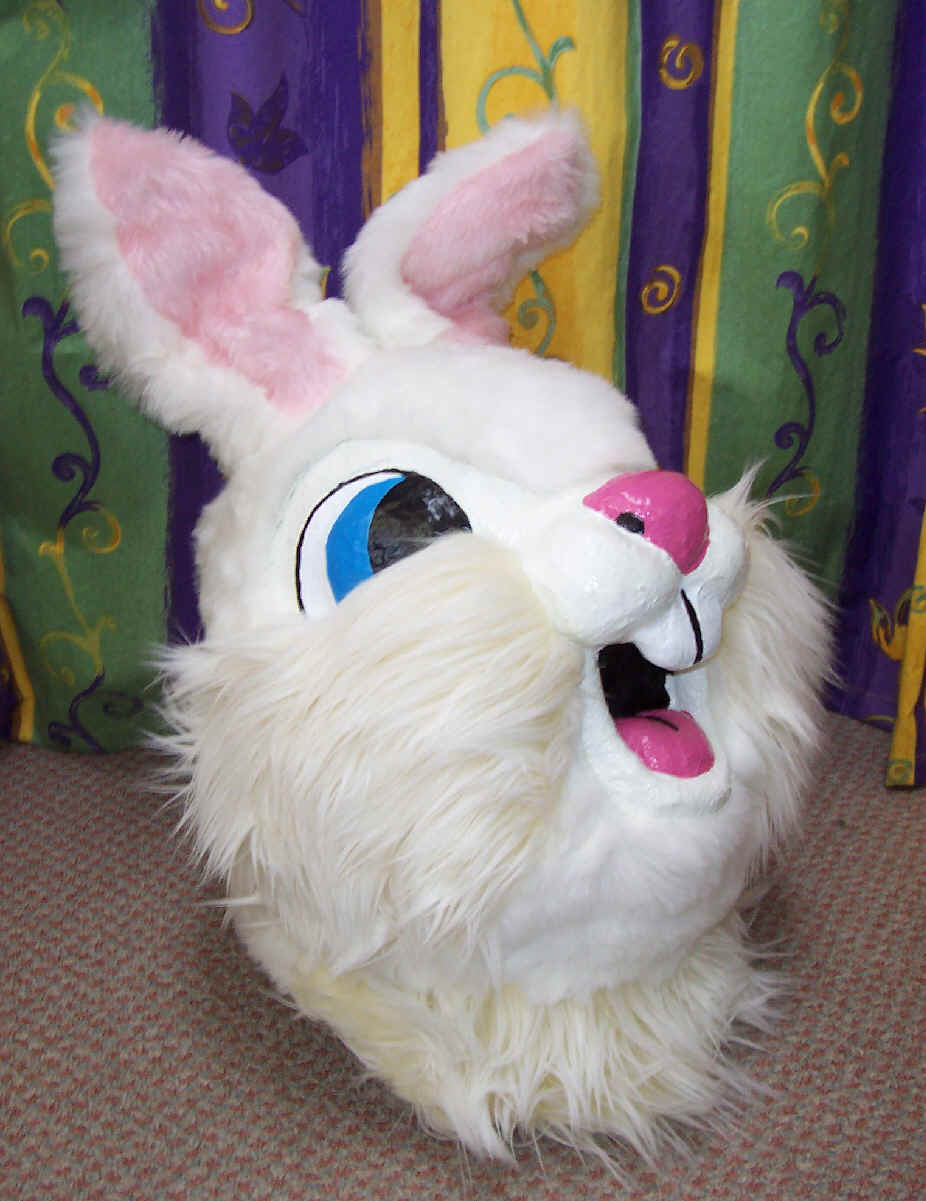
At the mall, Ellen’s two-year-old, Sarah, was fidgety in her stroller, until she spotted the Easter Bunny — on a raised platform with green shag carpet and an arrangement of painted wooden tulips and eggs.  The bunny sat in a white wicker queen’s chair.  “Mommy, it’s the Easter Bunny!” Sarah shouted, waving her hands over her head.

“I see him.  We’ll go see the bunny after we get Granny’s hat, okay?” Ellen said as they maneuvered around the long line of squealing toddlers, toward an accessory store she hoped would have the hat.

“Okay, Mommy,” Sarah said, craning her head to get another look.

Blocking their path around the long line of small children were a couple of teenage girls.  One of the girls was smoking, and as Ellen passed, the girl glanced at her with what Ellen recognized as contempt, flinging her long hair back — the cigarette dangling from her full lips — and prancing over to the mirrored window of the jewelry store across the way to inspect herself.  Her bangs were teased to a great height, sprayed so heavily into place they looked varnished, though the rest of her hair hung in a limp curtain over her shoulders.

It was odd how the teenager kept staring at Ellen even as she primped in the mirror — the girl’s eyes were large and black, her face unlined, uncomplicated.  Ellen stared back without blinking until both mirror and girl were out of sight.

There was one rhinestone cap left at the store, in the window display.  “Do you have any more of these?” Ellen asked, pointing.

“That’s the very last one,” the clerk said.  She and Ellen traded smiles.

“I’ll take it,” Ellen said, not bothering to check the price tag.

On the way back, the teen girls were still near the Easter Bunny display, only now they had been joined by a couple of boys.  The dark-eyed girl slouched back on the bench, sharing a cigarette with a pale blonde wearing too much makeup.

Ellen watched her giggling daughter run to the giant white bunny.  She paid seven dollars to have Sarah’s picture taken with the rabbit, but in the first Polaroid, Sarah’s eyes were closed.  “Sleeping Beauties, that’s what we call those,” the photographer told her.  Ellen wanted to keep it anyway.

“I want to kiss him,” Sarah said.

“Okay, honey,” Ellen said, squeezing her small squirming body in a fierce hug.  She tried to imagine Sarah in another ten years, all pouty lips and thrust-out chin.  Cans of hair spray, and unspeakable things like peppermint flavored lip gloss.

The second picture turned out beautifully.  Sarah held the bunny’s gloved hand, smiling, eyes open, rapt to the camera.  The rabbit got up and strolled down the ramp of his platform, Sarah following, reaching out like a pilgrim to stroke the fluffy white fur.

“I want to tell him I love him,” she whispered to Ellen.  “Pick me up.”

Ellen held Sarah up so she could whisper in the bunny’s ear.  “I love you,” Sarah whispered into the tattered pink plush.  She kissed the nose, patting the wire mesh covering the open mouth, inside which Ellen could see the blurred outline of someone’s face.  Ellen turned away, remembering this morning, before she’d left for the mall.

“Give Granny a hug,” she’d told Sarah.

“I don’t want to,” Sarah had whined.

Ellen’s anger had seemed reasonable in one sense, though completely out of proportion to Sarah’s predictable toddler whimsy.  How many times were left to bestow such affection.  How many times would Ellen be able to bring her mother a daft, pathetic gift from the mall.  Just then, the teenagers laughed their little ignorant heads off for the hundredth time in ten minutes, the air ringing with their simple, donkeylike braying, and Ellen stabbed at them reflexively with her gaze.  How dare they be so happy.  How dare they be so young.

“Why does that stupid bee keep staring at me?” said the dark-haired girl, glaring back at Ellen.  The group around her laughed, nodding at their compatriot’s clever wit.  Ellen stopped, Sarah heavy on her hip.  Bee — for bitch?

“I was wondering the exact same thing,” Ellen said.

The blonde moved several steps toward Ellen then, folding her spindly arms over her chest, shaking her head.  “Hey,” she said, squinting her eyes.  “Don’t you get fresh with my friend.”  She tossed her head back, her stiff bangs remaining frozen, like armor, despite the movement.

Ellen bent to strap Sarah into her stroller.  “I understand your type,” she said to the dark girl, her eyes drifting over the entire group.  “I used to be a snot-nosed adolescent, just like you.”

“Still need to wipe your nose, if you ask me,” said the dark-haired girl, thrust forward on one thin leg, her shoulder flung back.  She looked to her friends, as if for confirmation, and the two boys gave each other sloppy high-fives.

The entire group of teenagers was laughing now, holding their sides, tilting their heads and letting their mouths hang open, their glistening, foamy tongues quivering with hilarity.  In a flash, Ellen’s heart hammered so briskly she could feel her pulse inside her mouth, her tongue; her teeth were being jarred out of their gums.  Ellen wanted to crush them under her shoes like bugs.  “Fuck you,” she said.  She noticed, too late, the horror of the other grown-ups as they clapped their hands over the ears of their small children, the parents staring at Ellen, their eyes wide.

“And just what kind of example are you trying to set?” one woman asked.  Ellen walked at great speed away from the mob, pushing the balky stroller as fast as she could.  Sarah sat in the umbrella stroller, clutching the Easter Polaroids in her tiny hand, her small frame curved into a limp macaroni shape, her perfect, smooth elbows bouncing off her knees as the wheels vibrated over the rough brick floor of the mall.  Ellen walked so fast she began panting, her calves starting to cramp as she rounded the nearest curve, heading for the door she had entered, long ago, in another lifetime.

She saw a bank of pay phones.  She stopped, looking around and behind her.  Fishing in her purse, she found a quarter, then flipped through the telephone directory, looking for the mall’s security office.

“I thought you should know there’s a group of disruptive teenagers hanging out in front of the Easter Bunny,” she said to the voice on the line.  “They’re standing around smoking and making rude comments to the customers.”

“Can you describe them?” the voice asked.

She visualized the girls, their long hair, their cheap-looking teased bangs.  “They had ugly hair,” Ellen said.

“Could I have a little more detail?” the voice asked.  “What were they wearing?”

Ellen could not see anything but the scornful face of the dark-haired girl, the pinched, sour face of the blonde.  “I don’t know,” she answered.

“Well, how many of them were there?” the exasperated voice asked.

“Four,” Ellen said.  “Two girls and two boys.  In front of the Easter Bunny.  Smoking and laughing and being nasty to people.”

“We’ll send someone over there right away, ma’am,” the voice said.  “Would you like to come in and file a formal complaint?”

Ellen visualized herself in handcuffs, being led away.  “No, thank you, that’s not necessary,” she said, hanging the phone up with a bang.

As she tried to push the stroller away from the phone, she saw Sarah was tangled up somehow, her fingers twined through the cord holding the phone book.  “Let go,” she told Sarah, light-headed with the panic jigging through her in ragged bolts.

“But I want to call somebody,” Sarah whined, clutching at the metal cord with both hands.  “I want to call the Easter Bunny.”

“We don’t have time for that right now,” Ellen said.  “We have to take Granny her hat.”  She imagined the teenagers telling their side of the story to the security guards.  Ellen uncurled Sarah’s fingers and flew toward the exit, toward the safety of the parking lot.  No one, apparently, was after her.

Her hands trembled, her arms weak from adrenaline as she unlocked the car door and strapped Sarah into her car seat.  Heaving the stroller into the trunk, she got in and power-locked the doors, hearing the dull thunk inside, pressing the button three more times for good measure.  As they exited to the main road, she looked back at Sarah in the rear-view mirror, saw her little round face composed and serene, her eyes open but vacant-looking.  “Wasn’t that fun?” Ellen said, smiling.   “Getting to see the Easter Bunny?”

“No,” Sarah said, her eyes droopy, her head turning to nest against the padded wing of the carseat.  Lulled by the car’s rhythmic movement, the child’s lids fluttered closed.  Her cheeks were smooth, rosy with health, her lips parted, her pearly teeth visible.  One wispy curl of hair clung to her damp forehead.

Ellen’s face was benumbed; she drove home from the mall to deliver her gift to her mother, tears coming to rest in the corners of her mouth — her cheeks twitching from exhaustion as she forced her lips to stay drawn back, her teeth bared in a ghastly smile, a grimace of love.  She would deceive no one with such a face, most certainly not her dying mother — but of course she couldn’t allow herself to quit trying.

1 Comment

Filed under anger, apologia, cancer, daughters, death, easter, fiction, love, short stories

the day before closing, a poem (for nana)

ktp 1964 nightgown841 oleander drive three sisters yellow doorktp 1964 backyard tree

The Day Before Closing (for nana)

Out in the yard there is the tree
you planted when I was born.
It’s tropical, fast-growing, but

even so — I can’t circle my arms
around the trunk! The thing
towers above the house, thick

branches like beams, supporting
my sky of childhood. Tomorrow this
place will belong to someone else:

the old gardenias, the dense hedge
of bamboo out by the laundry line,
the bent but still perfectly good mailbox.

Please let them leave a few things
the same. I’ve gone through closets,
cabinets, a dozen times but I keep

finding more old letters, more
scraps of paper bearing your quick,
vivid writing. There, amid

the dustballs glimmers one more
strand of your hair, catching
the wan light, curled and silvery

against the bare floor.
I slip it into my pocket,
then remember how you used to

put on your hose, sitting
on the edge of the bed, sighing
softly as you pulled the rolls

of nylon up your lovely legs.
Just as abrupt comes one last vision
of myself, at five, dancing wildly

in your filmy yellow nightgown,
whirling around the cleared
living room to your applause.

3 Comments

Filed under poetry

notes from september 18, 2001: richard

illustration rastafarian man

Notes from September 18, 2001: Richard

That morning, I heard my three-year-old daughter wake up and say with delight, “It’s not dark out anymore.” I went in and saw her already sitting up in bed — the brilliant sunlight streaming in through the pink, translucent curtain of her bedroom — and saw how her head was haloed, as usual, by what resembled the pale, disorderly golden floss some people put on their Christmas trees. Angel hair — she was a tousled, blinking pink-and-gold person, recently emerged from babyhood.

“That’s right,” I said. “It’s not dark out anymore. Good morning.” She flopped back down and remained lying in her bed, even after I folded her white net safety-rail down. “What a beautiful girl,” I said, smiling down at her.

“I can’t get up,” she said.

“Why not?” I asked.

“I can’t get up because I’m dead.”

My heart darted out of my chest, chirping and flapping and shedding feathers like a startled wren but somehow I managed to feign businesslike nonchalance and smile reassuringly. “You’re not dead.” The effects of the terrorist attacks one week ago had filtered all the way down to toddlers far away in Florida.

Well, later that morning, after dropping her at her baby-sitter’s, I stopped at a mini-market at S.E. 9th Street and University Avenue to get a bottle of water. As I pulled up, there was a guy tottering oddly across the sidewalk in front of the market, very tall and skinny, and his long, skinny pink tongue hung out like a dog’s, quivering with each stride. I hoped — no, prayed — that he would not speak to me. He stood in front of me at the counter to purchase a bottle of cheap wine with some very tattered, dirty money. His coins were coated with sand and dirt, and the clerk swept them into a pile then covered them with a napkin as he left the store. I paid for my water. Several middle-aged men stood talking energetically while their lottery tickets printed out.

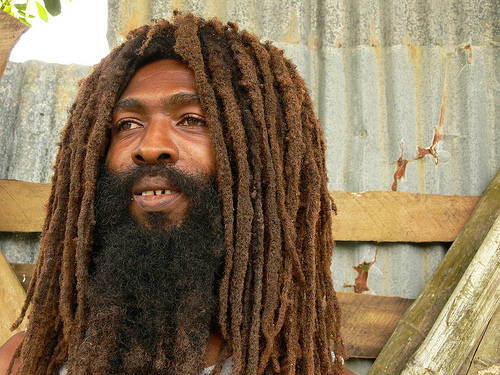
After paying for the water, I walked to my car and there stood a tall, picturesque man, vibrant and attractive even though missing most of his teeth. He wore a black cap with stars embroidered along the front: three black stars, on a vivid yellow ribbon band. A paler yellow jumpsuit, a long beaded necklace — and long, luxuriant dreadlocks. He wore a couple of rings on his hands, a small silver nose-ring, and a gold earring in his left ear. He was quite handsome, though at the same time I could tell he’d recently been through some very hard times, and probably had been in those bad times for a quite a while.

For a second, I worried, because of the other man, and that man’s obvious level of dissociation with the world (I really had prayed to avoid him), but in a second of observing this man, I knew I was on much more solid ground. I wouldn’t be talking to a total lunatic. He held out to me a book — a Bible — and said he had just seen someone throw it in the trash, and God had told him to get it out and now pass it on to me. I took the book from him, bedraggled and slightly crusted on the cover with God-knows-what. I felt instantly ashamed for worrying what germs might be on the cover of the old, battered Bible, but I forced myself to disregard that, and act untroubled.

During our brief chat, he told me he was a Vietnam veteran. He pulled out a battered leather wallet and showed me his VA Hospital ID, which I knew to be genuine, as I have seen others: his picture was on it, and his name and date of birth. He was born Christmas Day, 1947.  I cannot remember his last name, only his first name, Richard, the same as my father’s.  I looked at the ID and then back at his face, and what I saw was an honorable man, intelligence shining out through his eyes, but also in his eyes a sadness that probably ran deeper than I could ever imagine. His radiance and his sorrow ran through me like a knife, because of my very-realistic fear we’ll now be in another war – one which will kill many young men and destroy the spirits of many more. I was suddenly and inexplicably paralyzed by grief for him, as a veteran, as a street person, as someone now obviously fairly troubled in life. I saw him as he must have been, all those years ago, young and strong and relatively unscarred, and the breath caught in my chest, seeing him both then and now in the very same instant.

After a few moments, he asked very gently and politely if I had any money I could give him to buy some coffee. I was so happy he asked for something, so I could give him something. Ordinarily, I would give someone in this situation a few dollars, but I gave him $20 — I just wanted to give him something. Nobody can give him back what he lost, and money is a poor substitute for what he lost, but it’s a substitute nonetheless. Money and kindness are all we can really give. He went inside, and I buckled my seatbelt, turned on the car, grabbed the steering wheel, but then sank down over it, clutching it, sobbing for the first time in a long time, not caring in the slightest who saw me or heard me. It felt like a release; I only wish it had gone on longer. He came out with his coffee, saw me hunched over sobbing, and got alarmed — he knocked on my window.

“Are you okay?” he asked. Genuine concern; sincere compassion. I can detect those things in other people from the slightest of nonverbal cues, unguarded genuineness and sincerity are so rare in this world. His sincerity made it better, but also worse at the same time.

“I’m okay,” I choked out between sobs. “It’s just this whole thing.” He didn’t have to ask what I meant, because of course he already knew. The power of these events to affect us has crossed every kind of barrier — sex, race, socioeconomic status, education level, sanity level — we’re all family right now. I rolled down the window and he embraced me. I was grateful for the human compassion, pure and simple. His smell was strong and complicated, some of the notes pleasant, some sour, but oh, so real and human and I drank it in, all of it, the bitter and the sweet, a primal metaphor for this crazy life itself. He asked, tentatively and graciously, could he sit with me a while.
“Yes,” I answered. “Please.”

He started to talk, and I listened, giving him my fullest attention. I bonded with him in a way I’ve never bonded with any stranger in such a short time. I guess we spent about an hour together. Richard, from West Virginia. He is a Vietnam veteran, former Marine, former POW. He talked generally about what he was trained to do in the Marines, but said he didn’t want to tell me anything too specific about his experiences during the war — he said women shouldn’t ever hear such things. We talked about everything there is for human beings to talk about and he read to me from the Psalms and Matthew. So devout, so earnest, he held my hand in his while he read Scripture, ministering to me like a Sister.

In fact, he had been in the past a minister, he said, and from his familiarity with the chapters of the Bible I knew he wasn’t exaggerating. He has two living daughters, now grown, and another daughter who died at age two, just two years ago, from a heart ailment. He has his deceased baby’s name tattooed on his shoulder, plus three scars from cigarette burns — two for each of her birthdays, and a third for the day she died. He cried twice with me, once while talking about her — Zaidyn — and a second time while talking about how his stepfather used to beat his mother, years ago. He told me he still calls his mother “Mommy” when he calls her on the phone.

“Do you think that’s stupid?” he asked. “For a grown man to say, Mommy?”

“Absolutely not,” I answered. “I think it’s wonderful. I think more grown men should.”

He has been barred from our local homeless shelter, St. Francis house, for two years for giving food he obtained there to someone else. It’s a rule there, you’re not supposed to do that, share your rations. What a dehumanizing policy. It’s our basic need, to share. Damn them for that. He lived in Jamaica at some point for five years, his grandfather was born there. One of his grandmothers was a full-blooded Cherokee. He had played conga drums with Bob Marley.

I felt, I think, something like the presence of what human beings call the Divine. Divine love. I comforted him, he comforted me. I gave him another $20, all I had left in my wallet. He blessed me, I blessed him back with all my heart.

He still played conga drums around town. He knew of Ajamu Mutima, another drummer. “Another tall, skinny dude with dreads,” he said, laughing. As Richard and I spoke, I thought often of my father, and my stepmother Dorothy (his African-American wife), and of the rich heritage from Africa we all need to embrace.

He spoke of his lost two-year-old saying to him “I love you, Dada.” As a fellow parent, I knew how precious those words were. His pain at her loss, I felt it palpably, physically.

He knew when to end the interaction, and for that too, I was grateful, as I was overwhelmed and needed to go off and write it all down so I would never forget. Though I didn’t want to break our contact, I somehow understood it had to be broken, because it had been so miraculous, we had gotten so much from each other, we didn’t want anything to detract from the miracle. We didn’t want to descend into ordinariness with each other. He didn’t want it to end, either, but he was gracious enough to know to end it. Restraint can be admirable; sometimes, less is indeed more. But we were both reluctant to leave each other, and when I started the car and put it in reverse, he approached the window one more time. And that, too, was perfect.

Because he asked me, at the end, the question that made it all even more clear, more passionate and more profound. The question that made it, well, I don’t use this word much, but there is no other word to use in English — perfect.

“Did you feel it, too?” he asked me. He looked at me, searching my face with his deep brown eyes, eyes that held the world in that moment. Eyes I wanted to fall into.

I knew precisely what he meant, and I had indeed felt it. He had asked a question I couldn’t even have begun to formulate, so overcome was I with my feelings. “Yes,” I answered. “Yes,” I repeated, nodding to him with absolute recognition, and with that he leaned in and embraced me with joyous intensity for one final moment. I returned his affection as I would return my own child’s, or my mother’s. I am profoundly grateful, and I will never forget him. It’s true, Mystery can manifest in the most unlikely ways. We fell together like long-lost twins, then slowly let each other go.  Without saying much of anything but “Did you feel it, too,” and “yes,” we both knew without doubt that he was a noble person with an eternal soul, and so was I, and we had finally found each other for all eternity in a single hour. The force resonating through our bodies was Divine.

6 Comments

Filed under 9/11, bible, daughters, fatherhood, memoir, notes, peace, rastafarian, veterans, war

hungry baby, a short story

illustration hungry babyillustration hungry baby croton

(originally published in Cenotaph)

Hungry Baby

Whenever I’m feeling close to the edge, a hairsbreadth from lunacy, I like to shop for groceries. I go up and down all the aisles, methodically picking out food. I throw boxes and jars and bags and cans willy-nilly in my cart, always stocking up for the big one, the storm that’ll tear the roof off. It’s a habit, one I learned as a child. The women in my family were bony, starry-eyed drunks, with bad skin and lank hair, but by God, they knew how to grocery shop.

I’ve fallen into this twitchy, nervous state because my mother showed up again last night. I don’t know if it was a dream: I hope it was. I opened my eyes and saw her standing next to the bed, almost touching the mattress. She didn’t smile or speak but simply shook her head. She seemed angry; I could tell she wanted to hit me. She was jealous that I was still alive, driving her car, watching her TV, wearing her jewelry. I met her fierce gaze without moving, then closed my lids against her image like hurricane shutters.

The room was so dark, she was like a column of gray smoke, rising over me. Knowing death hasn’t changed her face one bit. How is it that I still miss her? That is an embarrassing, childish pain, an overgrown mouth sucking a rubber pacifier. There will never be a second chance for her and me; I sure wish I could believe in heaven like I believe in hell. If she’d loved herself, or me, even a little, maybe she’d have pulled through the dark waters. But she was so full of self-hate there was no room for anything else. Now I’m afraid her habits are coming after me.

I confess it; often I hated her too, while she lived. I even killed her once, in my sleep. I stabbed her many times with a kitchen knife, and it felt right, like it was the only graceful way out for both of us. There wasn’t as much blood as you’d expect, though there was still enough to soak her nightgown all the way through. When I woke, clammy and trembling, I hurried to her room to make sure she still breathed. I knelt at the side of her bed, watching her scrawny chest. At first, it didn’t stir, and I almost cried out. Then I saw movement, enough to know she lived. Forever after, I feared the terrible anger in me. It’s always waiting, a tiger with ivory teeth and steel claws — waiting for me to stumble, to lose my grasp on mercy, on forgiveness, and throw open its cage.

Wishing my mother was dead half the time didn’t keep me from breaking down her door in a panic when I thought she’d overdosed. After the first incident, I wasn’t all that worried, I knew her to be too much of a bumbler, she’d screw it up like everything else. The door became only an excuse to use my rage, to make my hatred tangible, give it life, a physical existence. I used a heavy folding chair, swinging it over and over again, watching first the splintered crack appear, then the bit of light, marveling at how the door-frame itself gave way all at once and the entire door fell cleanly into the room. She sprawled on her bed, half-clothed, her knobby knees the bulkiest part of her, her wet brown eyes looking puzzled. Even with all the noise, she couldn’t figure out how I’d gotten in the room. Later, sober, she realized she’d underestimated me, she hadn’t known what I was capable of. Much later, when I left home, after a hundred false starts, she managed to finish what she’d begun.

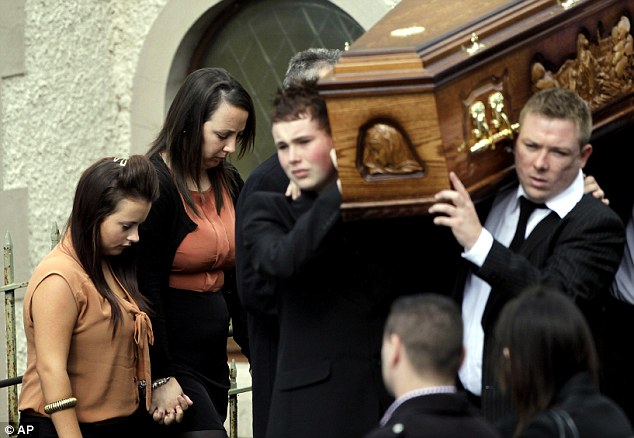
I shopped hours for the perfect funeral dress; pulled grimly through all the racks, looking at everything dark. No, not dark, black. Nobody wears mourning black anymore, the saleslady said, but for my own mother I insisted. In photographs, I appear the proper, bereaved daughter. I spent three days wearing the black dress, feeling grimy by the day of the burial and glad of it.

We buried her in front of a croton bush, God, how she hated those things, crotons. I stared at her shiny marble urn where it sat in the little hole, the tacky brass plaque glued to the top. I couldn’t object to the shrubbery, not with the priest standing there, tall and lean and handsome like some Marlboro Man, chanting and swinging his billowy canister of incense on its copper chain, the black robes clinging to him under the harsh weight of the sun, his hand so big and hard when I shook it my knees almost gave way.

That night, I left the house long after dark, walked in shaky high heels down the street and around the corner, ruining the delicate heel tips on the asphalt. I decided to keep walking until I dropped; to walk forever if no one came running after me. I stopped only a couple of miles away, limp from the humid August air. Crickets vibrated, frogs exhaled, stars flickered; the glowing yellow windows of strangers were my last comfort, my final safe haven. Nothing but love for those strangers kept me from leaving for good, nothing but fear of the tiger kept me from going any farther after my mother; I stood alone in the velvet grief of that hot summer night, calling her name over and over again like a stupid, hungry baby.

2 Comments

Filed under short stories