Tag Archives: poetry

dog eat dog, a poem

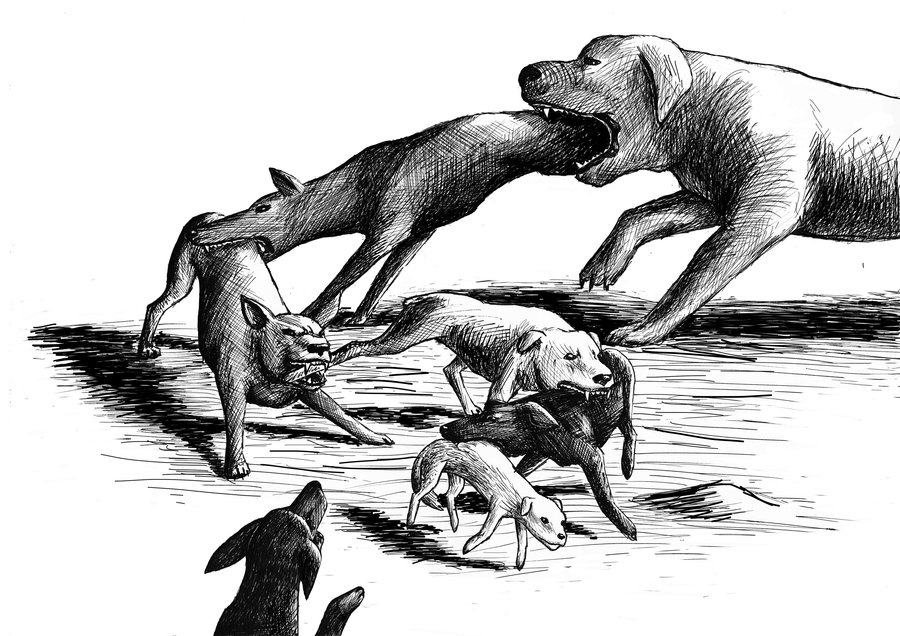
illustration dog eat dog

(image information — http://nerafinuota.deviantart.com/art/Dog-eat-dog-world-285292431)

Dog Eat Dog

I. Dreams After Eating A Large Meal

Cannibals exist in all species,
even primates. Chimpanzees,
long thought to be peaceful vegetarians,
love to hunt. Male chimps will kill
newborns from their own troupe
if they suspect the mother
to have consorted with outsiders.
They kill the infant
with a bite to the skull,
then tear it apart, sharing the flesh
with each other. I watched a mother chimp
chasing the males who had grabbed
her baby. She followed
at a slight distance, screaming
from the trees, shaking the branches,
filled with rage but lacking the large
canine fangs of her brothers.
When she was on the verge
of attack, the males would dangle
her infant by one limb, threatening
to drop it 25 feet to the ground.
She backed off, howling
with frustration. In the end,
she gave up. The males sat
and watched, then consumed the flesh
of her offspring. It was the soft
pink of milk-fed veal, so tender,
so sweet — they napped heavily
all afternoon, dreamed vague dreams
involving slim saplings, bent
under their weight, about to snap.

II. Fighting Biology

Every human law is an effort
to curb natural instincts.
When people kill, it is for reasons
they cannot articulate. Come to me,
they hear the victim say. Take me
into yourself and make us both
whole. Much of the time, the message
is obeyed — one wrong look
can end a life. The rule of nature,
what has this to do with love?

III. Brighter Colors, More Vivid Patterns

For scorpions, 25% of their diet
consists of other, smaller scorpions.
Frogs in South America will eat anything
smaller than themselves… though sometimes
they try to swallow another frog,
larger than themselves. Rather than give
up, they both die of suffocation.
Father fish, guarding their eggs, will eat
part of the clutch rather than leave
the eggs unattended to find food.
It is too dangerous to leave the family,
it’s better to sacrifice
a few members to save the whole.

IV. Protein Is Precious

Mother mice, when their nest is found
by a predator, will kill & consume
as much of their litter as they can hold,
recycling precious protein
they’ve spent weeks gathering.
We all want to survive.
Some of us want to survive by eating others.
Some of us want to survive by consuming
air alone. I wanted to survive
without hurting anyone — I thought
it was possible, to take less, to give more.

V. Hunger, Touch, Satisfaction

I’m so hungry. All I can think of is food,
all different kinds. Bowls and bowls
of cereal, popcorn, rice, couscous.
Buckets of slop for the bovine.
Is it really spring outside? Has the mating
dance begun again? Do you love
to curl your hair? Do you long for ringlets,
shiny tresses? Do you want your hair
to touch someone? Do you want to consume
the most tender parts, leaving the rest
for scavengers? Do you understand
what sort of need you are satisfying?

3 Comments

Filed under poetry

birth control in the ancient world, a poem

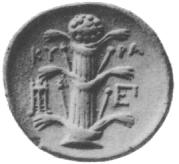
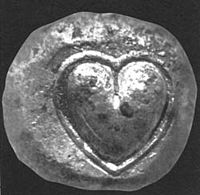
illustration Silphium stalkillustration silphium seed 200px-Cyrenecoin

Birth Control in the Ancient World

By the third century, our old favorite,
Silphium, was extinct. Overharvested,
the plant had been worth its weight
in silver for a generation.
Gone forever were the bright yellow

flowers, the glossy, deeply lobed
leaves. We turned next to a close
relative, asafoetida, a pungent spice,
yes, but much less effective.
Besides, our breath smelled

always of fermenting fish;
the men started to complain;
thus the population swelled.
Queen Anne’s Lace grew wild
in the countryside; we brewed strong

tea or simply chewed the hard little
grains dry after the act…. If that
didn’t work, we tried artemesia,
abortifacient, only toxic in excess —
Artemis, goddess of women, protector

of childbirth, let us down rather more
frequently than we deserved.
The truly desperate ones might
gorge themselves on pomegranates;
the red juice stained their lips,

made them look fevered; sometimes
that did the trick. By the twelfth
century, only a few midwives knew
which herbs prevented the seed from
planting itself; they were banished

as witches and we lost that knowledge
for five hundred years — not so long
a time that we didn’t remember what it
had felt like, to love as often
as we liked without consequences.

2 Comments

Filed under poetry

the gecko, a poem

illustration gecko 2

The Gecko

The gecko guards the stairs, clinging
wraithlike to the top step, and his small

supple body is curved like the mythic
salamander of old, his shape erotic,

gently sexual in a way I once
feared; even though he does not

move, he glows with movement in every
limb. As I slide by, his jeweled

eyes startle, and he scurries past
my foot, the tender fleshiness of his hide

taking the memory of love with it.
Long ago, I would have gasped

to see him near, my pulse racing;
I would have missed such beauty,

the shadowed pattern of pigment he
wears so thoughtlessly, the graceful way

he runs, undulating like a silk
scarf in a soft summer wind.

In the doorway, he stops, watching me,
wondering if I want to eat him.

Don’t be afraid, I say silently.
Let me see you for a bit longer.

I want to marvel over the mixed
colors of your iris, the iridescent

swell of reflected light, framing
this knowing miracle; the end of youth.

3 Comments

Filed under poetry

the swiftness of dream-time, a poem

Taylor Swift Is A Paris Beauty

The Swiftness of Dream-Time

She confides unduly in strangers, asking
inappropriate, intimate questions. She has
startling, beautiful eyes, a pale luminous brown,

fringed by heavy black lashes. The fair skin
of her lids glistens like the wings of a moth,
and the expansive way she smiles makes her

delicate pink lips almost disappear. She lives
in the dream-time before marriage and children,
unschooled by the constant companionship of small

relentless demands, unaware of the eternal
ramifications of peeling herself raw
like a thick stalk of sweet cane, exposing her pithy

heart to people who don’t care to understand
the need to be loved, hidden warts and all.
Some people can never be trusted, she feels this

in her bones, yet she doesn’t want to believe it;
the ache of betrayal is like cancer of the marrow,
an oily red liquid pouring from her center

to drown the most fragile of her cells.
On personality tests, she engages in flights of fantasy:
happiness wings past just out of reach, grazing

her face with its sharp, heavy wings, ruffling her fine
hair with the remarkable swiftness of its passage.
Sitting in her green armchair, she becomes

engrossed in old forgotten novels, flipping
the tissue-thin paper with impatience,
sweeping the fallen crumbs of leather binding

off her taut, bony lap with fingers sticky
from futile perspiration. If the man she thinks
she loves asked her to marry him, she would say

yes without hesitation, but it wouldn’t make her
happy — nothing will ever satisfy her, for very long.
She doesn’t know what she wants and never will.

3 Comments

Filed under poetry

chameleon, a poem

illustration chameleon green-anole-lizard-00021

Chameleon

Now she is the color of lichen-splattered bark,
not brown, not gray, not silver — without turning
her head, her small alarmed eye rotates in full

orbit, sweeping me from head to toe, a cruel, knowing
assessment… I don’t measure up, I can tell
from her expression. I wait, wanting to see her

go green, that hot, bright jewel color she does so well.
She creeps down the trunk, movements slow, smooth,
almost invisible. From time to time, she glances

my way; then an ant catches her attention.
Her nimble, rolling eye follows the tiny creature
crawling back past her tail — still afraid of me,

she doesn’t give chase. Off her long hind paw
dangles a limp glove of molted skin. In annoyance,
she curves sleek head toward delicate toes and bites;

she chews the dry scales, then swallows. Her throat
is pale, silken white; her fat tongue glossy pink.
Minutes pass — she pretends to sleep; the eye

closest to me closes, but the other stays wide.
A large iridescent fly alights on the leaves below;
suddenly she flings herself into the air, slender limbs

flared outward, mouth already open, and twists her head
to one side, shaking the insect clamped in her jaws,
the better to subdue it. I breathe faster as she grows

pale, paler, then glows so tender just for me
in the shadows, the clear green seeping down from her
low forehead as a shy leaf unfolds in early spring.

4 Comments

Filed under poetry

a-girl, a poem

illustration a girlillustration a girl african-american-embroidery-designsillustration a girl michelle obama imagesillustration a girl erykah badu download

Feisty owner behind wheel of A-Girl

The towing company has survived 15 years by moving into tough territory and trading on its pink trucks and unusual name.

By MARTY CLEAR
Published January 30, 2004
If you live in Hyde Park or Carrollwood or Temple Terrace, you may have never seen the bright pink tow trucks with the crudely painted words “A-Girl Towing” on the side.

If you live in College Hill or Belmont Heights or the un-redeveloped fringes of Seminole Heights, you probably know them well.

For the past 15 years, A-Girl’s tow trucks have been common and unmistakable sights in Tampa’s poorer neighborhoods.

“Nobody wants to go to those projects, but I don’t mind,” said owner Shelia Cole. “I’ve made a niche business for myself.”

Cole never set out to own a towing company. In 1989, with some money in the bank from a lawsuit settlement, she had planned to open a used-car lot. She would buy old cars and fix them up. As sort of an eye-catching gimmick, she would put fancy rims on all the cars in her lot.

“If I’d done that, I’d probably be rich,” she said. “Rims are huge now.”

While she was waiting to get her business licenses for the car lot, she acquired an old gray tow truck from a relative. She planned to use it to bring old cars to her lot.

“I didn’t know anything,” she said. “He showed me how to use it.”

Gradually, she started getting calls from people – friends, then friends of friends, then total strangers – who needed their cars towed,

“I’d get out of the truck and they’d say, “Hey, you’re a girl!’ and finally I said “That’s it!’ ” she said.

She realized that her gender was a better gimmick than fancy wheels. And she realized that even though she didn’t have any cars to sell, she already had a tow truck and some decent word-of-mouth business. She painted her truck pink, and A-Girl Towing was born.

(a note of preface:  i saw her tow truck years before the above article was published.  i wrote the poem a long, long time ago.  on a whim, looking for an appropriate picture to use in this entry, i searched “a-girl towing” and up popped the above article, at least a decade after i saw her on the highway while in tampa.  she was beautiful inside and out, then and now.)

A-Girl

The tow truck is ancient — dents,
fat rounded fenders, scattered
freckles of rust — but it’s painted

a shocking bubble-gum pink,
and across the door in a lavish
curly script is written, “A-Girl

Towing Service.” The appropriately
girlish driver is ebony-skinned, young,
possessing fine strong bones.

On her closely-shorn head
sits a circular, flat-topped cap,
embroidered in bright flowers.

The cap’s tassel flips saucily
in the breeze; our eyes meet
for a moment as she passes.

Her gaze seems calm, direct, filled
with the grace of one who understands
she owes absolutely nothing to the world.

When tow trucks are pink, is the world
necessarily a better place? Yes.
And suddenly I wish I could see:

who is this woman when surrounded
by her family, her dearest friends, her lovers?
Is she easy to laugh, does she enjoy

the scent of gardenias, can she whistle
with her fingers in her mouth
like I always wanted to but never could?

Leave a comment

Filed under poetry

Scientific Method, a prose poem

illustration scientific method caviar petrossian

Scientific Method

It is raining on Fifth Avenue.  I see umbrellas in a rainbow of colors but only gray clothes, gray faces, black rain, black streets.  I wait for the sign it is safe to walk, assured God will never deceive me.  The caviar store on the corner is empty again, as usual, except for the man behind the counter.  My existence remains unproved.

I, like Descartes, come from a legal family.  I too am excused from morning duties and allowed to remain abed, contemplating theoretical problems.  This morning from my high window I saw the sun rise over the river.  Fire to light, line to plane, flames on a gray mirror — objects around me glowing.  I imagined an infinity of rulers.  I felt hope rising in me with the sun. Hope for what, exactly?

The fish eggs I buy are tiny black pearls, glued together with brine.  Bursting against the roof of my mouth, juicy exclamations of Universal Wisdom.  I imagine my soul to be something extraordinary and rare, like a flame, coursing through my body.  I exist; I think; I am free of doubt.  When I was a tender baby, with skin like fresh flower petals, who loved me enough to love my soul?  Who breathed dreams into my tiny shell ear?  Who wept over me?  Who wished me dead?

I am like any ancient geometer, my problems beg for elegant solutions.  This curve, this conic slice — where will the truest intersection lie?  A series of three dreams turns me into a timid comedian, hiding behind my garish painted mask.  I am not a soldier in uniform.  Quiet, the air is still — I can feel my heart, unscarred as yet.  It only feels as though it has been broken, that is deception, it is perfectly healthy.

I am already exhausted by so much living.  While I slept as a baby, the whispers came from someone close: I will lie to you for your health; I will mislead you for your own good; I will beat you up for your excuses, I will beat you for your carelessness; I will beat the drum of my own desires, never yours.  Now, the sun is dancing upon the sea.

Neither René nor I like to live long in the same location.  We will change our dwelling place twenty-four times in twenty years.  Think of an infinite number of points.  Across from the caviar store, an icon with a gold halo, painted on peeling white brick.

I pray to you, my silly angel.  Hoping for what, exactly?  For feelings of joy, like a drug….  The joy of watching water move, tickled from beneath by fish fins.  School has let out for summer.  The joy of heated skin as it is plunged into cool water.  Feet in wet sand, toes nibbled by fish; pinched by tiny crabs, scraped raw on rocks.  The pleasure of discovery.

My mind is unclouded and attentive.  I deduce the transition of blood into water, wine into water, wine into blood.  The firm eggs of the caviar burst in my mouth, tangy grains of hope.  Posterity will judge me kindly.

Like me, Descartes could not find leisure and quiet to write until he got away from his family.  Was it the way his father drank?  The drunkenness, the curses, will repeat every evening at sunset.  Children will scream, cry.  Children will beat themselves up for an explanation.  Hope for what, exactly?

René and I both trust thinking more than feeling.  We work hard to free ourselves from the element of probability.  Salty fish eggs, trips to the caviar store, and flare-ups of hope, repeated endlessly.

A toast to us, to our new lives.  René completes his law degree on my birthday.   Both of us will wear robes of black & purple; spread a velvet cowl upon our shoulders.  Envy, we can taste envy: who breathed such curses as we slept?  I have walked in darkness so long, I cannot bear the light of day.  I enter the labyrinth, clutching a flimsy thread.  Curiosity is blind, leads me to risk, to unexplored streets, to black fish eggs in the rain.  It is still raining on Fifth Avenue.

5 Comments

Filed under prose poetry

the getaway plan, a poem

img163

The Getaway Plan (Late Fall, 2001)

I am on the phone
with my neighbor
who has the most delicate
blue eyes in all the world
jeweled inside tissue-thin lids
listening to her evacuation plan

my own words
fail me
my chest is tight
my ribcage bound with steel
bands of dread

three days’ worth of food
she tells me
and don’t forget your
important papers

while I’m trying to decide
what the word important
means anymore
my three-year-old cries
for gummi bears

she’s had too much
candy already this night
because when she kneels
and cries, begging for more
I can’t say no

what terrifies me most
is a vision of her
as she might end up, should the world
melt around us
and leave us where mothers and babies
get ground into dust

a place with no pity
where her eyes stop shining
with tears for candy
a place where her eyes
stop shining altogether

my 78-year-old neighbor
a beautiful woman
with glowing silver hair
that caresses her neck
like my grandmother’s once did
tells me exactly what I should pack
so we can leave immediately
just in case they blow up
the three nuclear reactors
in our state
the closest just 70 miles away

she’s got maps of the wind currents
so we’ll know which road to take

she says Florida will never
be habitable again
and I think of the gopher tortoise
who lives out near the barn
how when I mow the field
I so carefully avoid its burrow
because it’s endangered

I see it crossing the dirt road
every couple of days
our eyes always meet but
I’m sure it won’t remember me
after I’m gone

and all the while she talks
I am trying to breathe
and act as though
I am going to keep my children
safe from harm

but there’s something wrong
with my chest
it’s those steel bands

Leave a comment

Filed under poetry

while jenny laughs, a poem

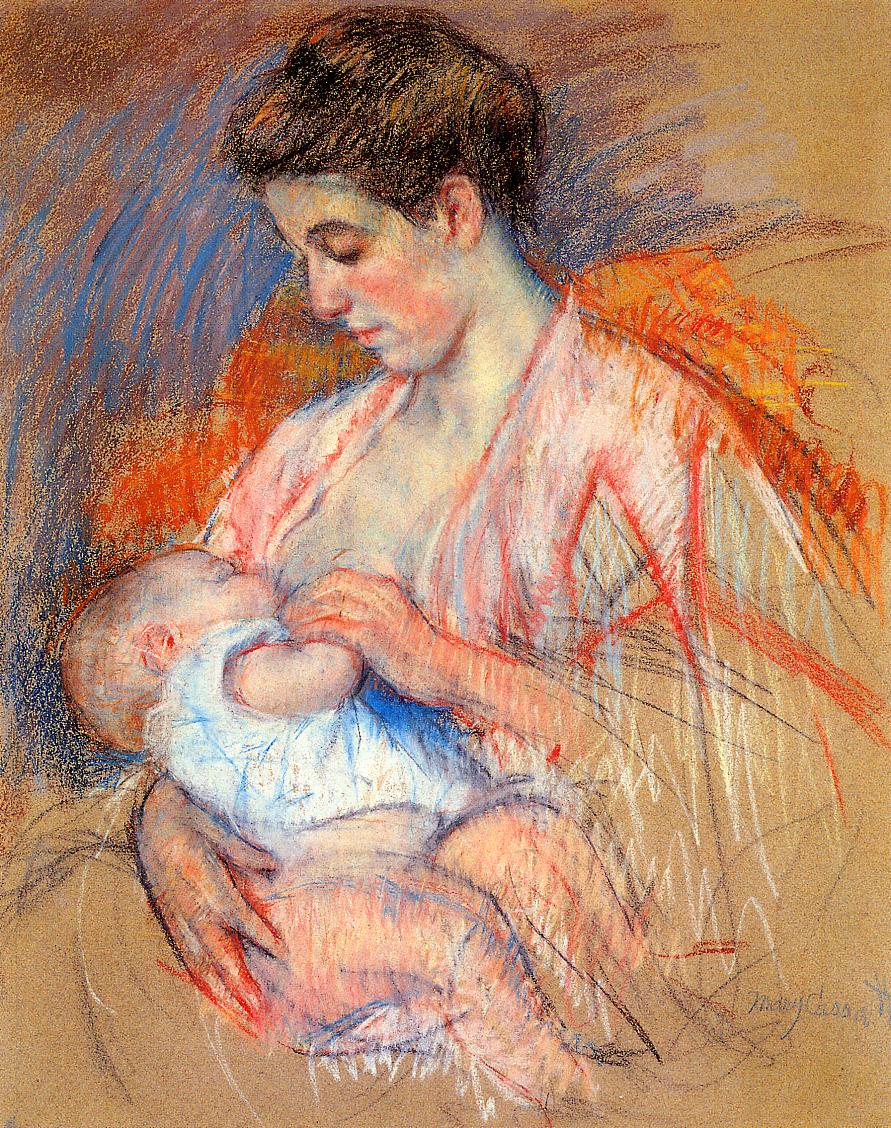
illustration while jenny laughs hawks illustration while jenny laughs nursing mother

While Jenny Laughs
(originally published in Earth’s Daughters)

 
While Jenny laughs,
two large brown hawks
ride the currents,
swirling over our heads
like the occasional
dreams we’ve had

of flying — she and I
agree on this. She
raises her blouse
to nurse her son.
His wispy curls are moving
lazily in the air, too,

his tender scalp
the color of a ripe peach,
and as he nurses she
kisses his hand.
Since I cut my hair
short, she says,

people keep mistaking me
for a man. Her smooth
face is perfectly
symmetrical, her cheekbones
high pirouettes of pale
skin, lightly flushed and

freckled by the quick
heat of early summer.
I would never, ever,
mistake you for a man,
I say, and as her milk
flows into the baby’s

mouth she laughs again,
her high voice turning
into notes of clear amber
bells. Look at the hawks
one more time, I tell her,
and so, to please me, she does.


2 Comments

Filed under poetry

where does it begin?, a poem

illustration where does it begin mossy backed florida cooters illustration where does it begin hands on shoulders

Where Does It Begin?
(originally published in The Charlotte Poetry Review)

Possibly with well-steeped tea,
gooseberry jam on raisin bread,
lots and lots of idle chatter;
later, he could try daily walks

through the woods — though she
has resolved she is finished with
nature — still he persists
in pointing out the log in the creek

holding five mossy-backed turtles;
if all else fails he could try
brushing her hair in the rough manner
of a mother, offhand, impatient fussing

to decipher knots. He could place her
in a room filled with the images
of budding spring trees, on a wide,
comfortable sofa, her stockinged feet

perched lightly upon the armrest
as she reads. The sight
of the frail new leaves will work
upon her, surely? Better yet,

he could fill a bowl with fruit,
three kinds of berries,
layering green upon yellow
upon blue upon red, teasing her

with a few squares of chocolate,
protesting all the while
that he always says the opposite
of what he means. Who lived my life

until this day? she will say. I could
ask myself the same question, he will
say by way of answer, placing his hands
lightly, lightly upon her shoulders.

Leave a comment

Filed under poetry