Divine Love, Divine Hate, an essay

illustration divine love divine hate

Divine Love, Divine Hate, an essay

Scientists have of late discovered that music stimulates the same areas of the brain as food and sex. That’s why listening to music can bring a chill, raise the small hairs on the back of the neck. That’s why music demands — and gets — our closest attention. You need me, the music calls, you need me to survive, to perpetuate your species. Without me, you will have less well-being, less pleasure and satisfaction. What a design! Food, sex and — music.

The pleasure centers of the brain — the reptilian, primitive intelligence — is not involved in abstract thought but entrusted with the very essence of staying alive. Yet the impulses and desires which originate there find means of expression in our higher intelligence. Food and sex are necessary for survival, so necessary that sometimes it seems as though the whole human world, all human society and culture, can be thought of as nothing more than an interesting mechanism to keep us supplied with food and sex.

The appreciation of music springs from that same primal area of the brain — could this possibly mean there must be a God, after all — a God who gave us another instinct, one for pleasure and beauty, in addition to our basic instincts to survive? Music, a divine invention with no practical purpose. No purpose at all other than to inspire in us joy, mystery, fear and abandon.

Think of all the emotions we can express with food, sex and music:   passion, joy, disinterest, experimentation, violence, anger, tenderness, wistfulness, meditation, transcendence. Food, sex and music can be used to communicate, even intensify, all these emotions, yet the trio can also be used to push us past all of these feelings to a region of Godlike rationality and knowledge. Yes, occasionally our existence becomes clear, understood fully until surface complexity falls away into the deeper simplicity of detached understanding. A strangely quiet joy — a joy beyond anything prosaic.

A poetic joy, able to recreate itself in the mind forever. Sometimes the memory of such enlightenment is what keeps us going when the enlightenment itself feels as far away as Uranus or Pluto — as cold, as unreachable. Remembering how once we held it in our bodies and it filled us so there was nothing empty, noting lacking, nothing to fear — not even death. It is a knowledge, a contentment, which infants possess without awareness. To possess this peace with awareness is the greatest achievement, but one which few people are able to sustain for long. We hold it and fall in love with it and in an instant it twists out of our hands and flashes off into the distance like an agile, silvery minnow. Enlightenment as God’s minnow. Look at it too closely, try to keep it too long, and you may never see it again.

I myself have only a rather wobbly faith in God’s existence, but I nonetheless feel pity for people who declare without hesitation that nothing divine exists. What a drab, ugly world their interior castles must be, with only themselves for company.

The divine cannot be ruled out. We cannot know what exists beyond our senses.   Certainly people have been enraptured by the idea of divinity — especially, most recently, the notions of divine anger, divine vengeance — modern terrorists have embraced these, but without embracing the corresponding ideas of divine love and divine compassion. Yes, people have fastened their wills on the idea of divine judgment, but they have ignored completely divine forgiveness.

The cockroach is as marvelous a creation as anything — see it scuttle away from the light, a most marvelous mechanism, see it copulate, see it reproduce itself, see it taste its food with pleasure twinkling in its delicate, wavelike feelers. No less miraculous than us. But we have an ability the cockroach does not have — to be self-aware of our divine impulses — our duty as human beings is to dive both below and above our own ordinary human consciousness. To bring all our unconscious knowledge and desires into to the conscious realm — both those desires labeled primitive and those labeled exalted.

Some elements of love are to be found in the roach. It loves its life: flees from danger, attempts to avoid harm, and tries to survive no matter what the odds. This is where the terrorists have failed. They have embraced only half the divine order — divine hate — the half that appeals to them more and suits their political purposes. They need to stretch themselves, accept all things God has created — even those they find distasteful or abhorrent — and leave the judging to God. They need to cultivate in themselves divine compassion and divine love. Terrorists profess they love God, but they do not love God’s creation — therefore that love is flawed, is not really love at all. Their love has turned inside out into hate.

They need to learn from the cockroach, as do we all. We possess vast potential for divine virtue, yet are so capable of falling into the abyss of pride. These terrorists have fallen, and they are trying to pull us down with them. We must not surrender to only part of the divine order. We must catch ourselves with the feelers of the insect before we tumble too far.

I cannot blame anyone who feels the need to destroy the terrorists. I feel that need myself, the blood lust of anger and retribution. But we must find a response pleasing to the divine. That is what prayer is — thinking about what a divinely perfect being might do, waiting for the small voice to tell us the right way to handle this new permutation of evil — without ourselves falling under its wicked spell.

This is what all religious searching has been aimed at. Whether we believe God exists or not — we can imagine God, as God might exist. Sometimes it is better to die than to kill the blameless. We can feel such things in our deepest selves, and these places are just as important to reach with the conscious mind as the highest levels of abstract thought.

We can imagine God, we can love God, we can honor God, and that is what matters most, not whether God truly exists. Good and evil, love and hate, right and wrong, call it whatever you like. It is our uniquely human gift, our uniquely human burden. Did we ask for this? Be careful what you wish for, goes the old admonition. Would I rather be my dog, or my cat? Sometimes I envy their peace of mind. They don’t know about world wars. But my most divine pleasures, feeling them and knowing that I am pleased, and knowing why — in this way I have my cake and eat it, too. The lure of that apple in the garden is a lovely allegory, whether it happened or not — we invented it. This is the quality of our humanity which we can never give back, no matter how much we might want to.

10 Comments

Filed under beauty, charity, compassion, enlightenment, essay, faith, forgiveness, god, hope, humanity, love, peace, world

Project Drawdown – substantiative solutions to Climate Change

~ Laura's avatar~ L to the Aura ~

In a moment of sincere disappointment and loss of hope, I was blessed to have the rare gift of speaking to an incredible human being, a golden soul that has inspired me for many years: Paul Hawken. His words, compassion, and optimism continue to resonate:

Is climate change happening to you or for you? If it is happening to you – you are a victim, you are an object, you are dis-empowered. But if you embrace it, it is your ally. We need to embrace climate change as a guide to a far better world than we know now. Avoidance of despair is an essential condition in order for humanity to creatively respond to the future we face. The public’s willingness to respond to climate change can shift, if they can see opportunity instead of dread, that a transformation can benefit them individually and collectively.

It is not game over…it is game…

View original post 183 more words

1 Comment

Filed under Uncategorized

Would you like to write for BBC Radio 4?

leedslibraries's avatarLeeds Reads

Opening LinesThe BBC Radio Drama Readings Unit is looking for submissions from writers new to radio for their annual series, Opening Lines which is broadcast on BBC Radio 4. The closing date is 13th February 2015.

Three successful writers will have their stories broadcast on BBC Radio 4 and be invited to the BBC in London to see their stories being recorded. As well as broadcasting the three strongest stories, the BBC publish transcripts of the best stories submitted within this period on the Opening Lines website. (You can read previously published stories), A longlist is published on the BBC Drama Readings website by 15th May.

Stories should be between 1,900 – 2000 words and can cover a broad range of subject-matter (nothing too dark, harrowing  etc. as the programme is aimed at a wide audience). Submissions should be one story per writer. You can read all the terms and conditions and more detail about what is…

View original post 2 more words

Leave a comment

Filed under Uncategorized

The Message She Sent, a short story

illustration the message she sent

The Message She Sent, a short story

Geri and her little sister, Rachel, were both deaf. Geri was a year or two younger than I; Rachel was a year or two younger than Geri. I never met their parents, so I don’t know if they were deaf, too. The two deaf sisters latched onto me probably because I was the only kid in the neighborhood who could bear to look them in the eye and try, laboriously, to understand what it was they were trying to say. This was during the era when all deaf children with even a small degree of hearing were made to wear cumbersome, boxy hearing aids strapped to the body and were trained, with varying but always limited degrees of success, to speak. Some deaf children growing up at that time were forcibly kept from using sign language.

The hearing world wanted them to blend in, to not cause trouble. The philosophy was to treat them just like the hearing, well-nigh ignore their disability. The approach had worked only slightly for Geri. She could speak, in a flat, nasal voice, but she left out many of the necessary sounds of the words. Her lips moved correctly, her teeth and tongue worked properly together as she’d been shown, but a word like “hello” would be unrecognizable without great effort on the part of the listener. I had to read her lips, too, just as she read mine.

She taught me the alphabet in sign language, and tried to teach me signs for whole words, but I couldn’t seem to remember them no matter how much we worked together. Sometimes I had her write things down, but mostly, I understood what she wanted to tell me without much trouble. We communicated a lot without any language. In fact, the very best times with Geri were when there was nothing to say, no requirement for communication whatsoever, when all that was necessary was a simple co-appreciation of events, a shared glance and smile. Geri’s hearty, soundless laughter was infectious and could usually cause me to fall to my knees with mutual hilarity.

She was a beautiful girl, far more so than I. Her hair was sun-streaked blonde and fell to her waist — her arms and legs were so long she seemed like a young antelope. Her skin was a clear, delicate buff — her eyes stood out, big, round and blue, set in a long, fine and lively face. Her eyebrows were usually raised in attitudes of curiosity, delight, or occasionally, trepidation. The only thing less than perfect were her buck teeth, but even those were startling white, gleaming, and pushed her rosy, full lips into a charming pout of concern.

Her sister Rachel, on the other hand, was a little troll. Similar to Geri in certain respects, but short-limbed and stout, not fat but packaged with strong, barrel muscles. She could not speak at all, wore no hearing aid, and only grunted. Geri’s hands flew, talking to Rachel. But Rachel, when she came over to my house, was interested chiefly in food, and eventually didn’t wait for an offering but rummaged through our pantry and refrigerator on her own and ate anything she pleased.

The first time she did so, I was shocked and angry because ours was not a house of plenty and I knew I would be in trouble when my parents found out, but Rachel turned her face to me with such complete incomprehension and joy as she ate, that I knew there was nothing to be done. Geri scolded her with her fingers but Rachel wouldn’t turn her head out of the refrigerator to look. She loved sweets, cookies or candy, even fruit yogurt. We didn’t have much, but she ate whatever we had in its entirety. Geri, by contrast, would hold one cookie and make it last, nibbling tiny bites in neat order.

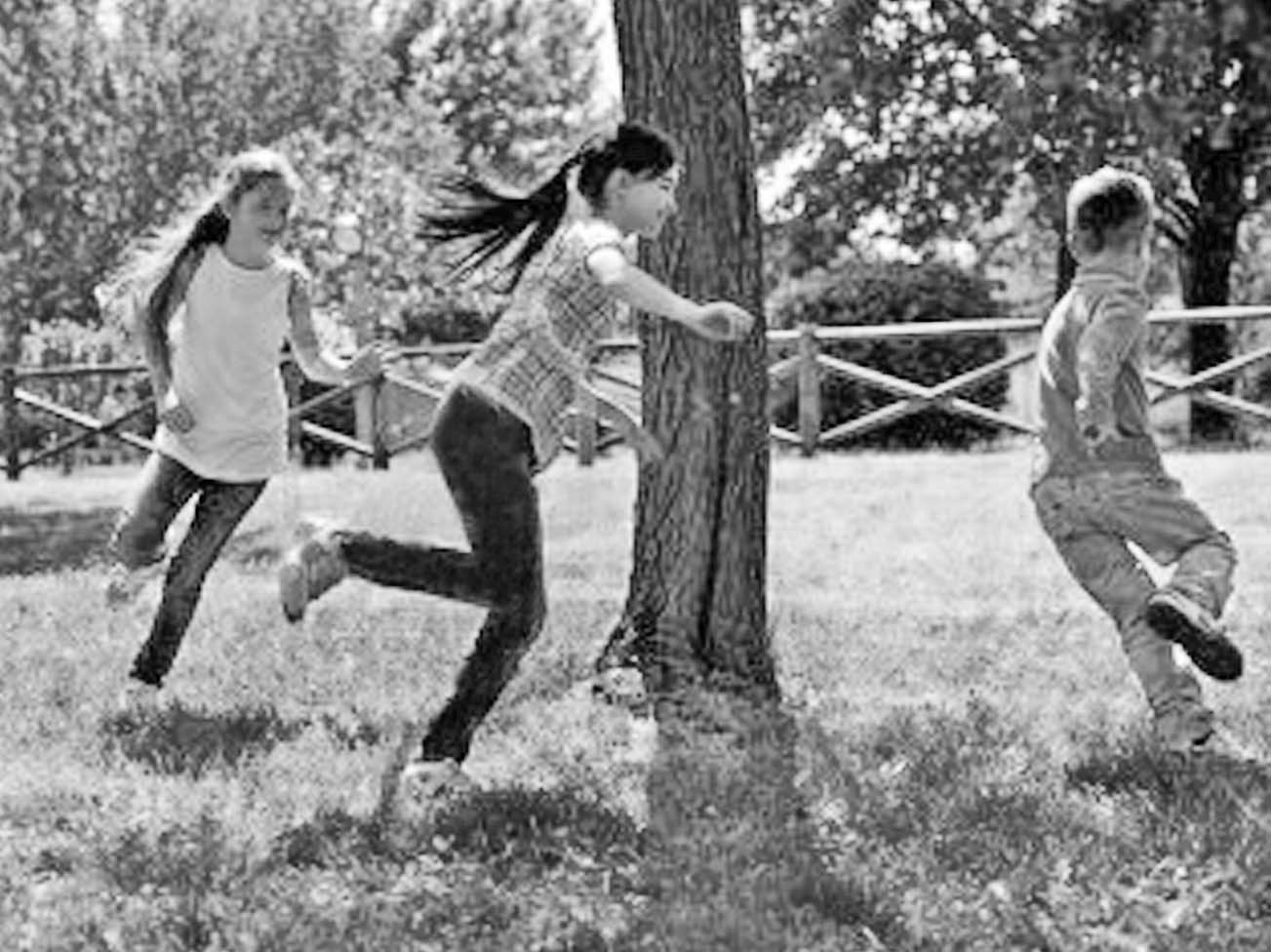
Our daily bike races — Geri’s hair flying out behind her — were evenly matched. Geri always seemed on the verge of flight; sometimes it seemed God’s cruelest trick that she had no wings to carry her about. Climbing trees could take an entire Saturday. So could sitting under the bushes watching an anthill or hunting for duck nests. Geri always seemed to know where to look to find something beautiful. Her favorite game, though, was to give chase or be chased. She’d tap my shoulder and take off. I’d do the same. But the other kids in the neighborhood would leave the area in a hurry whenever they saw Geri and her sister coming.

Slowly, Geri and Rachel began to be my only company. They were always there. First thing in the morning, last at night. Whenever the doorbell rang, it was them. I didn’t mind, exactly, until the kids at the bus stop started conspicuously falling silent as I approached. They’d move their lips and pretend to keep talking. I tried to ignore them, not very successfully.

One day, Geri wanted to brush my hair — her fingers were monkeylike on my scalp, and her touch provoked a tender shiver and the rising of small hairs on the back of my neck and shoulders. Her hands were gentle, even courtly, with the brush. Then she indicated to me she wanted to braid it. She did, but so terribly loose that afterward I was afraid to move my head too far in one direction or the other for fear of spoiling her work.

She was guileless, unsullied by the meanness or lasciviousness that was slowly engulfing the other neighborhood kids our age — yet late at night in my bed, when she inevitably appeared in my winding-down thoughts, I was startled to find myself imagining her dancing in the nude — turning her head this way and that, angling her arms and legs in slow Kabuki triangles. She was above the messiness of our lives, lofted into the thin blue stratosphere by an absence of one sense combined with a flowering of something else — a physical sensibility like that of a genius. I was stunned to worship many times by her careful placement of herself — her torso, arms and legs, arranged so gracefully.

I cannot tell you why, 30 years later, the thought and image of Geri renders me still and quiet, hushed and worshipful, feeling clumsy, insignificant and most profoundly inept. No — that’s a lie. I can. She was a beautiful deaf girl who loved me — this was the message she sent into the roots of my hair, lifting each section of braid like it was a rare, dissected, pulsing nerve. She made two careful braids, one behind each ear. The way she parted my hair with the comb was like zipping my head open and rearranging the numb contents. She was a beautiful creation. Her deafness had become to me not a defect, but a gift. She seemed like a butterfly perched on my finger. That delicate — but a butterfly who came back to me over and over.

Other friends grew distant; it took me weeks to notice. I lived in a world of chosen wordlessness. More than once, Geri put on the huge padded headphones from my father’s stereo — signaling me to turn the volume all the way up — and we danced, Geri with the headphones on, trailing the cord. I could hear the beat of the music, tinny, through the cups around Geri’s ears. Geri’s smile grew bigger than her face. Her buck teeth glowed as she tossed her long hair around, and I was happy, too.

Then one particular Saturday, Geri did not appear shortly after the dawn as was her habitual routine. Feeling odd, a bit adrift but also a bit scot-free, I rode my bike aimlessly down the road and ran into another bunch of kids, playing a more or less moronic game we called “TV Tag.” I hadn’t played it with them in a long time. The point of the game was to hide, to run for the base at a strategic moment, but then to call out the name of a television show if and when you were tagged, and if the TV show hadn’t yet been called by someone else, that meant you wouldn’t have to be “it” yet. We were in the thick of the game when someone spotted Geri and Rachel on foot headed toward us.

The sudden, unspoken agreement was for the group — yes, even me — to hide from the deaf girls, not to embrace them in our play, but to banish them utterly. Thus, I learned from the other children who’d been doing so for months how pitifully easy it was to hide from the deaf girls and to stay hidden, since we could call out their moving whereabouts freely to the others, and merely shifted farther and farther down the block away from them, running as fast as we could, shrieking as loudly as we pleased. That day, I learned a most horrible game of hide & seek. I have never forgotten the way Geri’s face looked, alarmed at first, then slowly sad, so very sad and lonely, pale and drawn — and from my ever-changing hiding places I saw her eyes, felt her gaze as she scanned the bushes for me, and heard her calling my name, that nasal and malformed sound I had grown to love. We didn’t stop hiding until she and Rachel had given up and, presumably, gone home.

Yes, I was a droll girl in those days — I hid from my deaf best friend and later the same day fed a morsel of prosciutto, Italian ham, to my Jewish best friend, Melinda. My misdeeds had to keep chop-chop with my brand-new knowledge of my own baseness. I knew it wasn’t a sin for her if she didn’t know it was ham — I told her it was Italian corned beef, and she, with misplaced faith, believed me. I understood I would be the one who went to Hell for it. Oddly enough, Melinda was the least deaf of anyone I knew. She could hear, it seemed, my thoughts. But only Geri knew my feelings.

If I could hold that girl and kiss her now, I would. With delight and affection, as if she were a sweet, melting jelly bean against my lips. I would tell her how I never forgot her, and never forgave myself. Because from that day — when I heard her call my name over and over and could not bring myself to answer — it was as if I was the one who was truly deaf, and she the one who could hear.


1 Comment

Filed under ancient history, apologia, apology, beauty, childhood, compassion, fiction, girls, ignorance, karma, life, love, mea culpa, mysterious, personal responsibility, regret, short stories, sisters, soul, spirit, teenagers, youth

Everyone has inside of him a piece of good news. The good news is that you don’t know how great you can be! How much you can love! What you can accomplish! And what your potential is!

Anne Frank, bringer of light….

Don Charisma's avatarDon Charisma


«Everyone has inside of him a piece of good news. The good news is that you don’t know how great you can be! How much you can love! What you can accomplish! And what your potential is!»

— Anne Frank


DonCharisma.com-logo-4Charisma quotes are sponsored by DonCharisma.com – you dream it we built it … because – “anything is possible with Charisma”


View original post

Leave a comment

Filed under Uncategorized

Summer Evening, Beaumont, a poem

illustration murder in beaumont

Summer Evening, Beaumont, a poem


I was not there. I am only an observer.

The four-year old on his tricycle is

dressed for the heat in loose shorts

and nothing else. His hair appears


disarrayed as he stares at the ground.

The back of his bare skull is as finely

carved as a newborn’s, the delicate

shadows of his shoulder bones ask for


touch. The clumsy chalk lines on the

pavement are from a murder and he

knows it — the blood came out last

night as the torpid sun was going down.


This boy has to make stories up in

his head, but the shy universe he

creates is a notion he’ll never share.

I was not there. I am only an observer.


The dead man was 300 pounds and didn’t

talk much, as he, too, was waiting for a

miracle. Gang members used five or six

bullets, then ran away without taking his


wallet, the item they wanted most of all.

I was not there. I am only an observer.

Hours earlier, the victim had left his

rented home in all-white Vidor; he told


how the folks there threatened to hang him,

he told how lonely it was to wake up every

day and remember where he was. He wasn’t

afraid, he said, just tired of fighting.


2 Comments

Filed under anger, blood, compassion, criminal, criminal behavior, criminals, death, evil, funeral, history, ignorance, karma, mortality, murder, poetry

Catalyst to a Potato, a poem

illustration catalyst to a potato 3

Catalyst to a Potato, a poem


Can I perform the miracles of earth, sun, water?

Can I be the warmth that gently pries open

eyes, that coaxes forth pale shoots, that causes


hardness to soften to green? If I throw the potato

against the wall again and again, will I ever cause

the potato to change? For so long, I tried to form


myself in the potato’s image. I tried to become

round, dense and heavy with stability, I tried

to protect myself. It did not work, it failed.


Now all there is left is her, one small girl alone

in the world. Her lips are redder than mine ever

were. Her shoulders are strong, she is not fragile.


You were the potato, the one I could never change.

Lobbing you again and again brought no result,

no visible difference. Yet in your eyes I am


the one who remained indifferent. I am not

ashamed, yet I am the one who needs to change.

You want only to rebuild. Take stock of your


small garden, not everything there is sound.

There is no such thing as healing. There is only

covering over, sweeping under, tamping down.


You know we will never love each other again,

yet you do not weep. This time I will not do it

for you. I am finished with praying for miracles.

3 Comments

Filed under ancient history, anger, apologia, compassion, development, divorce, earth, heart, justice, karma, logic, love, marriage, maturity, mea culpa, mourning, mysterious, nature, personal responsibility, poetry, regret, relationships, soul, spirit, spiritual, truth

Crocuses, a poem

illustration crocuses

Crocuses, a poem


I.  Signs of Spring

Suddenly, there they were by the front door,

and at my son’s preschool — purple and yellow

and green, poking through the snow

like small erections, out of the body of the earth,

the earth’s slumbering winter body.

My husband was always at work then,

they, the flowers, were my best companions.

“God is!” they said. “We’re God’s greatest effort,” they said,

“We’re God’s peeping blooms, despair must go to sleep,

and all creatures must go out of their lairs to frolic.”

My husband did not feel the urge.


II.  The Mole

Such loneliness I had battled all winter!

I made chicken, hot crescent rolls,

and buttered beans to make us happy,

but my husband was never hungry.

Lots of things took his appetite clean away.

I hadn’t scrubbed the toilet in two weeks,

this distressed him, he was a stern master.

The crocuses were so calm and forgiving,

purple and yellow like bruises;

my husband inflicted bruises without knowing.

He could not see, or did not want to.

His face lit up upon our child, that was all.

He was too important to sweep, or dust, or scrub.

I was the babysitter. I was happy with the crocuses,

and then one day, a dead mole; my son didn’t know

what dead meant, so I had to explain it.

He petted the soft fur, wanted to snuggle it

to his cheek. We paid homage to the mole.

We buried it under the snow, amid the crocuses.


III.   Troubling Questions

My husband didn’t know the bruises he left behind;

the flowers were my trusted companions.

His face lit up, gazing upon his son,

his finest possession; my husband would jerk him

away from me, hate in his eyes, when the crying boy

awoke in the night. The crocuses poked their heads out,

asking questions I couldn’t answer. My husband

didn’t want to see the bruises, or he was colorblind.

He was too important to notice the marks.

The crocuses asked, “Where is pleasure?”

“Not here,” I said. “Maybe next door?”


IV.  The Body’s Lament

The earth’s body was waking up,

but mine wasn’t, my husband was too important

to worry about my body. The head of his penis

was purple like the crocuses, but it asked no questions.

His body was warm, but not for me:

for the pure idea of sex, the attractive notion.

He wanted a thinner, more charming woman

with a better degree, one who would clean the house

more often, and with a smile.

Oh, he wanted a warm, dark place to set

himself, but one with no conversation.

As I put away the winter wools, the smell of mothballs,

white, crystalline like snow, inflamed my fears.

When the rest of spring arrived,

the warm air did not ease the tightness,

the block of ice around my heart.

2 Comments

Filed under beauty, compassion, earth, eternal, eternity, father, flowers, god, health, heart, identity, kindness, life, love, man, marriage, maturity, men, mother, mysterious, nature, relationships, sex, soul, spirit, spring, warmth, winter, woman, women

Paris – Evil Speaks

poetreecreations's avatarpoetreecreations.wordpress.com

paris

We must recognize

this is not our home,

yet, their home is ours as well.

We must realize

our world is inter-connected

their pain lays dead in our street,

We must remind

ourselves that our freedom

was just desecrated by the strong arm

of evil, it lurks, around us, anywhere it chooses.

We are asked

to understand

Charlie Hebdo is satire,

in violent terms their point is made,

yet we cannot laugh,

only mourn,

for those souls that lay dead on the tiles,

are us, are you, are me, are human beings.

Tonight, the sun has set on Paris,

people will not sleep,

people will worry, hold one another, walk in confusion.

Tonight across the globe,

we know again,

the pen wields a powerful angst,

yet,

we must also respect,

human lives could not ever deserve,

their legacy to be defined by a bullet.

Let’s pick up our pens and…

View original post 73 more words

Leave a comment

Filed under Uncategorized

Mr. Rogers Visits Koko the Gorilla, a poem

illustration mr rogers visits koko the gorilla

Mr. Rogers Visits Koko the Gorilla, a poem


Koko was clearly in love with him.

He was the human equivalent


of what in her world would be a male silverback

& I think she would have adopted him into her tribe


in a heartbeat. She took his shoes & socks off

& tickled his feet & pressed them to her own.


She kissed his hands & groomed his face & hair

with her fingertips. She wanted his gold cufflinks


(to remember him by) & you could hear the anxiety

in his voice when he said “My grandfather


gave those to me.” Really, really hoping

he was going to get away still possessing


his treasured cufflinks. What if Koko

had insisted? Would Penny have been able


to talk her out of it? Distract her to something else?

Mr. Rogers seemed nervous but in awe


at the communion with such a “being,”

as he called her. She flirted, playing


peekaboo with him, her large eyes knowing & coy

from underneath a cloth covered with pictures of kittens.


1 Comment

Filed under love, mysterious, poetry, relationships, science, soul, spirit