Tag Archives: love

Blind Man’s Bluff, a poem

illustration blind mans bluff

Blind Man’s Bluff

What is this game?  I am thirty-three,

and my eyes are covered up for play.

The world is solid black, my movements


slow & clumsy with fear.  All around

my floating head, voices chatter & laugh.

Tree roots line the ground, dangerous


protuberances, desiring my blood.

At a distance, I hear water falling,

it sounds uncommonly happy, it sounds


like someone peeing.  I could stay

this way forever, or at least

for a few minutes.  My own daughter


giggles when I stumble, and I wave

my hands to catch her hair:  sweet web,

tying my heart to my body


so it dares not take flight.

I don’t know anymore

if the grass is green here; mostly I sense


bare, flaccid soil, decaying leaves.

What chemicals created this relentless

natural discontent?  Is there a cure?


Old desires for wandering flood upward,

through jagged white bone, never coming

to fruition.  This tender moment


of blindness is welcome relief.

Certainly if I were to break an arm,

a leg, I would be taken out


of this awful inertia.  The laws of physics

are absolute, giving no small comfort

to a homeless spirit like mine.


There is nothing like the delight

of a very young child — to fracture

such a short-lived spell


would bring the greatest weariness of all.

Yet, if despair is the only real sin,

I am surely damned.  In the darkness, I reach.


As I grope her small round face, she speaks,

and I feel the soft lips move

under my fingertips:  you found me, Mommy.

66 Comments

Filed under short stories

True Love, a short story

illustration true love

True Love

            Mythical, that’s how they looked — when she got up close, she experienced both hormonal lightning flashes and the peculiar sensation of having a trick knee.  The famous Gower brothers:  high foreheads, broad shoulders, meaty yet sculpted forearms.  Granted, for Amy, myth and heroism consisted of “Jason and the Argonauts,” and the Classic Comic Books version of “The Iliad and the Odyssey,” but she was on the right track.

“This is Amy,” said her friend Claudia.  She stood with her arm across Amy’s shoulders.  “This is my ex-husband, Burnett, and this is Carey — we call him Shorty.”

It was admirable the way Claudia and her ex hadn’t let their divorce get in the way of business.  Amy wondered if she were capable of such sophistication — perhaps it was bound up with the Bohemian temperament musicians were supposed to have.

“Nice to meet you,” Amy said.  “I’m enjoying your music.”

“Thanks, Amy,” said Shorty.  “That’s what we like to hear.”

“Mind if I sit here?” he asked.

“No, please,” she said.

He chewed his little red straw, stirring his drink with a finger.  The gesture was boyish, clumsy.

“How long have you been playing here?” she asked.

“Six months,” said Shorty.  “The owner is a jerk, but he’s hardly ever around.”

“Well, I’m glad the band stayed together,” said Amy.  “This is the most fun I’ve had in a long time.”

He tossed his head, and gave her an aw-shucks-ma’am grin, showing his teeth and squinting his eyes.

“Me too,” he said, touching her arm.

“You’re just as pretty as Claudia said you were,” he said.

“Oh, I bet you say that to all your groupies,” she said, laughing.  He laughed too, squeezing her arm.  She felt his large fingers against her skin, the calluses on his fingertips.

They had another job tomorrow night, he said, over at Lazy Susan’s.  Would she like to come listen?

“A friend of mine is having a party we could go to,” he added.  “It won’t get cranking until around two a.m. — you know, a bunch of musicians.”

“Sounds great,” she said.

“Stay for the next set, won’t you?” he asked her, tipping his glass to drain it.  The lime wedge fell on his nose, and he laughed, then put it in his mouth and sucked the pulp.

She sipped her wine.  A bit drunk, she was relaxed even more by the sound that poured over her, brushing her skin like velvet.

When the music was finished, Shorty walked her out to her car, opening and closing the door of the little Datsun for her.  Squatting on his heels, he rested his elbows on the open window, leaning his chin on his hands.

“I don’t do this very often,” he said, his face dusky under the streetlight.  “Ask anybody, they’ll tell you.  I’m not a flirt.  I don’t operate that way.”

He took her hand and held it, shaking his bangs out of his eyes.  Staring at her, his eyes were sleepy-looking.

“Yes, ma’am, it’s been a real pleasure,” he said, drawling the words out, going corn-pone, laughing.

***

Shorty was sweet, honest, Claudia said, a guy who would do anything for you.  It was true, he didn’t pick up women.

“But he’s kind of involved with somebody,” she said.  “It’s a weird thing:  they’re separated right now.  I know he’ll tell you himself, so don’t say anything.”

“Separated?”  Amy said.  Gruesome visions of surgery flashed in her head, the kind used for taking apart Siamese twins.

“Well, he and Bonnie have lived together, off and on, for years,” Claudia said.  “Lately, it’s been mostly off, but neither one of them has ended it.”

“Where is she now?”  Amy asked.

“Dallas.  She manages a restaurant out there.  Some relative of hers got her the job.  Everybody thinks she’s been bad to Shorty.  He needs to get on with his life.”  Claudia shrugged.

“I don’t understand how people can live like that,” Amy said.

“I know,” Claudia said, sighing.  “So if you get close with Shorty, you better keep Bonnie in mind.  They go back a long time.”

“I’m not looking for anything serious,” Amy said, twirling her hair.  “I just want to have some fun.”

In fact, whenever she broke up with someone, she’d swear she would never get “involved” again — she would become independent, self-sufficient.  Then she’d wake up months later — as if from a trance — realizing that she had somehow ended up in another relationship.

***

The musicians were taking a break when she walked in, and Shorty was standing in the entryway talking on the phone.  He mimed delight, his eyebrows raised, and he beckoned.  She stood near him:  bending, he put his arm across her shoulder, drawing her to his side.  He pulled her tight against his body, curling his arm around her neck and looking down at her curiously from that skewed, clumsy angle.  She could smell him; fresh, clean sweat that carried the smell of his aftershave, and underneath that, the blunted tang of alcohol and bar smoke.

“You sure are a sight for sore eyes,” he said.  “I’ve been thinking about you all day.  I was starting to think you’d forgotten.”  His face was mobile, relaxed, expressing shy fascination.

He wanted to stop home and change before the party.  “You don’t mind, do you?” he asked.

“Of course not.”  She followed him in her car.

Waiting in his living room, she flipped through his magazines:  RollingStone, Time, and Omni.  He emerged from the bedroom with a clean shirt on, hair wet, combed down tight, the tooth-mark pattern of the comb pressed into it and a few wet curls on the back of his neck dripping on his shoulders.  His skin was fair; a dark mole next to his mouth stood out against the flush of color brought out by the shower.

“Let’s take my car over to the party,” he said.

His back seat was folded down, the space crammed full of guitar cases and scuffed black boxes.  He sat with his hands on the steering wheel as if he were trying to remember how to drive.  Then he fished a half-smashed pack of cigarettes out of the side pocket on the door.  He lit one, dented and pressed flat, inhaling with a sigh, thin lengths of smoke swirling about his face.  He offered the crumpled pack to Amy.  “No thanks,” she said.  “I don’t smoke.”

“Neither do I,” he said.  “I like the way it looks sometimes, how your hands feel lighting up.”

Shrugging, he pulled out the ashtray, tucking the smoldering butt into one of the grooves.  In one smooth motion, he leaned over the gear shift and kissed her, cradling her head in his hands.  Then he let go and took her hand, laying it in his lap, against the rough-sewn corduroy crotch of his jeans, and he whispered.

“See what you do to me?” he said.

***

Later that night, she discovered the shoes.  On the floor of the bathroom, tossed in front of the linen closet, she saw a pair of running shoes, women’s, size five.  She held one of them up to her bare foot.  Her own size nine looked huge next to the tiny shoe.

Carrying it back to bed with her, she lay down next to him, holding the shoe up with one arm, over her face, the laces dangling down, almost brushing her nose.

“Whose is this?” she asked.

“That’s Bonnie’s,” he said.

Amy let the shoe drop to the floor.  The room was still, quiet.  She felt a protective third eyelid go down over something vulnerable inside her.  “Is she living here?” Amy asked.

“Hell, no,” he said.  “I haven’t heard a word from her in at least six months.”

She found herself possessed by quiescent maturity, a vague memory of some letter to the editor she’d read in Playgirl.  She would handle it in that abstract way; not a whimper would come out of her.  She took the shoe and put it back in the bathroom, coming back to bed, and drawing the comforter up over her bare shoulder.  As she had known would happen — her reward for being a good girl — he reached out under the blankets, pulling her to him and curling around her, her head hooked under his chin and her feet pressed against his shins.  He was warm and soft-skinned and large and solid, all at once.  She was in a masculine sort of womb.

“You’re the only one here with me,” he said.

She could see something that looked like love, the old kiss-me-until-I-die extravaganza.  She couldn’t tell him, could she?  Her blood swelled and pounded and she imagined saying it, imagined him saying it back, falling asleep next to him at last, her mind flickering through images like the arthritic film projectors she remembered from high school:  tiny shoes, and faceless petite women wearing nothing but a mist of blue glitter as they dove into murky tropical lagoons in the dark.

***

For Shorty’s birthday, they were going to an expensive restaurant.  Almost ready to go pick him up, she was slipping into her shoes when the phone rang.

“I’m sorry,” he said.  “I’m not going to be able to make it tonight.  Bonnie flew in this afternoon.”  He paused; Amy said nothing.  She didn’t intend the silence to be accusatory, but that was how he seemed to take it.  “Amy, I swear,” he said.  “I had no idea she was coming.  She called from the airport and said she was here to wish me a happy birthday.”

Amy breathed in, her chest stretching until it hurt.  For a moment she didn’t know how the air would get out — some sort of one-way valve had shut down — but then her chest was empty.  She waited.

“I’m sorry,” he said, whispering now.  “She’s in the next room.  I don’t know what else to say.”

“Well, have a happy birthday,” she said.  She placed the phone in the cradle in slow motion.

***

Amy drove over to the bar.  Burnett was there, of course, and some other guy on bass, filling in for Shorty.  She had his birthday present — a gold chain — shoved in her purse.  When the band went on break, she and Burnett walked outside.  They sat in her car in the darkness.

“He’s with Bonnie,” she said.

She took the small velvet box out of her purse, handing it to Burnett.  He held it for a moment, and then put it on the dash.

“My brother doesn’t know what he’s doing,” he said.

“Neither do I,” she said.

He picked the box up and held it, his eyebrows raised, questioning.  Shaking her head, she closed his fingers over it.  “This is really nice,” he said, when he opened it.

She took the ends of the clasp and put the chain on him — his neck damp, but round and full and hard as a barrel under her fingers.  As she worked with the necklace, the tiny lever on the clasp stabbed underneath her thumbnail.  She sucked on her finger, tasting blood.  The strand of gold glinted against his skin, his long hair sweeping past it and over his shoulders, the pale blonde glow of the hair as pretty as any woman’s.

She drove home with Burnett after the bar closed.  In his living room, sitting on a sprung green brocade sofa, they drank beer in silence, the room lit by one enormous rainbow drip candle.  Putting his empty bottle down, Burnett stood and held out his hand; she didn’t hesitate, just rose to follow.  His bedroom was tiny; the double bed used up all the space.  She had to hitch her way around the nightstand and halfway there, she toppled, falling panicked, then sprawled on the bed.  Burnett looked down at her, pulling his shirt tail out of his pants.

The brothers were like two sides of the same coin.  When she closed her eyes, they had the same feel, the same weight; they even smelled the same; except she knew it wasn’t Shorty because of the way the long hair trailed over her skin when he bent over her.  It tickled her skin like a spider’s web, it was so silky.

***

When Amy phoned Shorty, a woman answered on the second ring.  She didn’t hang up the way she had planned.  She asked for him.

“Hello?” he said.  He sounded tense.

“Hi.  It’s me.  Was that Bonnie?” she asked.

“Yes,” he said.  She could hear him breathing and Bonnie talking in the background.  “Who is it?”  Amy heard.  The sound got muffled; she tried but she couldn’t make out his answer.

“Listen, I’m sorry,” she said when he came back on the line, her voice low and even.  Her stomach rolled with a peculiar heaviness, making everything seem vague and faraway.  “I know you can’t talk now.  Call me when you can, okay?”

“I will,” he said.  “You take care of yourself.”  His voice was slower, his drawl back to its normal rhythm.  He sounded relieved — she was being so civilized, so unlike what he had probably expected.  Although it wasn’t Shorty’s fault — he hadn’t lied to her — somehow, she was being too nice.

***

Amy had a New Year’s Eve vision:  a slow-motion perfume ad, a fuzzy dream of sensual retribution.  Oh, how she’d make him regret what he’d passed by on the way to his dry banquet!  Her heart — the childish construct of it, the big red valentine — was beginning to resemble a checkerboard.  Amy loved New Year’s — for an hour at least, everything seemed limitless.

Claudia was equally superstitious, always serving a big Southern breakfast — beans, greens, ham hocks, cornbread — at midnight.  “Don’t tell me you didn’t know about eating black-eyed peas on New Year’s?”  Claudia asked.

“Honestly,” said Amy, “I’ve never heard of it.”

“Well, you need some luck then, girl,” said Claudia.

“Yeah,” said Amy.  “I guess I do.”

***

The very first person she saw at Claudia’s party was Shorty.  His back was to her, but she knew even that angle; no plane of his body was unfamiliar, and she realized that was about as close as she — as close as anybody — could get to a person.  Shorty was standing next to Burnett; the boundary between their bodies seemed arbitrary.

Burnett spotted her first.  Smiling and nodding, he tapped his brother and waved.  Shorty turned toward her:  both men stood, grinning in her direction.  She didn’t care; all her pretenses flamed out in one big burn.  She shocked herself and then knew — with the thigh-weakening flush of any decent sort of compulsion — it still wasn’t enough.

Shorty pressed through the crowd toward her.  When he put his arm across her shoulders, she understood; either Burnett hadn’t told him or — more likely — it didn’t matter.  Perhaps this way was better; now they were of a piece.

“I’ve missed you,” he said.  It was the truth, she knew, not just a line.  He wasn’t a flirt, he didn’t operate that way.

“I’ve missed you, too,” she said.  “How’ve you been?”

“Okay,” he said.  “Bonnie went off to Mexico for the holidays.”  Shaking his head, he frowned — as if to say, isn’t that woman a mess?  “I’m just glad to see you.”  She knew he was glad; he was as honest as they came.

Claudia floated up with Burnett, her arm around him, her thumb hooked in one of his belt loops.

“Hey, you two,” she said, smiling.  “I wanted to tell you the good news–we’re getting remarried.  Isn’t that wild?  We’re going to do it at 11:59, kind of romantic, huh?”

“That’s great,” Shorty said, pleasure warming his voice, deepening his drawl.  “I always knew you two would get back together.”

I guess I did too, Amy thought.  Burnett’s not a flirt, either.

But she said, laughing, “This way you’ll never forget when your anniversary is, right?”

“That’s right,” Burnett said.  Amy cocked her head, winking at him, so small a motion that anyone watching would have seen only her eyes flicker as she bared her teeth.  She thought she saw him wink back the same way, flinging his hair out of his face and over his shoulder with a toss of his head.

A few minutes before midnight, Claudia and Burnett exchanged their vows.  The bride’s eyes glistened, her lips red, her skin pale underneath her freckles.  As the groom kissed her she put both her hands on his buttocks and squeezed them.  Everybody hooted and laughed.  “Going to be one hell of a wedding night!” somebody shouted.

Yeah, Amy thought.  One hell of a wedding night.

“Let’s go,” Shorty said, leaning down to whisper in her ear, his breath tickling and smelling of beer.  “I’d like to get out of this crowd.”  Putting his arm around her, he slid his fingers under the waistband of her jeans, rucking up her blouse and brushing the bare skin of her hips.

Her head felt swollen, too large for the rest of her.  Who was she, now?  She felt dizzy but she didn’t stop:  she couldn’t stop.  She had known all along, hadn’t she?  Shorty was — the kind of guy who would do anything for you.

“Yes,” she said.  “Let’s go.”

7 Comments

Filed under short stories

nana’s red blanket, a story for children

illustration nanas red blanket
NANA’S RED BLANKET

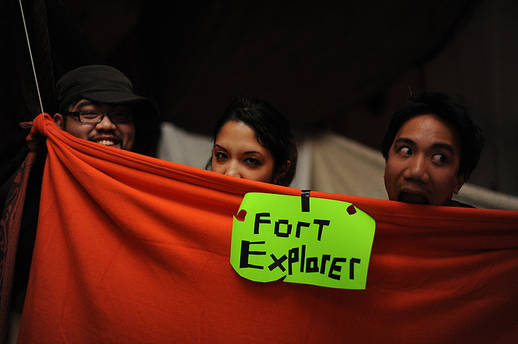
On rainy days when I was small, my grandmother — I called her Nana Banana – always let me build a fort indoors. She carried her tall kitchen stools out to the living room and fetched the biggest blanket from her cedar chest, which was perched on round feet in the shape of lion’s paws. The blanket was heavy red wool, hemmed on all four sides with shiny satin. Nana Banana had brought the blanket with her from Up North when she moved to Florida, and it was very, very thick and warm. Nana’s wooden stools had flowers and birds carved down the legs, and squeaky cane seats that had been woven by her very own grandfather. The blanket and stools were perfect for forts.

First, I always drew my map. I loved to decide where to build the fort. The furniture had to be all figured out and labeled. Sometimes the couch would be the mountains, other times it would be the forest — or, it might be I was in a big city and the couch was the library or the post office. The shiny coffee table could be the ocean, or a lake, or maybe the zoo. I would crumple up my map and smooth it out and Nana would singe around the edges with a match to make it look old. Then I would go to the building site and lay out the fort’s foundation, which was four stools, one for each corner. Nana would pick up two corners of the blanket and I would pick up the other two. We would billow the blanket up as high as we could and let it float down. It draped beautifully, like an Arabian tent.

I would crawl inside, and underneath the dense red blanket it was dark and quiet and far away from everything. From that place I could go anywhere in the whole world — or, I could stay right where I was if I didn’t feel like traveling. If I wanted to fly, Nana would make plane noises. If I wanted to sail, she would be the water and wind. Always, she was there to help me get to where I wanted to go. Later, if I crawled out of the fort and needed to buy something, she was the shopkeeper; if I wanted to sell something, she would be the customer. It seemed like I could always talk her into buying — no matter what it was I had for sale!

Sometimes, though, when I was tired and cross and just wanted to be by myself, I would take a flashlight into the fort and read. I had pillows and sofa cushions inside so I could be comfortable. Nobody would bother me under there — they’d act like they didn’t even know where I was. On days like that, sooner or later Nana Banana would silently push a bowl of popcorn or a plate of cookies through my door. The whole world shrank down to that warm, dark space underneath Nana’s red blanket; under there, because of her and how much she believed in me, I just knew I was the smartest, bravest, most important person ever born. But the best feeling of all on those long, stormy afternoons was when the rain finally finished — and I realized I was ready to leave my retreat and go back to the bright, quick, noisy life outside. Dinner that night would taste so delicious!

Please, tell me, tell me! Where will you build a fort, next time it rains? Once inside, where will you travel?

4 Comments

Filed under for children

Hitchhiker Dream With Beatles

illustration hitchhiker dream with beatles

Hitchhiker Dream With Beatles


Driving 70 miles an hour, I noticed two young men

walking down the side of the highway.  One caught my eye —

tall, lean, broad-shouldered, his thick hair flashing


bright in the harsh summer light.  Not knowing why, or how,

the two came to be there, I pulled over.  The blond

wanted to drive, the other sat next to him:


I, now a passenger, leaned in from the back seat,

asking Beatles questions.  How did Paul meet John, anyway?

What was the first date they sat down together


to write a song?  What exactly were they wearing

at the time?  No answers forthcoming — but I told the men

not to worry, I’d happily fill in the details.


Paul had on a twill safari jacket, I said, and John wore

an ugly plaid blazer.  It was late fall; the rusty leaves

twirled on their branches like pinwheels, and Paul was in love.


His girl, Peggy, was tall, full-breasted, and her hair

was black, curly, down to her waist.  John was terribly shy

with women, a bit jealous of Paul; soon enough John found fault


with the girl — her face was uninspiring, her nose crooked.

John was right; Paul gave her up.  Peggy married

the next man who asked her, divorced him in a year.


She’s on the dole now, lives with her mother,

who’s a real bitch and a half; won’t wear her teeth

or her hearing aid, loves to drive poor, lonely Peggy berserk.

Leave a comment

Filed under poetry

For Celibate Lovers Everywhere, a poem

for celibate lovers everywhere

For Celibate Lovers Everywhere

Leo was almost seven feet tall; his skin, dusty
brown as baker’s chocolate, his fawnlike eyes liquid,
shining, his manner shy and delicate.  I fell in love

with his polite voice that first night he came calling,
carrying his stack of Hindu texts in a wicker basket —
we were eating pizza, loaded with greasy sausage;

he looked down at us in my small dark room, polite, curious.
He spoke with a strange hesitation, his tone oval and clear
as the notes of a heavy iron bell.  He had been a monk

for years, wearing spotless but wrinkled saffron robes,
his head shaved except for one small tattered tuft
on the high, vulnerable peak of bone at the back of his scalp.

His hand was leathery, dry, smooth, like an expensive saddle.
It was embarrassing how I always wondered about his desires
for sex, wondering does he lie awake at night, thinking

about the bodies of women?  If so, what an awful shame,
for the way Leo moves, bowing his tall, elegant frame
through every narrow doorway, bespeaks a gentleness

with flesh, a respect for the gift of skin, the clarity
of nerves.  What a waste, I always think, but he’s given
his life over completely to his god.  His father was

disappointed when Leo gave up basketball; his long,
long palms still curve around in the air when he speaks,
as if reminding his body of what it once loved to do.

One day, I could tell he wanted me too, though only for an hour.
We walked the temple farm’s hot green fields, inspecting sacred cattle
together.  The dirt path circled around a lake, then wandered away

from the main house; next to a thicket of velvety cattails the same color
as Leo’s skin, we sat together on a stone bench, the surface gritty,
cold against the back of my knees.  I couldn’t look in his eyes.

I smelled the thick, wet breeze off the lake, and the wind ruffled
his gauzy robes.  I heard the snap of cloth against his lean calves;
his toes long and spidery, the nails thickened, blunt in his

canvas sandals.  His hand brushed mine on the bench – no accident.
But he had been celibate for nearly twenty years, and I would not
willingly be the cause of his release on that sad day, or any other.

2 Comments

Filed under poetry

she’s leaving tomorrow for new zealand

my darling daughter, turning 25 in april, is leaving tomorrow to go back to new zealand.  it’s been the greatest thing ever having her home… many postings to come!

Leave a comment

Filed under Uncategorized

he didn’t know he would die on december 19, 1979. a beautiful letter, regardless. my daddy. i loved him.

001

Thurs. 9-27 (1979)

Hello my beautiful daughter,

I haven’t checked my mail at Steve & Etta’s in a couple days, so I don’t know if you’ve written or not.  When I wrote you last and asked to hear whether you’d gotten it, that seemed important.  When I’ve thought about it since, it hasn’t.  That is, if you’re supposed to get my letters, you will; and if I’m supposed to/need to hear from you, I will.  I love you, and one of the things that means is that I enjoy expressing myself to you.  Don’t get me wrong:  I also really like hearing from you, hearing you/listening to you expressing yourself to me.  That’s what I want, and what I get will be what I need.

I hope you’re enjoying yourself and learning and growing.  I know you’re doing the latter two; the first is the only thing I’m unsure about.

Things are really interesting & exciting for me: seeing some patterns in my life, some big ones, for the first time ever.  They are really far out:  mostly they have to do with my history of relationships with women (including your mother & going back further than her) and how I use/have used those relationships to work out my feelings about my mother & her inability to give me love, affection, respect, hugs, kisses, TLC… that kind of stuff.  (I’m unclear about how much of this I “should” be sharing with you… when, if ever, should I relate to you like a peer?  Or:  when a father tells his child about his own emotional/psychological struggle/growth/insights/development, is that OK?  I guess I should go with my feelings and it feels OK to go this far; I’ll go as far as it feels OK to.  Part of my desire is for you to maybe learn a little something about your own psyche, and to know me as well as you can… given our… the way our relationship has gone (off the main point: I want you to know that I am not threatened or bothered at all, any more, by your relationship with your stepfather.  I accept that he was your father, is your father, in many ways.  And I think it’s beautiful that you have two of us.  How many young women have a straight dad and an unconventional dad?)  At any rate, the genesis of this recent big insight was George Oliver, from whose apartment I called you the other week.  I was talking to Geo. about my feelings of longing for Barbara & he told me that what I was saying sounded just like what I’d said & been feeling right after separating the last time from your mom.  That blew me away, because it was real true.  In essence, my largely unconscious/subconscious need/wanting to “get back at” my mother for what some part of me sees as her deliberate refusal to give me what I wanted, love, has led me over the years to play the game with women (who I’ve viewed as mother-surrogates) of “when I’ve got you, I don’t want you; when I haven’t got you, then I want you back.”

All this realization is so new I’m still trying to get my mind around it.  I’m pretty sure I want to stop playing it:  it sure doesn’t feel good for those involved, myself included.  (I realize that, at some level, it had to be satisfying some real deep need in me; otherwise why go on doing it for 30 plus years?)

Exciting and scary times.  The prospect of opting out of the game is exciting.  And scary:  the game-playing part of me says, “gee, what will I do if I don=t play that game?” or “But that’s all I know how to do!”

Incidentally, I have no regrets about having come down to Florida & having been there 3 & 1/2 months.  It all needed to happen, I’m sure of that.  And our time together was beautiful.

And something else that needs to happen is going to the first part of next week: I’m heading south again.  I’ll be driving in the van down Baja California to La Paz & taking the ferry across to mainland Mexico again.  I’m going to revisit some of the places I raced through (e.g. 3 hours in Oaxaca) and visit some of the places I chose not to make side trips to.  And drink in that delicious tropical sun & sea for a while.  I guess I’m feeling that I’d rather go to Europe in the spring, warmer weather.  (Sat.)  A feeling that’s really been reinforced by the last couple days in LA, real cool here, rainy & overcast on the beach today.

My current thinking about my travelling is that I’ll do Mexico again until Dec. or Jan. then go to the Caribbean.  I’d love to visit Jamaica, St. Martin, Puerto Rico, etc.  And then in summer go to Europe.  Rather than going to London now, then immediately to warm weather in Africa then going back to Europe next summer.  But, it’s real hard to stay definite..  I don’t know what this does to our talking about travelling together, but if we’re supposed to, we will.  And I would love to see the Caribbean with you.

I don’t know whether I’ve told you or not: when I came out here in Aug., my first stop was San Diego, where I talked to my Aunt Cecelia (who also was my godmother) & the lawyer that drew up my mother’s will.  Cecelia, after hearing that I felt humiliated, hurt and angry about Mom’s will, said that Mom had felt all those same things & ways about what I’d done in living my life.  Which is no doubt true.  And sad, that my efforts to live & be happy were taken so personally by her, and that she chose to be so upset about them.  There’s a lesson there, for sure.

I will write you from Mexico and I’ve decided to assume you will get my letters & stop worrying about whether Gail might intercept them.

My thoughts are with you a lot.  Know that I love you.  (The thunder outside seems to punctuate my writing with an exclamation point after that sentence!!)  Allow yourself to be who you are; remember that if you were supposed to be different, you would be.

Dad

Incidentally, I asked Sheila’s lawyer how long before I get my money from the estate & he said he couldn’t be definite (you know how lawyers are) but he thought it’s be sooner than 6 mos.!

(You can write me in Mexico if you want.  I’ll be stopping in La Paz, in the state of Baja Calif. Sur and mail will be held for me if you send it c/o Lista de Correos, for that city & state.  La Paz is 1000 miles or so south of San Diego so I shouldn’t be there until at least a week or so, more like 2 weeks, after you get this.)  I’ll let you know other cities later.  The next one after La Paz will be Puerto Vallarta, but I forget the state name, but you can just check an atlas.

3 Comments

Filed under notes

stone crab fossil, a poem

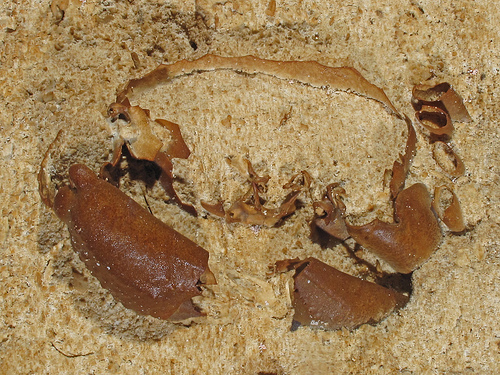
ocalina floridana stone crab fossil

Stone Crab Fossil

My daughter and I
wear our matching crab T-shirts.
We are known for our prickly natures,
our quick defenses.
We stare at Ocalina floridana,
which, though dead, reaches out
as if for rescue with its fat claws —
now pale, delicate shades of gray rock,
not orange and black as in life:
a desperate ghost crab.
Entombed in mud for millennia,
turned slowly to stone
by seep of minerals. The flesh
would have been delicious
with melted butter. Side-walker,
harbinger of bad luck, omen of the great flood,
enemy to all snakes, brave
in the face of death, the humble crab
goes down swinging. The crab does not run
from danger, the crab does not abandon
pride in the moment of attack.
When I was pregnant with her,
I had a taste for crab-cakes.
Sometimes I wear a hard shell,
sometimes I wish I could shed it,
leave it rolling down the beach
while I slip back into the clear water.
This year she learned to read,
tells me the name of everything
in the museum. Sometimes, just like me,
she doesn’t want to talk, she wants
to be alone. I hope someday,
should she ever have need,
she seeks me out, reaches toward me
in her distress, lets me in again.

4 Comments

Filed under poetry

sous la langue (under tongue), by nicole brossard

illustration sous la langue

I did not write this, but it has long been something that I thought worth reading…

Author:  Nicole Brossard, (translated by Susanne de Lotbiniere-Harwood).

SOUS LA LANGUE (UNDER TONGUE)

The body salivates, yet nothing is foreseen, not the wealth of touching, nor the furtive slowness, the exact frenzy of mouths.  Nothing is foreseen, yet at eye level is where the body first touches everything, without foreseeing the naked skin, and it needs saying, without foreseeing the softness of skin that will be naked even before the mouth signals the state of the world.

Nothing here to suggest that at the slightest touch the gaze already falters wanting already to foresee such a rapprochement.  Nothing is foreseen other than the breathing, the sounds resounding flesh to flesh.  Does she frictional she fluvial she essential does she, in the all-embracing touch that rounds the breasts, love the mouths’ soft roundness or the effect undressing her?  Nothing is foreseen yet at body’s uttermost the skin will image the body for without image there is nothing at body’s uttermost images shatter the state of the world.

You cannot foresee so suddenly leaning towards a face and wanting to lick the soul’s whole body till the gaze sparks with furies and yieldings.  You cannot foresee the body’s being swept into the infinity of curves, of pulsings, every time the body surges you cannot see the image, the hand touching the nape of the neck, the tongue parting the hairs, the knees trembling, the arms from such desire encircling the body like a universe.  Desire is all you see.  You cannot foresee the image, the bursts of laughter, the screams and the tears.  The image is trembling, mute, polyphonic.  Does she frictional she fluvial she essential does she all along her body love the bite, the sound waves, does she love the state of the world in the blaze of flesh to flesh as seconds flow by silken salty cyprin.

You cannot foresee if the words arousing her are vulgar, ancient or foreign or if it is the whole sentence that attracts her and quickens in her a desire like a scent of the embrace, a way of feeling her body as truly ready for everything.  Nothing is foreseen yet the mouth of bodies commoving aroused by the words by instinct finds the image that arouses.

You cannot foresee if the state of the world will topple over with you in the flavour and surging motion tongues.  Nothing is foreseen yet the shirt is half-open, the panties barely away from the cleft and yet the closed lids and yet the inner eyes are all astir from feeling the tender in the fingers.  You cannot foresee if the fingers there will stay, motionless, perfect, for a long while yet, if the middle finger will move O ever so slightly on the little pearl, if the hand will open into a star shape at the very moment when the softness of her cheek, when her breath at the very moment when the other woman’s whole body will weigh so heavily that the book where it rests gives way under the hand, the hand, at the very moment when balance will become precarious and thighs will multiply like orchids, you cannot foresee if the fingers will penetrate, if they’ll forever absorb our fragrance in the image’s continuous movement.

Nothing is foreseen for we do not know what becomes of the image of the state of the world when the patience of mouths lays being bare.  You cannot foresee from among the waves the one the unfurling one the split second that will image in the narrative of bodies whirling at the speed of the image.

You cannot foresee how the tongue wraps round the clitoris to lift the body and move it cell by cell into a realm unreal.

Leave a comment

Filed under prose poetry

the eternal conversation, a poem

IMG_1265

The Eternal Conversation

Hard wood portends on my truth, I long to burn every tree,

I long to sift the gray ash of discontent

for the few teeth and bits that remain.

My body is full of small holes,

the better to let you pass through me.

You old vagabond, the sun is you,

the sun is your heart, the sun is your eyes.

Look at me, I will blind you, you will remember nothing.

You will remember only how it felt to come inside me.

I melt men like sugar cubes.

Give me fountains of blue wine to drown myself in.

Let me swill from your fountains.

Let me piss in your bed and make you love it.

Only give me glory and work,

and I will tell you all I know, gladly.

This is what I know.

This.

Pretend you’re my father:  your one spurt of joy

caused me to begin ticking in your pocket.

Pretend you know my name.

Pretend you have always been with me.

Don’t forget me, don’t forget to wind me up,

don’t break the thin gold chain attaching me to your heart.

I am not a cat, I don’t have a plaintive past,

I can’t meow for attention.  I could try to scratch you,

but you would only fling me away in hatred, off to the floor.

Yet away you go, with soap to pass your outrage,

cleansing your sins like so much dry grit.

You boil your soup of amnesia,

burn your tongue with it,

lose the ability to taste anything, ever.

You are like a tourniquet of the breast,

keeping me tied to the earth.  I never let myself float,

I was always afraid I would never return to sanity.

I am an old vagabond, I will die without you.

But that is nothing new.  You abandoned me

on my first day.  You didn’t care what time it was then.

All you cared about was yourself.  You couldn’t live

your promises.  You are nothing.

You have no heart, you have only your tired words.

Taunt the people who are less fortunate than you.

Make them suffer even more, that is your duty and function.

Speak nothing without hunger and death

being always in your mind — these are

the only real problems.  This love, this is an illusion.

There is no love.  There has never been love.

There is only madness, heat and passion.

The game is to force myself out of myself,

into the bigger picture.  I want to be everyone,

all at once.  To rid myself of these cramps.

To stretch the labored muscles, to tear them,

to rend them from the bone, to flay the entire beast

and let it dry in the sun until it is harmless meat.

Dance with fossils without ceasing life.  The past haunts

but it does not weigh down our joy.  We can weep

and laugh simultaneously.  We do not need drugs for this.

I am finished viewing sickness at last.

I have no more patience for dying.  I will bury the dead,

but I will not visit their graves.  I will plant flowers

to bloom in perpetuity, then I will take my filmy scarves

and fly away toward joy.  I will sprout wings,

they will carry me to my own heart.

Those who have passed under my hand won’t suffer,

I am a slim ivory blade, sharper than a razor’s edge.

I am skillful at dispatching those who love me.

I am the merciful murderess, the killer who weeps

as she cuts the veins, sorrow for the blood but joy for the heat.

The others I have jettisoned are always sad,

they think of me with mingled regret and malice,

but they shouldn’t mourn, they’re better off without me,

this I know for I know where I have buried all the dead.

Courage for life, alleys are for the party afterwards,

the wake for the soul.  The body remains upright.

We live without life, we breathe without air.

We fuck without coming.  We give birth

without understanding the process.

The hospital where I will say my last good-byes

to everyone who harmed me, everyone who tried

to caress me.  I built the building, I know its every corridor.

May we all have a plain dance upon dying.

May we go stately to our blessed rot.

May we laugh as the teeth fall from our jaws.

I hope to see my destination, at least from a distance.

Will it be like a train through the mountains?

Will the air rush in to meet me?  Will the air

be like a baby’s kisses?

I see an old vagabond, moronic or just born,

and it is a mirror I stare at.  I have studied all the books,

but can remember only one thing.

Despair is a waste of time.

With artists, we dance my young age and love,

but white hair and rigor mortis are just around the corner.

I can get through anything in one minute segments.

I can breathe the pain through myself,

I can detach it from my body.

I am told when I was sleeping I was at my best.

That is when I hurt no one but myself.

In dreams, I am kind, I am eternal.

Respond to me, you seller of happiness.

Money can buy everything, didn’t you know?

They are only lying to you to keep you down.

The raw chicken sits on the board, weeping juice,

and it is cold under my hands.  To lift the carcass

takes more than I have.  How did my mother,

my grandmother, manage it?

I have been a good feaster of pain —

I have made the banquet from whatever bones were left.

I have seasoned the food until it does not remember

from whence it came.

Riches, I have dispossessed. I work hard

for tomorrow’s bread.  Someone will take care of me.

The poor are patriots, the poor can pass through the gates

into nothing special.  I am nothing special.

I am a very special nothing.

I have been asleep until I heard your voice.

I thought you despised me.  I tried to touch you,

but you were far away, and could not sleep.

You lost the paper with my name on it.

You forgot everything I taught you.

You old vagabond, you are maudlin and past.

I am the future.  I am the young blood,

the hawker, the fresh pain.

I hear what you say, I am only a poor man

but I will live to bury you.  I will live

until my energy is spent.  Then I will

tender my resignation.  Where is my combat pay?

The only true war is the war to be true.

Sharpen your teeth on my bones.

I have undressed the apple that moored me

to the board of my clothing.  There is no nakedness left

beneath this flesh.  I have fucked a thousand like you.

1 Comment

Filed under poetry