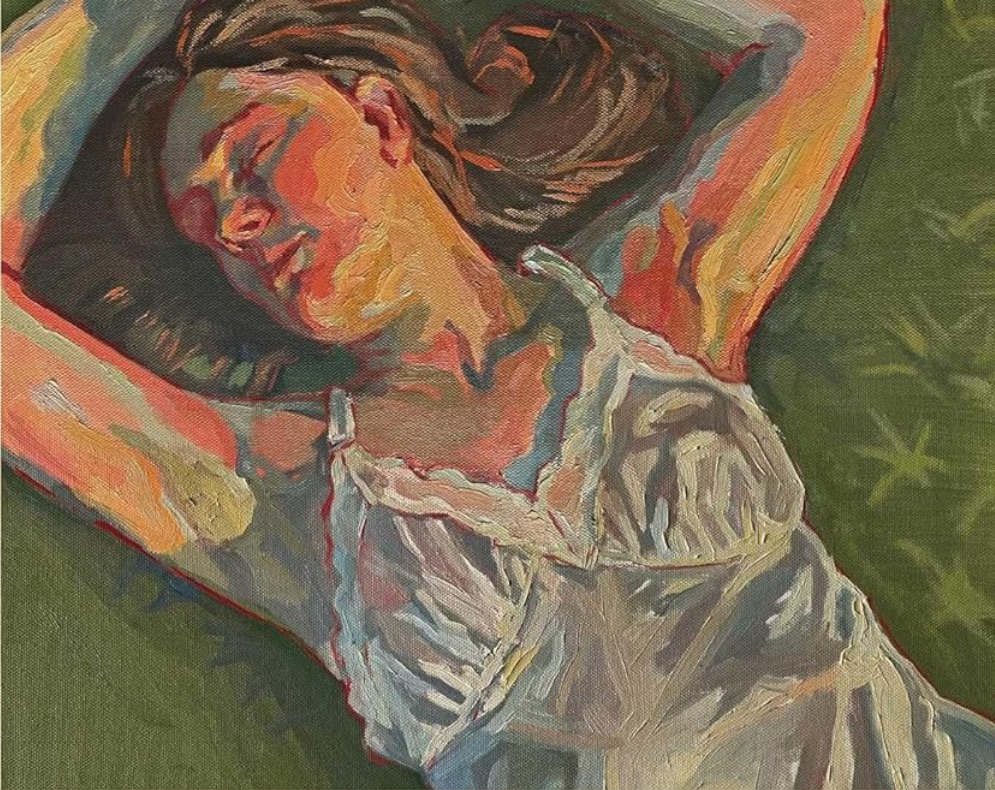
All sleepers seem helpless, snuggled up or spread out limp snoring a little breathing slowly completely at ease maybe some twitches when they dream, but they are not helpless. They are whole. They are sturdy.
She remembered the scandal about broadcasting Elvis‘s pelvis on national television. “Elvis the pelvis,” she’d laugh.
She wasn’t a huge Elvis fan. She liked Johnny Mathis, Ella Fitzgerald, Barbra Streisand, Maria Callas, Broadway show tunes, opera, folk, not so much rock ‘n’ roll.
My mother, she was soft. She was a soft girl, melting on the beach, into the waves, like the sea foam in her poem. Rolling on the beach with a magical someone, merging with the waves, and like seafoam, being swept away, swept away.
My mother wanted to be swept away from her feelings, from her deep, deep insecurity and shame, so much shame, my mother carried so much shame
First for leaving her mother behind at 14, and second for coming back divorced at 21, with a toddler and an ex-husband who was capable of paying exactly zero child support. The shame.
From the infinite promise to the dust of shame, my poor mother.
So sad all the time, she just wanted to blot it out.
Once in a while she’d be happy, once in a while.
That was the rare exception, for my mother to smile genuinely, and to laugh genuinely, and her eyes would clear, and they would look at mine and I could see her in there, not just a wall of shame and fear and alcohol.
A gypsy told me once that my mother was my soulmate, and that my heart broke the day I was born, because she was mine, but I wasn’t hers. That’s what the gypsy said, of course, then she wanted $10,000 to tell me more, which I did not pay, by the way
My mother, where to start?
Like one of the white flowers that smells like heaven, but you cannot touch because you will bruise it, my mother.
Even 40 years after losing her, 40 years later, the rusty sharp knife of it can still get you, right at the belly button. Right there. A kick in the solar plexus, 40 years later, it can still happen. It surprises you.
That’s how broken I was by losing her, broken by the whole thing, the whole sad episode, never on the track of my life again, always having to stay between the lines, for dear life.
Like that time I successfully hydroplaned in my car on the interstate, my child asleep in her carseat in the back, hydroplaned and lived to tell about it at the next rest stop, where I learned that a driver ahead of me hadn’t managed to hydroplane successfully, and their car skied up and over the concrete barrier into the oncoming traffic, and they were instantly killed.
I pulled into the next rest stop, which fortunately was not far, and I could not stop shaking, and my daughter was still peacefully asleep in her car seat. I shook and I shook, and eventually I recovered and drove another 150 miles to get back to my hometown, my dear little hometown.
Boy, did she know how to read between the lines! And upside down, and in a mirror, and in the dark. She knew how to read in Braille, in cuneiform, in emojis. She could read between the lines, and hear the unspoken secrets of many people. Not all, thanks be to god.
Goddess. There is only one woman, she heard in her head. There is only ONE WOMAN. One universal truth. Many fractured mirror truths. Everyone was cracked, somewhere.
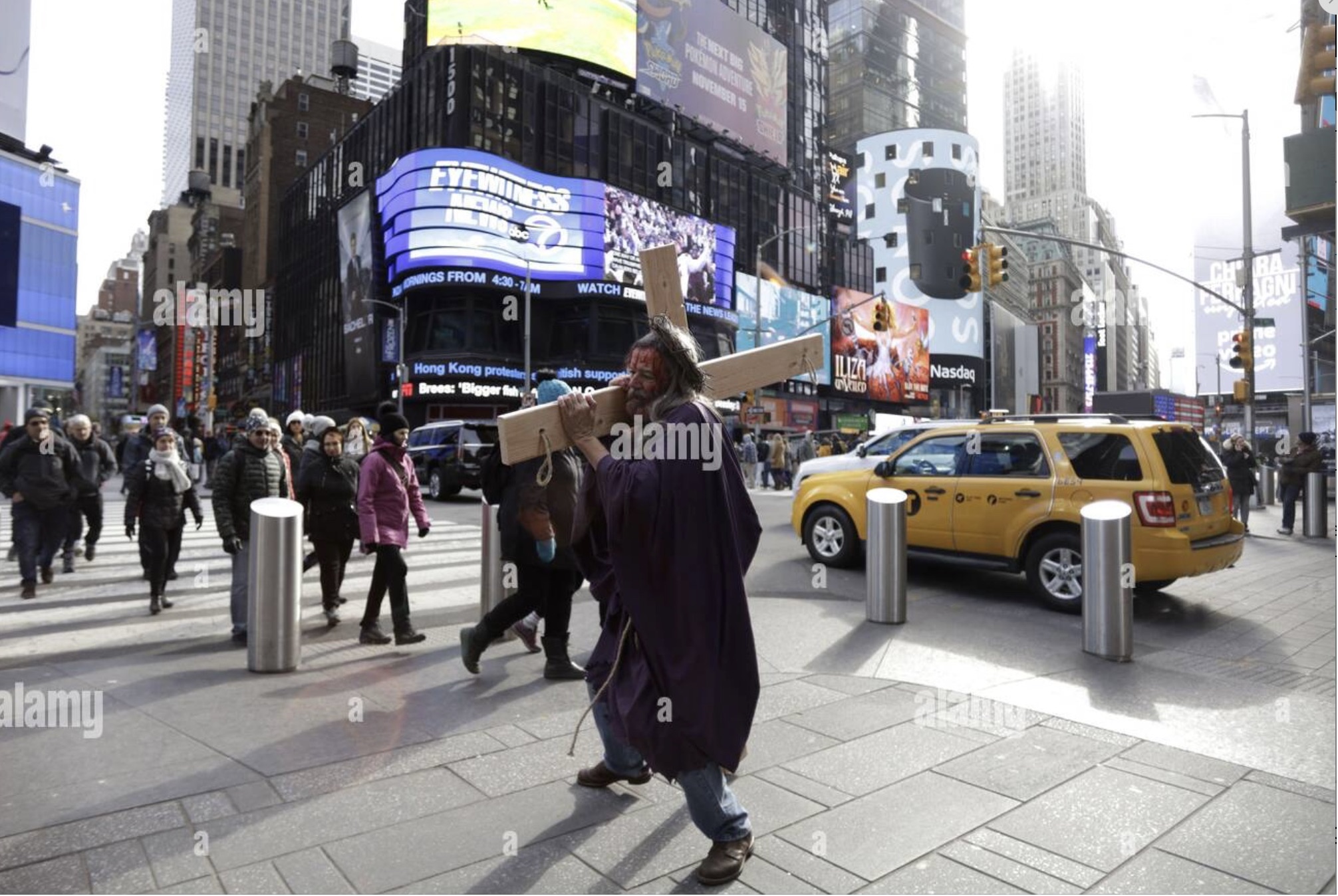
We met Jesus at his gate. My little daughter was so excited she ran up to him & clung to his legs. He put her little feet on top of his big feet & continued to walk forward wheeling his luggage, while she squealed like a parrot.
His suitcase was brand-new & shiny, and it had a piece of purple duct tape on it — JHC, his initials. His carryon bag looked like it had been trampled upon by a multitude. Jesus looked… tired & dusty.
Not what I expected. Always, always, always use waterproof mascara. One never knows when one might find it necessary to cry.
He couldn’t believe what people were doing with his name. The worst kind of identity theft, he called it. Jesus knew swear words that hadn’t even been written yet.
He had a work ethic nobody could fathom. But superhuman, no. He functioned mainly on coffee and chocolate and weed, just like the rest of us.
One late spring, my mother had a fit of nostalgia for her long-lost New England girlhood. As soon as school got out, Granny drove, my mother co-piloted, and I navigated, which meant flipping the pages over on the AAA Triptik. Each page brought us closer to an alternate universe. As soon as we crossed the Florida state line, even the pumps at gas stations along the way were exotic — brands with colorful logos I’d never seen. The morning air smelled rich and foreign and intoxicating. We were in another universe, the language spoken altering with each state line, vowels swelling then contracting like metamorphic rock.
The last day was excruciating. I felt that I would shrivel, grow old and die before we got there. It didn’t help that the night before, at the motel, I’d watched a horror movie where the villain speed-flakes down into ashes and dust because his youth potion — obtained by murdering people and boiling parts of them down into reddish concentrate — spills just before he’s supposed to take it. Method-acting, I too pulled hairs out of my scalp, one by one, and let them fly into the wild unknown out the back window of the car until my mother turned, glaring at me, her mouth half-open in a pinched V.
“Will you please stop it!” she hissed. “I’m sorry I let you watch that movie.” I fell into a sweaty doze and awoke as we left the highway for a series of turns through town. Deanie and Everett’s house was three centuries old, situated on top of a hill. A long driveway meandered around to the back of the house, and just behind that, across the top of the drive, was the barn. A swing hung from the center of the barn door, an soft and ancient rope so thick you had to grip it with both hands, the seat an epic knot at the end. There were milling dogs yapping, nosing my bare legs, as we got out of the car.
***
My uncle owned a large piece of land, and from the back of the house was a view of open meadow and beyond that, an endless grouping of thick green trees that to a sand-and-twigs girl was the forest primeval. The pony that had been mentioned in Katherine’s letters was gone — hoof problems — but that wasn’t enough to mar the promise of the summer.
“Where’s your tan?” asked Katherine’s friend, Betsy. “I thought everybody in Florida had a tan.” She inspected my arms, holding her own next to mine. Her skin was smooth and hot. “You’re whiter than I am.” I laughed.
“I don’t get a tan, even when I go outside,” I said. “It just turns red and peels.”
“You’ve got plenty of freckles, though,” Betsy said, squinting.
“She lives on a canal and they have a boat in their backyard,” Katherine said. “They can ride all the way to the ocean from there.”
I took on a role: sheltered innocent. Things had a way of filtering down. With eight kids, the youngest knew as much as the oldest — maybe more. We were left to run amok. Evenings, the adults played bridge. As a gang, we rode bikes everywhere. One evening, Katherine invited me out after dinner. “We’re going to the graveyard,” she said, with eyes that gleamed the unknown.
“The graveyard?” I asked. I figured she was pulling my leg. “What do you do there?”
“You’ll see,” she said. “Wear long pants.”
I scurried up the steep back stairway to the room I was sharing with Katherine and her youngest sister. When I entered, they broke apart, whispers interrupted. Laughter burst out of Melinda, at six already bored with the goings-on of seven older siblings.
I huffed up the hill behind Katherine. We passed the village crossroads and turned into a small paved driveway. “Hide your bike over here,” she said, pointing to a clump of bushes. “We’re not supposed to be in here after the sun goes down. They lock the gates.”
We walked through the dim woods, the air cool, the moist smell of fallen leaves and forest dirt fragile like perfume. We passed iron gates and what looked like an earthen dugout with a wooden door and sod roof. “What’s that thing?” I asked.
Katherine turned to me, blonde curls stuck to her forehead with perspiration. Her jawbone was delicate but determined. “That’s where they put people who die in the winter when the ground is frozen. They can’t dig the graves until it melts.” I’d never seen snow, except on TV.
“Oh,” I said. We rounded the curve of the gravel road and saw the tombstones. Some were so old you couldn’t read the lettering anymore, the marble smoothing itself out over centuries like embossed paper in the rain. Kat took me to the far end of the graveyard: four kids were in a circle on the ground behind a big mausoleum. A small pyramid with chipped edges sat near them, pudgy and squat like something amphibious.
“Don’t step on the actual graves,” she told me. “Follow where I walk.” She threaded a narrow path from the road to the mausoleum. I saw their bottles, wrapped in brown bags. We sat down and Katherine reached for one. She peeled wet paper and I read: Cold Duck. Pried off with her thumbs, the plastic cork flew over the stone markers, into the woods, landing with a faint thump and rustle in the dry leaves.
We passed the bottles around and I listened as the others told ghost stories. The light was gone and the moon only an anorectic sliver. With our faces dark, voices became harder to hear, as if the sun had been an aid to comprehension; as if we were losing touch with the world itself.
One of the boys, large, slow-moving, looked at me more often than the rest. I was listening to the story about the hook-handed psycho who escapes from prison, when I felt his arm settle across my shoulders. Its weight was astonishing; warmth flowed up my neck and out across my jaw as I tried to pretend the arm wasn’t there, freezing into position and continuing to stare out over the black canopy of trees. His hand moved like a soft, moist crab as he clasped my shoulder, one finger tracing an oval over my bones.
I wasn’t sure what came next but wondered: if I shrugged his hand away, would there be another chance? The critical moment lengthened, drawing itself out with a tense futility, until the decision had been made by default. I said nothing, only widening my eyes the merest bit as I gazed into his. My face moved into an expression of helpless innocence; one of incomprehension and a soft invisible yielding. Awareness dwindled to one compact fiery point behind my left ear. If he moved to kiss me, I would implode with a velvety gray heat.
Perhaps he thought me uninterested, despite my valiant attempt at mental telepathy; perhaps he thought me merely ill. In any case, he carefully removed himself from my flesh: my breathing slowed, though I felt my heart race with a new kind of desperation.
The ghost stories droned on and the last bottle was empty when we heard the whining of an engine, the crunch of gravel. Headlights swung around the curve, sweeping the granite and marble tablets. “The cops,” somebody hissed. “Get into the bushes.” Katherine took off and I followed her heels. We crashed through blackness, twigs scraping and breaking as we flew. We huddled behind the broad trunk of some tree — her hand gripping my elbow like pincers — as the police car drove through the place. When the car was gone, the air was thicker and quieter than before. I could barely see my own feet.
“All clear,” Katherine called, her voice high, wavering, and I smelled her breath, sweet with a bitter under-note of alcohol. I heard snapping and cracking as the others crept through the thick brush back to the grass but we didn’t move. “Wait,” she said as I began to turn away, squeezing my arm even tighter. “I’ve got to pee,” she whispered.
“Me too,” I whispered back. We turned our backs to each other and two solid streams hit leaf mulch. Done, we ran out of the woods, forcing laughter, breathless. The boy who’d fondled me looked blankly in my direction. After a quick series of good-byes, we left.
I stuck close to Katherine’s tail on the way home. We dumped the bikes in the barn and went inside. Everett, Deanie, Granny and the oldest of the cousins, Maryanne, sat in the living room playing bridge around a card table covered with fringed green felt. Some of the others were in the playroom with the doors closed, playing the stereo.
“Want to play pool?” Katherine asked, as we rummaged around the kitchen for snacks.
“Sure,” I said. Avoiding the living room, we circled around by way of the back hall. As we slid open the big creaking pocket doors of the playroom, Granny’s voice rang out.
“Jamie,” she called. “Come in here a minute.” Katherine lifted her shoulders, shrugged, tilting her head. Go on, she motioned.
The bridge table was a patch of bright in the gloom. The wide floorboards creaked under my feet, small snaps and pops as I moved. “Hi, Granny,” I said.
“I was just starting to worry,” she said. “Did you and Katherine have a good time?”
“Yeah,” I said, nodding and smiling with a forced hothouse energy. I held my head at an angle, hoping I looked pert and attentive, while my feet gripped the floor, my calves tight against swaying.
“Come over here and give me a kiss goodnight,” she said. “I’m going up to bed after this hand.” I held my breath as I bent down and brushed her powdery cheek with my lips. When I spoke, my voice was small because I was trying not to exhale.
“Goodnight, Granny,” I said. She reached up, plucking a dead leaf off my fuzzy pullover, then took my hand, squeezing it tightly.
“Good night,” she said. I turned and walked into the other room. Katherine was racking the balls.
“Did they say anything?” she asked, her firm little jaw stiff.
“Nope,” I said. We burst out laughing, doubling over with a weak hilarity that spread through our bodies, magnifying the effects of the Cold Duck, and making us feel as though we were queens of the world.
I was on my way upstairs with a huge stacked handful of oatmeal cookies when I noticed Uncle Everett sitting out on the back porch swing. “Jamie,” he said, his head turning to face me, the light from the kitchen reflecting off his glasses; making his eyes invisible. “Come here.”
I put the cookies down on the counter. He rose as the screen door thumped behind me, impossibly tall, impossibly strong. “Would you like to take a walk?” he asked. His speech was slow, deliberate, and his limbs moved like a dancer’s.
“Sure,” I said. He took my hand in his. He smiled, a gentle, droopy-eyed smile.
***
Everett was everybody’s favorite. He was a good dancer, and he smelled good — hair oil and talcum and aftershave. He had a taste for practical jokes, though not the mean kind. And he was a magician with cards. Once, he showed me how to shuffle fancy, pulling cards from behind my ears and rippling the deck back and forth, taking it over the back of his hand like a baton twirler.
His hands didn’t look fast. They were huge, and he had thick sausage fingers, the kind you’d find on some peasant farmer, except his were smooth and white, the nails not manicured but looking that way because he bit them off precise and even.
We walked down the hill behind the barn. The thin moon reflected off a small spring-fed pond, showing the tangle of blueberry bushes lodging innumerable hard pale berries.
Uncle Everett stopped at the edge of the berry thicket, still holding my hand. He knelt in the soft, downy grass, balanced on one knee, then — losing his balance slightly — planting the second. I saw his face in the light, and the two trails that swept down from his eyes, gleaming. “You know, your mom is so beautiful,” he said; I knew he was weeping not for her, but for me. He reached out and touched my chin with his hand. “Do you miss your father, Jamie?” he asked. I said nothing. He took his hand away. “I’m sorry,” he said, wiping his eyes with his fingers. “Your mother would kill me.”
He smiled and a few leftover tears plopped out, rolling past his jawbone. He stood up, leaning on my shoulder and brushing at his pants legs with one hand, but it was too late — the dew on the grass had seeped all the way into the fabric of his chinos. I could see dark spots where his knees had touched the ground in front of me. “You won’t tell her any of this, will you?” he asked.
***
Next morning, I was breaking out with blisters and so was Katherine. Poison ivy, in the bushes where we’d hidden from the police. We tried to keep covered with long pants and sleeves, but the rub of cloth and the increased perspiration made us more miserable. Aunt Deanie was a safer bet than Granny or my mom. We huddled in her sewing room with the door closed while she phoned the doctor.
She hung up, turning to face us. “I’ll have Everett pick up the medicine.” We made to leave, but Deanie reached out and tapped my shoulder. “Jamie, could I speak to you for a minute, please?”
I looked at the knitting machine and skeins of wool — some new, still wrapped in paper, some rolled into balls, reclaimed from children’s outgrown sweaters to be recycled into new ones. I reached out to touch the wool; Deanie picked up the skein I fondled and smiled. “This one is for your Granny’s Christmas present,” she said. “Isn’t it pretty?”
“Yes,” I answered.
“Would you like me to show you how to knit sometime?” she asked. The down above her upper lip was turning darker as she approached menopause — small, round beads of sweat dotted her skin there, clinging gemlike between the tiny hairs. I never sweated like that. My sweat dripped like my father’s — though I resembled my mother and her high Yankee family on the outside, his Bohemian blood in this way stayed true to itself; undiluted.
“I could never do that,” I said. “My mom tried to teach me to crochet and that was bad enough.”
“Anyone can do it,” she said, laughing. She started putting stray knitting needles in a maroon satin roll-case, arranging them by size. “How did you and Katherine get into that poison ivy?” she asked.
“We had to pee in the bushes,” I said. “It was dark.” Deanie didn’t look up from her needle-case. “Not that I would know poison ivy even in the daytime,” I added. There wasn’t a whole lot of unspoiled nature in Fort Lauderdale.
“Uncle Everett called your father yesterday to tell him you were here,” Deanie said, still not looking up from her sorting. “I don’t know why Everett got himself in the middle of this,” she continued. “I know your mother will be angry.”
“Maybe he thought I should see my father,” I said. My face got hot and tingly.
“Everett told him it was up to you,” she said. “I’ve got your father’s number here, if you want it.” She held out a yellow pad covered with doodling — stacks of heavy triangles. Her eyes were blank as she stared over the top of the half-glasses she used for handwork.
The phone was bright orange; over the place for the number somebody had taped a card reading Deanie’s Nip and Tucker Shop. My hands were damp and the receiver nearly jumped out of my hand as I pressed it to my ear.
“Dad? It’s me, Jamie,” I said when he answered.
We agreed to meet — Everett would drive me. The drug store downtown had a sandwich shop where my father and I could have lunch. On the way down the long driveway, Uncle Everett began to sing One Hundred Bottles of Beer on the Wall, poking me with his elbow after every chorus until I couldn’t help but laugh. There were still forty-five bottles left when we pulled into the parking lot. Even though I was expecting it, seeing my dad’s beat-up, rusty VW van made my breath come faster.
“I’ll wait here,” said Uncle Everett. He put his arm around me, compressing my shoulders with its weight. His eyes shone with an earnest glaze; I almost wished he wasn’t being so understanding. He had no inner core; every current in him swirled right up to his skin. He didn’t realize that made me want to hide myself deeper still.
I didn’t remember my dad being so bald. The last time, he’d still had a thin fisherman’s ponytail, tied with a piece of leather. Now, there was only one thick, tiny clump left on top, right in front, down low over his forehead, where his hairline had been. I knew at a glance he had done the best he could with it.
He ordered a root beer float. I got a double butterscotch sundae. I dug the spoon in, twirling it into the whipped cream and nuts, syrup strings like melted cheese, snapping into gossamer threads as I lifted the spoon and swiveled the bowl with my other hand. He reached out and tapped my wrist three times, an interrogatory tempo.
“How would you feel about seeing each other more often?” he asked. The root beer bubbled in the thick soda glass; the scoop of vanilla was melting, spreading a pale creamy brown lake. His straw lay on the counter, paper half torn off. A set of curved scabs on the back of his hand looked ready to come loose.
“What’d you do to your hand?” I asked, crunching nuts between my teeth.
“Burned it on the boat engine. Answer me, Jamie.”
He turned on the creaky stool to face me; I looked straight ahead, too intent on my sundae. I wondered if they had ever really been married — where was the documentation? I hadn’t found one photo, one letter, one Valentine card from him, while rifling my mother’s drawers. She’d saved everybody else’s love letters — even nerdy stuff from the eighth grade. Your mother sure liked the boys, Uncle Everett would say in front of us, teasing her.
“Mom’s afraid you’ll try to kidnap me,” I said. I spooned another glob, then turned to him. “I told her even if you did, you couldn’t keep me, not against my will. I know how to use a phone.”
He waited, staring at me, his eyes cold, the pupils contracted, leaving behind such a uniform and piercing blue that I felt sure he could tell what I was thinking.
“I’d rather try to talk to her myself, first,” I said. “Then, if that doesn’t work….” I shrugged.
“Don’t you think we’ve waited long enough?” he said. He picked up his straw and blew on it, the paper shooting out, dropping behind the counter, the waitress giving him an irritated look. He looked down at his float, stabbing what was left of the ice cream with the straw. “Guess I like it melted.”
“I know, Dad,” I said. “Let me try.”
“Okay,” he said, and he twirled his straw in the soupy float, bent over swallowing, his lips pursed, as if he were smoking a cigarette.
We browsed the magazine and souvenir section. Hanging on a circular rack were plastic-wrapped packages of T-shirts. Dad picked one that said Save The Whales.
“Is this your size?” he said. I knew he wanted to give me something. I thought the T-shirt ugly, but I nodded.
“Call me collect, anytime,” he said, as I stood near the electric exit door. I stepped on the black mat and the door jerked open, the air outside a hot bath after the ice cream and air conditioning. I turned my head to look at him again as the door began to close and he stepped back on the mat, holding the door open with his foot, wrapping his arms around me and kissing the top of my head. “One month,” he said, and then he moved away, off the mat and back into the drugstore: the glass door swept closed behind him.
At dinner, my mother stared at my whale T-shirt, one eyebrow raised. I was wearing the shirt not because I liked it, but because I knew — even without having discussed the topic of whales with her before — that she wouldn’t. “I didn’t know you were into that environmental stuff,” she said. She laughed and looked over at Everett at the other end of the table. “And how much did that charming garment cost you, dear brother?”
Before I could open my mouth, Everett spoke. “Not a cent. Her father bought it for her today.” He grinned at my mother, knowing she’d back down for him. Mother glanced down at her plate, her lips pressed together; a small sound came from her nose — a quivering kind of snort, something she usually uttered after heavy drinking. She brushed her hair behind one ear and fiddled with a length, twirling it until she let go and it snapped away, spiraling back to normal. She started to say something; Granny interrupted.
“I think it’s a nice shirt,” Granny said. She smiled over at Everett and patted my shoulder.
“Thanks, Mom,” said Everett, and, leaning his head to one side, he sneaked a wink to me.
“Well, I guess now that you’ve ganged up on me, I might as well surrender!” Mom said, shrugging her shoulders. She stood, pulling her long legs out from behind the farm-style bench we sat on. She flapped her napkin over her head as if she were waving to a departing ship. “Save the goddamned whales!” she shouted. We all raised our napkins, drumming the wooden floor with our heels, bleachers-style, until the silverware lying on the table rattled with the floor’s vibration.
Everett leaped out of his chair, grabbing my mom from behind and twirling her to face him — as if she were a doll — sweeping her around the table in an oddly timed silent waltz and shouting above the din, “What a heart, oh, what a heart!” My mother’s hair flew back off her face, and a light veil of perspiration shone on her forehead. She dragged behind him clumsily, weak-kneed from anger.
As I watched her face, the walls of the room seemed to move outward, her twirling figure becoming more and more distant until the light itself turned bluish and semi-opaque, as if I were underwater. For the thousandth time I strained imagination to picture them together: my father, my mother, clinging in delicate lushness, some kind of slow-motion rolling under bedclothes, a mouth brushing a mouth, fingers trailing a web of pleasure over bare skin; the moment of beginning. It nearly came, then turned as preposterous as always; instead, all I could envision was the face of the boy in the graveyard, his cruel lips, and his blank eyes.
“I surrender,” my mother kept gasping, as she continued to dance with her handsome brother, her head bouncing forward against his chest as he swept her around in dizzy circles, like a man intoxicated — her voice choked and hoarse, so that I could barely hear her over Uncle Everett’s own rounded laughter. “I surrender, I surrender.”
You were not built to carry the weight of this world, said God. And yet. It is upon you; you feel it heavier each day.
Your prayers have been shouted & whispered, in communion & all alone. There are four thousand languages in this world, God said. Don’t you think I can speak every one? Never be afraid to grieve; to cry; to pound the ground; to bang a drum on a beach somewhere; to dance before the fire of your own soul.
And don’t be afraid to make your own mark, God said. On the wall of a cave, on some paper, on a server, in a cloud.
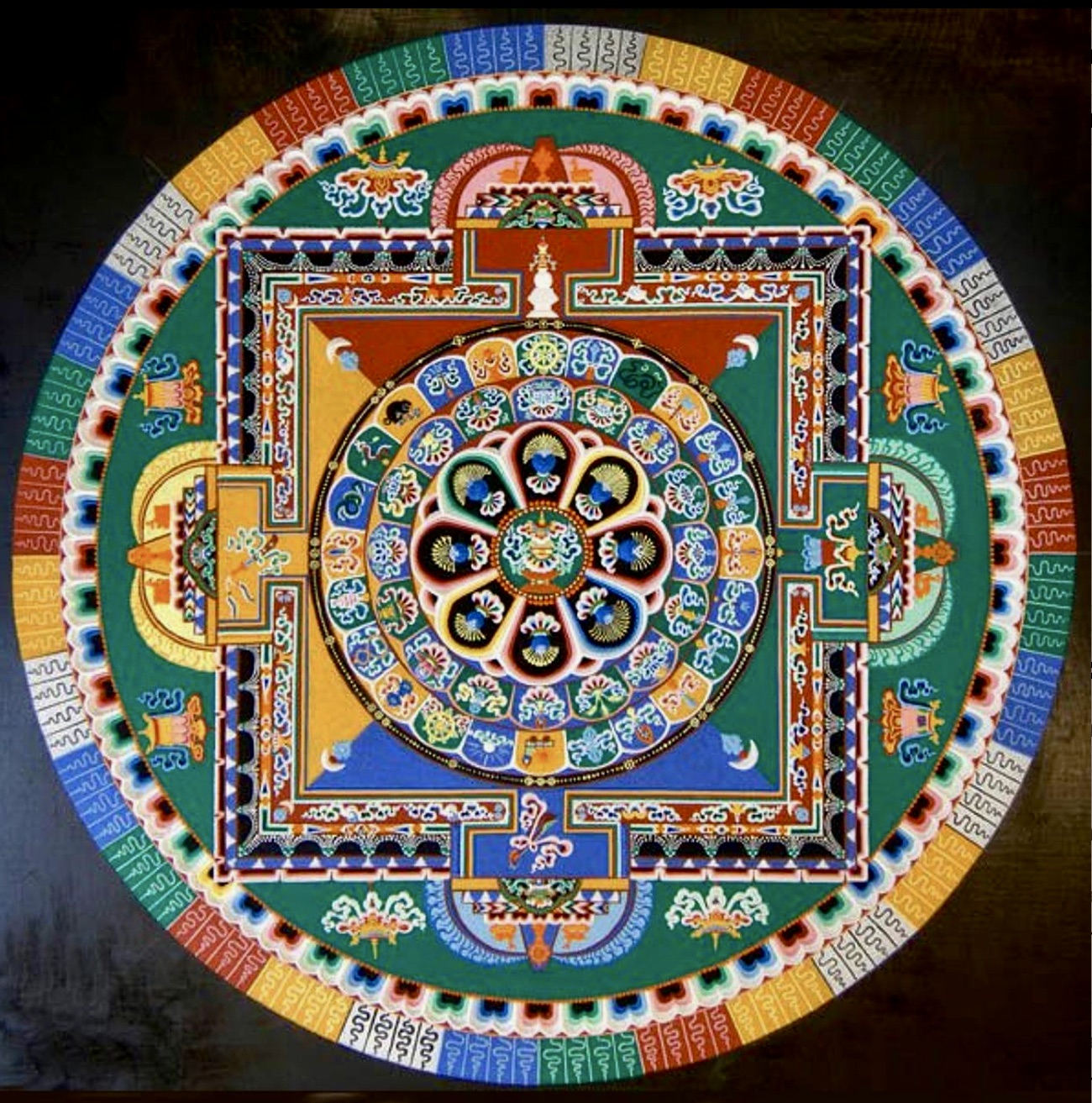
Do you need a map? Some create their own — mandalas with colored sand, swept away after three days.
There are so many ways to pray, and the most important way is kindness, said God. You, my beautiful daughter, will begin and end with a simple breath — and you, my well-loved child, were not built to carry this weight, the weight of the world.
You were not built to carry the weight of this world. And yet. It is upon you; you feel it, heavier every day. Your prayers have been shouted and whispered, in communion and all alone. There are four thousand languages, in this world. Don’t you think God can speak every one? Never be afraid to grieve; to cry; to pound the ground; to bang a drum somewhere; to appear naked as a jaybird, before your maker. And don’t be afraid to make your own mark, on the wall of a cave, on a server, in a cloud. Do you need a map? Some create their own, mandalas with colored sand, swept away after three days. There are so many ways to pray, and the most important way is kindness. You, my beautiful daughter, will begin and end with a simple breath — and you, my well-loved child, were not built to carry this weight, the weight of the world.
Sometimes we must learn to live with uncertainty, the priestess said. Sometimes we must endure the unendurable. She smiled at me. Come take a walk, she said. Let’s walk over there, under those trees. That pine grove over yonder. Under those quiet pines, on the hush of the needles. Let’s make a basket out of them. Let’s walk to the spongy banks of the creek & watch the salamanders wiggle across the damp. Let’s phone home, and listen to your mama’s voice. Go ahead, let us surprise ourselves by crying.
The woman sits up all night, listening to it rain. The woman has often sat up all night waiting for one thing or another to either leave or arrive: bandaged fingers, whooping cough, her own lookalike grandchildren. When she can, she sleeps next to her dying mother in the king-sized bed; she bangs her own shins on the high rails, climbing in. Her arms and hands are able to lift the wasted body of her dying mother with amazing ease.
She watches & waters the great rack of African violets in the living room; grows wheat grass for her mother’s cat. Other times, she sits in a high-backed wooden chair, needlepointing forests in wool, chain-smoking for hours. Her mother will die very soon; then the daughter will put on her navy dress with a large, elaborate organdy collar and fail to draw a deep breath for several days. The woman’s several brothers and their children will fly in from all over the country, and flower offerings will dwarf the grave itself.
After the burial, the woman will pack all sorts of mementoes into her mother’s old cedar “hope” chest: yearbooks, diaries, photographs, diplomas, invitations, programs, baby booties, baby spoons, baby cups, even a rather grisly alligator purse, complete with the head, legs, tail & feet and sharp black claws. When she has nightmares, more often now, she sits up all night, her fluffy gray tabby queen on her lap like a hot-water bottle. The cat’s purring leads the woman away from the perilous mountain passes & rocky cliffsides inside her head and back to level ground, so she can help her mother die properly. That is what proper love looks like, she thinks.





 Kimberly Townsend Palmer