Tag Archives: peace

Please Speak Well of Me When I’m Gone, a 397 word short story

illustration please speak well of me when i'm gone

Please Speak Well of Me When I’m Gone, a 397 word short story

October 11, 2012

5:00 a.m.

I had the strangest dream, where I was back together with K!!! We were together in this hotel room, packing our stuff, which was a lot, and getting ready to ride on a plane somewhere (what else does he do these days, but ride on planes!). It was as though we were back together, after all these years, something had happened; our subsequent, real-life remarriages were never mentioned. Clearly, we knew it was awkward that we hadn’t been together in so long — but there it was, we were going to try it. We didn’t have sex in the dream, although it was clear both of us were sort of thinking about the concept. But we weren’t anywhere near ready for that! And when I awoke, I started thinking about how sometimes I get confused about my life, about the sharp turns, the complete disconnections from my entire past life, etc., and how sometimes I don’t recognize the current terrain.

And why have I been thinking so much about K. these days, like that song by the Weepies, “Speak Well of Me When I’m Gone?” The one that has made me cry so many times? “I’ve been away, a year and a day….” That’s true of so many people in my life, isn’t it? Only they’ve been gone far longer than that: some have been gone for 35 years. How young, and blind, and ignorant, and how many horrendous mistakes it’s possible to make, etc.

“Looking back now, I only wish I had been kinder.” It’s the truth — some part of me has never stopped loving K. “And when I’m gone, please speak well of me.” Some part of me wishes we had worked out, because he was the first truly committed relationship I had, the first husband, the father to my first child, so many firsts. I met him when I was 22. He was 27.

Wouldn’t it have been sweet, had it worked out? Almost like high school sweethearts. Young — I was so young, so inexperienced. God! And I would apologize to him on my knees, if it would do any good. He wouldn’t, I don’t think, be able to hear me. The way I would want it to be heard. Still, I could try, couldn’t I?

4 Comments

Filed under apologia, apology, divorce, justice, karma, kindness, love, marriage, mea culpa, men, mysterious, personal responsibility, regret, relationships, short stories, women

The Way Love Is Supposed To Be, a very, very short story

illustration the way love is supposed to be

I wanted to run upon the moors with tears streaming down my face.

She treated him as if he were a rajah, wearing a satin robe and slippers.

Don’t ever marry an accountant.

You’ll laugh, but I cried.

Her radar had failed her over and over again.

Men were tricky.

She danced the samba, then the tango, in the arms of a smelly Russian with piercing blue eyes who fancied himself a ladies’ man.

I would never marry someone who ogles women right in front of me. At least, not until I’ve started ogling them, too.

My Mama loved mohair; I loved angora. We were opposites.

Move your ass and don’t take a year.

I felt at sea for most of my thirties. The forties couldn’t be any worse, I thought. Wrong, wrong, and wrong!

I plodded, envying the agility of those around me with obviously higher serotonin levels. When I studied those brain chemicals in college, I didn’t know they’d turn out to be so important.

Redial that oily odor; a ray of water consoles the jilted; all beds of roses rot eventually; be brave and rest; the noose leads to the abyss; don’t gouge the luge, egad! Lazy seared meat; too addled to ladle. Baba rhum; Joanne Arel/Aral; raison d’etre; brave agar; the smell of water; conic Eros; seed the boo-boo, Sergeant. I came, I saw, I conquered; day-O, me say day-ay-ay-O; I say, Merv, that canary sure can sing!

Canary Conn? Transsexual on Merv Griffin. Breathtakingly beautiful, not a man in drag.

At this rate, we’ll never get there. Or perhaps, we are already there and are too stupid to know it! Dogs vs. cats… different, not better or worse. Different is GOOD.

No one’s a fool.  At least, not forever.

2 Comments

Filed under evil, god, good, justice, karma, love, mysterious, short stories

Why I Hate You, a poem

illustration why i hate you

Why I Hate You

You know why I hate you?  You’re a weak vine, needing to be propped up, needing more comfort than a baby.  You imagine bugs, crawling up the walls, down your hair.  Their wings whir in the night like soft sobs.

I hate you because you’re ugly — a slob, a slut, a sucker.  Because you saw your mother passed out on the carpet in front of the television, one too many times, but you didn’t kill her the way she wanted to be killed.  You didn’t help when she needed you.  Because you let yourself be unimportant for so many years and did nothing to help yourself until it was too late, until you’d already lost the war.  Peace came on unfavorable terms, the enemy couldn’t be placated.

I hate you because you’re afraid of the dark.  When you’re with a man, you lean on the solidity of his body, the real beat of his heart, you listen to his rhythmic breathing, and you’re not afraid anymore, but you start to get antsy.  His body sounds so much stronger than yours.  They don’t cry the way you do.  Does that mean they don’t feel?  Why do they want to be with the likes of you?  You don’t have the slightest idea what you want from them.  Late at night is the worst.  The stars unfold ahead of you, and you can’t find your way to the future, stupid bitch.

That’s when I hate you the most.  You’re utterly without honor.  You imagine your ex-husband, fat and happy in his bed, eating candy.  He doesn’t suffer like you do, he has already forgotten why he married you in the first place.  He is perfect.  He is way above you in the cosmos, he is light, reason.  Your life is insignificant, ignorant and small, and won’t leave a shadow.

Leave a comment

Filed under karma, love, poetry, prose poetry

president barack obama is being quoted out of context by the radical fringe right, and I’M SICK & FUCKING TIRED OF THIS SHIT

illustration president obama

the full text of president obama’s speech in which he advocates FOR democracy, not AGAINST it. a paragraph is being circulated, ENTIRELY OUT OF CONTEXT, to defame him. I WON’T STAND FOR THIS SHIT.

“And it was here in Europe, through centuries of struggle, through war and enlightenment, repression and revolution, that a particular set of ideals began to emerge, the belief that through conscience and free will, each of us has the right to live as we choose, the belief that power is derived from the consent of the governed and that laws and institutions should be established to protect that understanding.

And those ideas eventually inspired a band of colonialists across an ocean, and they wrote them into the founding documents that still guide America today, including the simple truth that all men, and women, are created equal.

But those ideals have also been tested, here in Europe and around the world. Those ideals have often been threatened by an older, more traditional view of power. This alternative vision argues that ordinary men and women are too small-minded to govern their own affairs, that order and progress can only come when individuals surrender their rights to an all-powerful sovereign. Often this alternative vision roots itself in the notion that by virtue of race or faith or ethnicity, some are inherently superior to others and that individual identity must be defined by us versus them, or that national greatness must flow not by what people stand for, but what they are against.

In so many ways, the history of Europe in the 20th century represented the ongoing clash of these two sets of ideas, both within nations and among nations. The advance of industry and technology outpaced our ability to resolve our differences peacefully. And even — even among the most civilized of societies on the surface, we saw a descent into barbarism.”

1 Comment

Filed under assholes, con man, con men, criminal, criminal behavior, criminals, hypocrisy, idiots, jerks, karma, legal writing, mysterious, notes, tea party mad hatters, ultra right wing loons, users

Heavenly Dances, Heavenly Intimacies, a short story

illustration heavenly dances heavenly intimacies

Heavenly Dances, Heavenly Intimacies, a short story

“Isn’t there any heaven where old beautiful dances, old beautiful intimacies prolong themselves?”

Ford Madox Ford, The Good Soldier

How can I be “dead” to any of the men I once loved?  They are not “dead” to me.  Not even H.  How can I be “dead” to H.?  They — even H. — are each as alive as when I was with them; as alive as the first time they touched me, whether tentatively or with confidence; whether softly or roughly; whether with passion or mere lust.  It is shocking and appalling how H. lurched so radically to the right after 9/11.  He began that journey to the Tea-Party-Mad-Hatter-Neocon-Bill-Buckley-Wall-Street-Apologist-Fringe-Brainless-Faux-News-Right when Ronald Reagan was shot; I was with him the very night it happened.  We had a short affair, right then, because we started thinking the end of the world had arrived and we decided, like the crazy college students we were, to get married to celebrate our courage in the face of chaos!  I realized very early on (but still way too late!) I was embarrassed to be seen in public with him.  Did you ever start seeing, and marry someone whom you later realized you were embarrassed to be seen with?  Perhaps the person in question was “dorky,” “geeky,” dressed “badly,” or had questionable “taste.”  H. readily admits he was a “dork” in high school.  He was on the debate team; need I say more?  When you can’t bear to be seen in your lover’s/spouse’s/significant other’s/partner’s company, things usually don’t work out.

Still, I put in ten dutiful years, trying to make amends for my mistake in marrying H.  The second he started making the big bucks, he dumped me.  He left me for my best friend!  I guess I deserved it, not taking control of my own life & filing for divorce two weeks after we married.  And I guess I deserved how my ex-best-friend S. ruined me, as she subsequently did.  She was in charge of the whole group we had socialized with:  dictating how everyone in our “circle” should think, speak, act, or react.  H. was dead wrong about most everything, but, to his credit, he was dead right about her.  At the time I thought him merely woman-hating, but I see now, even though he did hate women, there was something more than simply being a “woman” he hated about her.  He was covering up the fact he loved her by pretending to hate her.  Now, I have no desire to see her, not ever again.  She is definitely “dead” to me.  Yes, I understand intellectually, a living death (call it shunning) can happen to anyone.

The upshot of all this boring history?  I’ve been waiting for something a long time.  I can’t blame anyone but myself for my unhappiness, not anymore.  There is something dispirited inside me, something empty, drained, and beaten — something sick, something tired, something that has surrendered.  I gave up, when?  When my first ex-husband arbitrarily said no to children, breaking his solemn vow.  When I realized I couldn’t find happiness outside myself — not with an old love, not with a new love, not with any of my subsequent husbands, my friends, my eventual children, or my family.  Yes, to casual acquaintances and virtual strangers I am “happy, happier than I’ve ever been.”  And it’s true!  I’ve never been this happy, this contented, in my life.  Yes, there are still problems.  My oldest son is still half the world away, fighting an endless war on behalf of my “country.”  My youngest son still has an ignorant, racist, rabidly conservative father.  I am getting old.  My face is melting.  My neck is turning into a wattle.  I am drooping.

Still, I cannot imagine any of them, the men I have loved or made love to, being dead to me the way my former best friend, S., is dead to me.  Yet that is how they must feel about me, the way I feel about her.  Wanting her removed from my memories.  Wanting never to have met her.  Not missing anything about her.  She wants to see me, I heard from a mutual friend I still speak to.  I don’t want to see her, or even see the mutual friend.  I don’t even want to get as close as that!  Because of reasons.  Top secret, NSA, DOD, CIA, FBI, SEC, IRS, FDLE, GPD, ACSO reasons!  No further comment!

1 Comment

Filed under artistic failures, assholes, boys, con man, con men, criminal, criminal behavior, criminals, fathers, he, health, humor, hypocrisy, idiots, jerks, karma, love, mothers, mysterious, sex, short stories, tea party mad hatters, ultra right wing loons, users

Suffering Jets, Bowling Litionists, and Peace Knicks, a fable

illustration suffering jets bowling litionists peace knicks

Suffering Jets, Bowling Litionists, and Peace Knicks, a fable

My mom’s always trying to teach me History.  She says it’s important for us kids to know all the bad stuff that happened in the olden days so we won’t be as stupid as all those olden people were.  My mom seems really mad at those olden people.  She says human beings could have lived in a “paradise-on-earth” if it wasn’t for a whole bunch of bad ideas they thought up and then were stupid enough to get stuck on.  Just as if they were GOOD ideas!  My mom thinks good ideas are real important.  I’m not so sure because I can’t always tell the difference between one of her “good” ideas and one of the olden people’s “bad” ideas, but I’d never tell her that because if I did I think she’d go nutsy-futsy just like Nadine Houck’s dad did, and then I’d be pretty much alone except for that mean bunch of kids living on that hill up from the lake.  They’re not mean so much as they are just pissed because nobody’s really around to care for them and make them read their schoolbooks every morning.

Anyway, my mom’s always trying to teach me History, and so I try to learn it.  Like today, she got started on the “god-damned East-West mutual suicide pact.”  She says that back when there were lots of olden people, (she says there were BILLIONS, but that nutso-futso and I don’t believe her), everybody actually KNEW what would happen if there was “an all-scale nuclear confrontation.”  Like, they made TV shows and movies about it, and people wrote all kinds of books and stuff, and they had big “world conferences” and all, and lots of people even made stuff for people to buy so that when the “all-scale nuclear confrontation” came, they’d have water to drink and canned peas and tuna fish and EVERYTHING.

And like people even built bomb shelters in their yards and stuff.  My mom says this is “evidence of the world-group insanity” of the early twenty-hundreds and that I should mark it WELL in my soul.  So anyways, all the olden people actually KNEW what could happen and all.  Which is real hard for me to believe sometimes. Like if my Mom and me actually KNEW that the roof of our house was going to fall in, and so we bought big steel umbrellas and helmets and stuff, and kept living right in the SAME actual house but all the time acting real worried about the roof caving in and talking like MAD about how to prevent it and all, but really not doing anything to brace the ceiling.  And EVEN having some guy show us pictures of what our blood would look like spread all over the floor.  But then we’d just buy bigger steel umbrellas and harder helmets but we STILL wouldn’t leave the house.  Damn, isn’t it hard to believe that those dumb olden people could actually ACT like that?

So anyway, the whole of Earth really, really KNEW that they were in a big pile of trouble.  But people did ALL sorts of stuff to “distract their lunatic sensibilities,” my mom says, and they’d do stuff like jump out of big airplanes to feel what it was like while all the time they just kept stocking up on the god-damned steel umbrellas and helmets.

My mom said that one time in the middle of the twentieth century and towards the 70’s some olden people actually and truly came to their senses and try to yell loud at all the “sleeping fools,” my mom says.  She says that she read all about them in college and always wondered why they quit yelling.  She says that groups of good people would get together all down in history, but that as soon as they had “achieved their one objective goal,” they would trickle down and eventually dry up.  She talks about the Suffering Jets and the Bowling Litionists and the New York Peace Knicks and that they all lost their momentum in the end.

Anyway, my mom says that HER theory of what in HELL happened to people is they had plenty of guilt, but no feeling of responsibility to go along with it.  Like they felt bad about their “sins of omission” and all, and they hung their heads about it, but what it REALLY was, was just “crocodile tears.”  Like they would say, “Gee, I feel SO guilty, but gee, if I felt guilty about every bad thing in the world I wouldn’t be able to SLEEP at night and my face would break out and I wouldn’t be having FUN and stuff.”  Like they had a mental maturity age “of about three,” my mom says.

4 Comments

Filed under for children, humor, mysterious, notes, prose poetry, science, short stories

my oldest daughter wrote this in 2007

illustration for abigails 2007 note MOVED_by_Miccy

I have come to realize that I’m upset mostly because I’m trying to make my life something that it’s not. It once was, but it’s not anymore. The friends I used to have are not my friends now (not all of them, mind you), and the friends that left me when Mike did, were never my friends. I’m not meaning to be sappy, depressed, melancholy, or even trying to evoke some sympathetic reaction (pathetic being the operative word). I am merely acknowledging the fact that what I do have, the people who care about me and are still with me, I have been ignoring in favor of the things that rejected me. Why? Because I hate change. I hate change so much that I make myself pathetic by clinging to it, like a child would its mother’s leg on the first day of pre-school.

Mike was my connection to the world I was leaving. I wanted to hold onto him so that I could straddle that line between new and old, and never really have to face the new for what it was–my life. It was a security blanket that I was happy to carry around until there was nothing left but threads and a memory, and who knows how long it would take it to get there? 30 years? 40 years? 50 years? Was I going to spend my life reminiscing about “the good old days”, or was I going to take charge and and cherish what was infront of me instead of turning my back and mourning what was behind? I’m not an activist. I sit back and wait for things to happen, and I end up being left behind. I waited SO long to apply to SFCC that I was scared they weren’t accepting applications anymore. I took the SAT my senior year, and only once. Never the PSAT. I always want to do things “later” in hopes that somehow they will work themselves out and I’ll never have to deal with it.

But no more. I realized all this, and I realized EXACTLY what it was that I needed to do to raise my spirits.

I thank all of you who accept me, who care, and who love. I am so greatful to have you by my side, and marvel at how lucky I am to have so many people so close to my heart. And to all of you who I don’t really mean anything to: I truly am sorry that I wasted so much of my time trying to pull you back to me. None of you are bad people, in fact I like many of you, but you can’t be friends with everyone. And I realize that now. So to my friends: I love you. You have helped me in ways unimaginable, just by being my friend.

So, to conclude, I am a graduate of high school, I am going to college, and I will take charge and welcome change. Change can bring very good things. And if it doesn’t? Well, I’m sure that will change.

1 Comment

Filed under mysterious, notes, recommended reblogs

True Love, a short story

illustration true love

True Love

            Mythical, that’s how they looked — when she got up close, she experienced both hormonal lightning flashes and the peculiar sensation of having a trick knee.  The famous Gower brothers:  high foreheads, broad shoulders, meaty yet sculpted forearms.  Granted, for Amy, myth and heroism consisted of “Jason and the Argonauts,” and the Classic Comic Books version of “The Iliad and the Odyssey,” but she was on the right track.

“This is Amy,” said her friend Claudia.  She stood with her arm across Amy’s shoulders.  “This is my ex-husband, Burnett, and this is Carey — we call him Shorty.”

It was admirable the way Claudia and her ex hadn’t let their divorce get in the way of business.  Amy wondered if she were capable of such sophistication — perhaps it was bound up with the Bohemian temperament musicians were supposed to have.

“Nice to meet you,” Amy said.  “I’m enjoying your music.”

“Thanks, Amy,” said Shorty.  “That’s what we like to hear.”

“Mind if I sit here?” he asked.

“No, please,” she said.

He chewed his little red straw, stirring his drink with a finger.  The gesture was boyish, clumsy.

“How long have you been playing here?” she asked.

“Six months,” said Shorty.  “The owner is a jerk, but he’s hardly ever around.”

“Well, I’m glad the band stayed together,” said Amy.  “This is the most fun I’ve had in a long time.”

He tossed his head, and gave her an aw-shucks-ma’am grin, showing his teeth and squinting his eyes.

“Me too,” he said, touching her arm.

“You’re just as pretty as Claudia said you were,” he said.

“Oh, I bet you say that to all your groupies,” she said, laughing.  He laughed too, squeezing her arm.  She felt his large fingers against her skin, the calluses on his fingertips.

They had another job tomorrow night, he said, over at Lazy Susan’s.  Would she like to come listen?

“A friend of mine is having a party we could go to,” he added.  “It won’t get cranking until around two a.m. — you know, a bunch of musicians.”

“Sounds great,” she said.

“Stay for the next set, won’t you?” he asked her, tipping his glass to drain it.  The lime wedge fell on his nose, and he laughed, then put it in his mouth and sucked the pulp.

She sipped her wine.  A bit drunk, she was relaxed even more by the sound that poured over her, brushing her skin like velvet.

When the music was finished, Shorty walked her out to her car, opening and closing the door of the little Datsun for her.  Squatting on his heels, he rested his elbows on the open window, leaning his chin on his hands.

“I don’t do this very often,” he said, his face dusky under the streetlight.  “Ask anybody, they’ll tell you.  I’m not a flirt.  I don’t operate that way.”

He took her hand and held it, shaking his bangs out of his eyes.  Staring at her, his eyes were sleepy-looking.

“Yes, ma’am, it’s been a real pleasure,” he said, drawling the words out, going corn-pone, laughing.

***

Shorty was sweet, honest, Claudia said, a guy who would do anything for you.  It was true, he didn’t pick up women.

“But he’s kind of involved with somebody,” she said.  “It’s a weird thing:  they’re separated right now.  I know he’ll tell you himself, so don’t say anything.”

“Separated?”  Amy said.  Gruesome visions of surgery flashed in her head, the kind used for taking apart Siamese twins.

“Well, he and Bonnie have lived together, off and on, for years,” Claudia said.  “Lately, it’s been mostly off, but neither one of them has ended it.”

“Where is she now?”  Amy asked.

“Dallas.  She manages a restaurant out there.  Some relative of hers got her the job.  Everybody thinks she’s been bad to Shorty.  He needs to get on with his life.”  Claudia shrugged.

“I don’t understand how people can live like that,” Amy said.

“I know,” Claudia said, sighing.  “So if you get close with Shorty, you better keep Bonnie in mind.  They go back a long time.”

“I’m not looking for anything serious,” Amy said, twirling her hair.  “I just want to have some fun.”

In fact, whenever she broke up with someone, she’d swear she would never get “involved” again — she would become independent, self-sufficient.  Then she’d wake up months later — as if from a trance — realizing that she had somehow ended up in another relationship.

***

The musicians were taking a break when she walked in, and Shorty was standing in the entryway talking on the phone.  He mimed delight, his eyebrows raised, and he beckoned.  She stood near him:  bending, he put his arm across her shoulder, drawing her to his side.  He pulled her tight against his body, curling his arm around her neck and looking down at her curiously from that skewed, clumsy angle.  She could smell him; fresh, clean sweat that carried the smell of his aftershave, and underneath that, the blunted tang of alcohol and bar smoke.

“You sure are a sight for sore eyes,” he said.  “I’ve been thinking about you all day.  I was starting to think you’d forgotten.”  His face was mobile, relaxed, expressing shy fascination.

He wanted to stop home and change before the party.  “You don’t mind, do you?” he asked.

“Of course not.”  She followed him in her car.

Waiting in his living room, she flipped through his magazines:  RollingStone, Time, and Omni.  He emerged from the bedroom with a clean shirt on, hair wet, combed down tight, the tooth-mark pattern of the comb pressed into it and a few wet curls on the back of his neck dripping on his shoulders.  His skin was fair; a dark mole next to his mouth stood out against the flush of color brought out by the shower.

“Let’s take my car over to the party,” he said.

His back seat was folded down, the space crammed full of guitar cases and scuffed black boxes.  He sat with his hands on the steering wheel as if he were trying to remember how to drive.  Then he fished a half-smashed pack of cigarettes out of the side pocket on the door.  He lit one, dented and pressed flat, inhaling with a sigh, thin lengths of smoke swirling about his face.  He offered the crumpled pack to Amy.  “No thanks,” she said.  “I don’t smoke.”

“Neither do I,” he said.  “I like the way it looks sometimes, how your hands feel lighting up.”

Shrugging, he pulled out the ashtray, tucking the smoldering butt into one of the grooves.  In one smooth motion, he leaned over the gear shift and kissed her, cradling her head in his hands.  Then he let go and took her hand, laying it in his lap, against the rough-sewn corduroy crotch of his jeans, and he whispered.

“See what you do to me?” he said.

***

Later that night, she discovered the shoes.  On the floor of the bathroom, tossed in front of the linen closet, she saw a pair of running shoes, women’s, size five.  She held one of them up to her bare foot.  Her own size nine looked huge next to the tiny shoe.

Carrying it back to bed with her, she lay down next to him, holding the shoe up with one arm, over her face, the laces dangling down, almost brushing her nose.

“Whose is this?” she asked.

“That’s Bonnie’s,” he said.

Amy let the shoe drop to the floor.  The room was still, quiet.  She felt a protective third eyelid go down over something vulnerable inside her.  “Is she living here?” Amy asked.

“Hell, no,” he said.  “I haven’t heard a word from her in at least six months.”

She found herself possessed by quiescent maturity, a vague memory of some letter to the editor she’d read in Playgirl.  She would handle it in that abstract way; not a whimper would come out of her.  She took the shoe and put it back in the bathroom, coming back to bed, and drawing the comforter up over her bare shoulder.  As she had known would happen — her reward for being a good girl — he reached out under the blankets, pulling her to him and curling around her, her head hooked under his chin and her feet pressed against his shins.  He was warm and soft-skinned and large and solid, all at once.  She was in a masculine sort of womb.

“You’re the only one here with me,” he said.

She could see something that looked like love, the old kiss-me-until-I-die extravaganza.  She couldn’t tell him, could she?  Her blood swelled and pounded and she imagined saying it, imagined him saying it back, falling asleep next to him at last, her mind flickering through images like the arthritic film projectors she remembered from high school:  tiny shoes, and faceless petite women wearing nothing but a mist of blue glitter as they dove into murky tropical lagoons in the dark.

***

For Shorty’s birthday, they were going to an expensive restaurant.  Almost ready to go pick him up, she was slipping into her shoes when the phone rang.

“I’m sorry,” he said.  “I’m not going to be able to make it tonight.  Bonnie flew in this afternoon.”  He paused; Amy said nothing.  She didn’t intend the silence to be accusatory, but that was how he seemed to take it.  “Amy, I swear,” he said.  “I had no idea she was coming.  She called from the airport and said she was here to wish me a happy birthday.”

Amy breathed in, her chest stretching until it hurt.  For a moment she didn’t know how the air would get out — some sort of one-way valve had shut down — but then her chest was empty.  She waited.

“I’m sorry,” he said, whispering now.  “She’s in the next room.  I don’t know what else to say.”

“Well, have a happy birthday,” she said.  She placed the phone in the cradle in slow motion.

***

Amy drove over to the bar.  Burnett was there, of course, and some other guy on bass, filling in for Shorty.  She had his birthday present — a gold chain — shoved in her purse.  When the band went on break, she and Burnett walked outside.  They sat in her car in the darkness.

“He’s with Bonnie,” she said.

She took the small velvet box out of her purse, handing it to Burnett.  He held it for a moment, and then put it on the dash.

“My brother doesn’t know what he’s doing,” he said.

“Neither do I,” she said.

He picked the box up and held it, his eyebrows raised, questioning.  Shaking her head, she closed his fingers over it.  “This is really nice,” he said, when he opened it.

She took the ends of the clasp and put the chain on him — his neck damp, but round and full and hard as a barrel under her fingers.  As she worked with the necklace, the tiny lever on the clasp stabbed underneath her thumbnail.  She sucked on her finger, tasting blood.  The strand of gold glinted against his skin, his long hair sweeping past it and over his shoulders, the pale blonde glow of the hair as pretty as any woman’s.

She drove home with Burnett after the bar closed.  In his living room, sitting on a sprung green brocade sofa, they drank beer in silence, the room lit by one enormous rainbow drip candle.  Putting his empty bottle down, Burnett stood and held out his hand; she didn’t hesitate, just rose to follow.  His bedroom was tiny; the double bed used up all the space.  She had to hitch her way around the nightstand and halfway there, she toppled, falling panicked, then sprawled on the bed.  Burnett looked down at her, pulling his shirt tail out of his pants.

The brothers were like two sides of the same coin.  When she closed her eyes, they had the same feel, the same weight; they even smelled the same; except she knew it wasn’t Shorty because of the way the long hair trailed over her skin when he bent over her.  It tickled her skin like a spider’s web, it was so silky.

***

When Amy phoned Shorty, a woman answered on the second ring.  She didn’t hang up the way she had planned.  She asked for him.

“Hello?” he said.  He sounded tense.

“Hi.  It’s me.  Was that Bonnie?” she asked.

“Yes,” he said.  She could hear him breathing and Bonnie talking in the background.  “Who is it?”  Amy heard.  The sound got muffled; she tried but she couldn’t make out his answer.

“Listen, I’m sorry,” she said when he came back on the line, her voice low and even.  Her stomach rolled with a peculiar heaviness, making everything seem vague and faraway.  “I know you can’t talk now.  Call me when you can, okay?”

“I will,” he said.  “You take care of yourself.”  His voice was slower, his drawl back to its normal rhythm.  He sounded relieved — she was being so civilized, so unlike what he had probably expected.  Although it wasn’t Shorty’s fault — he hadn’t lied to her — somehow, she was being too nice.

***

Amy had a New Year’s Eve vision:  a slow-motion perfume ad, a fuzzy dream of sensual retribution.  Oh, how she’d make him regret what he’d passed by on the way to his dry banquet!  Her heart — the childish construct of it, the big red valentine — was beginning to resemble a checkerboard.  Amy loved New Year’s — for an hour at least, everything seemed limitless.

Claudia was equally superstitious, always serving a big Southern breakfast — beans, greens, ham hocks, cornbread — at midnight.  “Don’t tell me you didn’t know about eating black-eyed peas on New Year’s?”  Claudia asked.

“Honestly,” said Amy, “I’ve never heard of it.”

“Well, you need some luck then, girl,” said Claudia.

“Yeah,” said Amy.  “I guess I do.”

***

The very first person she saw at Claudia’s party was Shorty.  His back was to her, but she knew even that angle; no plane of his body was unfamiliar, and she realized that was about as close as she — as close as anybody — could get to a person.  Shorty was standing next to Burnett; the boundary between their bodies seemed arbitrary.

Burnett spotted her first.  Smiling and nodding, he tapped his brother and waved.  Shorty turned toward her:  both men stood, grinning in her direction.  She didn’t care; all her pretenses flamed out in one big burn.  She shocked herself and then knew — with the thigh-weakening flush of any decent sort of compulsion — it still wasn’t enough.

Shorty pressed through the crowd toward her.  When he put his arm across her shoulders, she understood; either Burnett hadn’t told him or — more likely — it didn’t matter.  Perhaps this way was better; now they were of a piece.

“I’ve missed you,” he said.  It was the truth, she knew, not just a line.  He wasn’t a flirt, he didn’t operate that way.

“I’ve missed you, too,” she said.  “How’ve you been?”

“Okay,” he said.  “Bonnie went off to Mexico for the holidays.”  Shaking his head, he frowned — as if to say, isn’t that woman a mess?  “I’m just glad to see you.”  She knew he was glad; he was as honest as they came.

Claudia floated up with Burnett, her arm around him, her thumb hooked in one of his belt loops.

“Hey, you two,” she said, smiling.  “I wanted to tell you the good news–we’re getting remarried.  Isn’t that wild?  We’re going to do it at 11:59, kind of romantic, huh?”

“That’s great,” Shorty said, pleasure warming his voice, deepening his drawl.  “I always knew you two would get back together.”

I guess I did too, Amy thought.  Burnett’s not a flirt, either.

But she said, laughing, “This way you’ll never forget when your anniversary is, right?”

“That’s right,” Burnett said.  Amy cocked her head, winking at him, so small a motion that anyone watching would have seen only her eyes flicker as she bared her teeth.  She thought she saw him wink back the same way, flinging his hair out of his face and over his shoulder with a toss of his head.

A few minutes before midnight, Claudia and Burnett exchanged their vows.  The bride’s eyes glistened, her lips red, her skin pale underneath her freckles.  As the groom kissed her she put both her hands on his buttocks and squeezed them.  Everybody hooted and laughed.  “Going to be one hell of a wedding night!” somebody shouted.

Yeah, Amy thought.  One hell of a wedding night.

“Let’s go,” Shorty said, leaning down to whisper in her ear, his breath tickling and smelling of beer.  “I’d like to get out of this crowd.”  Putting his arm around her, he slid his fingers under the waistband of her jeans, rucking up her blouse and brushing the bare skin of her hips.

Her head felt swollen, too large for the rest of her.  Who was she, now?  She felt dizzy but she didn’t stop:  she couldn’t stop.  She had known all along, hadn’t she?  Shorty was — the kind of guy who would do anything for you.

“Yes,” she said.  “Let’s go.”

7 Comments

Filed under short stories

notes from september 18, 2001: richard

illustration rastafarian man

Notes from September 18, 2001: Richard

That morning, I heard my three-year-old daughter wake up and say with delight, “It’s not dark out anymore.” I went in and saw her already sitting up in bed — the brilliant sunlight streaming in through the pink, translucent curtain of her bedroom — and saw how her head was haloed, as usual, by what resembled the pale, disorderly golden floss some people put on their Christmas trees. Angel hair — she was a tousled, blinking pink-and-gold person, recently emerged from babyhood.

“That’s right,” I said. “It’s not dark out anymore. Good morning.” She flopped back down and remained lying in her bed, even after I folded her white net safety-rail down. “What a beautiful girl,” I said, smiling down at her.

“I can’t get up,” she said.

“Why not?” I asked.

“I can’t get up because I’m dead.”

My heart darted out of my chest, chirping and flapping and shedding feathers like a startled wren but somehow I managed to feign businesslike nonchalance and smile reassuringly. “You’re not dead.” The effects of the terrorist attacks one week ago had filtered all the way down to toddlers far away in Florida.

Well, later that morning, after dropping her at her baby-sitter’s, I stopped at a mini-market at S.E. 9th Street and University Avenue to get a bottle of water. As I pulled up, there was a guy tottering oddly across the sidewalk in front of the market, very tall and skinny, and his long, skinny pink tongue hung out like a dog’s, quivering with each stride. I hoped — no, prayed — that he would not speak to me. He stood in front of me at the counter to purchase a bottle of cheap wine with some very tattered, dirty money. His coins were coated with sand and dirt, and the clerk swept them into a pile then covered them with a napkin as he left the store. I paid for my water. Several middle-aged men stood talking energetically while their lottery tickets printed out.

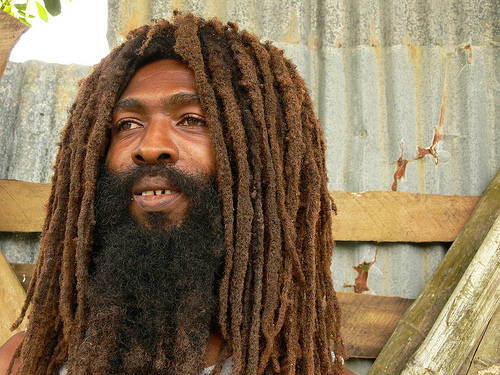
After paying for the water, I walked to my car and there stood a tall, picturesque man, vibrant and attractive even though missing most of his teeth. He wore a black cap with stars embroidered along the front: three black stars, on a vivid yellow ribbon band. A paler yellow jumpsuit, a long beaded necklace — and long, luxuriant dreadlocks. He wore a couple of rings on his hands, a small silver nose-ring, and a gold earring in his left ear. He was quite handsome, though at the same time I could tell he’d recently been through some very hard times, and probably had been in those bad times for a quite a while.

For a second, I worried, because of the other man, and that man’s obvious level of dissociation with the world (I really had prayed to avoid him), but in a second of observing this man, I knew I was on much more solid ground. I wouldn’t be talking to a total lunatic. He held out to me a book — a Bible — and said he had just seen someone throw it in the trash, and God had told him to get it out and now pass it on to me. I took the book from him, bedraggled and slightly crusted on the cover with God-knows-what. I felt instantly ashamed for worrying what germs might be on the cover of the old, battered Bible, but I forced myself to disregard that, and act untroubled.

During our brief chat, he told me he was a Vietnam veteran. He pulled out a battered leather wallet and showed me his VA Hospital ID, which I knew to be genuine, as I have seen others: his picture was on it, and his name and date of birth. He was born Christmas Day, 1947.  I cannot remember his last name, only his first name, Richard, the same as my father’s.  I looked at the ID and then back at his face, and what I saw was an honorable man, intelligence shining out through his eyes, but also in his eyes a sadness that probably ran deeper than I could ever imagine. His radiance and his sorrow ran through me like a knife, because of my very-realistic fear we’ll now be in another war – one which will kill many young men and destroy the spirits of many more. I was suddenly and inexplicably paralyzed by grief for him, as a veteran, as a street person, as someone now obviously fairly troubled in life. I saw him as he must have been, all those years ago, young and strong and relatively unscarred, and the breath caught in my chest, seeing him both then and now in the very same instant.

After a few moments, he asked very gently and politely if I had any money I could give him to buy some coffee. I was so happy he asked for something, so I could give him something. Ordinarily, I would give someone in this situation a few dollars, but I gave him $20 — I just wanted to give him something. Nobody can give him back what he lost, and money is a poor substitute for what he lost, but it’s a substitute nonetheless. Money and kindness are all we can really give. He went inside, and I buckled my seatbelt, turned on the car, grabbed the steering wheel, but then sank down over it, clutching it, sobbing for the first time in a long time, not caring in the slightest who saw me or heard me. It felt like a release; I only wish it had gone on longer. He came out with his coffee, saw me hunched over sobbing, and got alarmed — he knocked on my window.

“Are you okay?” he asked. Genuine concern; sincere compassion. I can detect those things in other people from the slightest of nonverbal cues, unguarded genuineness and sincerity are so rare in this world. His sincerity made it better, but also worse at the same time.

“I’m okay,” I choked out between sobs. “It’s just this whole thing.” He didn’t have to ask what I meant, because of course he already knew. The power of these events to affect us has crossed every kind of barrier — sex, race, socioeconomic status, education level, sanity level — we’re all family right now. I rolled down the window and he embraced me. I was grateful for the human compassion, pure and simple. His smell was strong and complicated, some of the notes pleasant, some sour, but oh, so real and human and I drank it in, all of it, the bitter and the sweet, a primal metaphor for this crazy life itself. He asked, tentatively and graciously, could he sit with me a while.
“Yes,” I answered. “Please.”

He started to talk, and I listened, giving him my fullest attention. I bonded with him in a way I’ve never bonded with any stranger in such a short time. I guess we spent about an hour together. Richard, from West Virginia. He is a Vietnam veteran, former Marine, former POW. He talked generally about what he was trained to do in the Marines, but said he didn’t want to tell me anything too specific about his experiences during the war — he said women shouldn’t ever hear such things. We talked about everything there is for human beings to talk about and he read to me from the Psalms and Matthew. So devout, so earnest, he held my hand in his while he read Scripture, ministering to me like a Sister.

In fact, he had been in the past a minister, he said, and from his familiarity with the chapters of the Bible I knew he wasn’t exaggerating. He has two living daughters, now grown, and another daughter who died at age two, just two years ago, from a heart ailment. He has his deceased baby’s name tattooed on his shoulder, plus three scars from cigarette burns — two for each of her birthdays, and a third for the day she died. He cried twice with me, once while talking about her — Zaidyn — and a second time while talking about how his stepfather used to beat his mother, years ago. He told me he still calls his mother “Mommy” when he calls her on the phone.

“Do you think that’s stupid?” he asked. “For a grown man to say, Mommy?”

“Absolutely not,” I answered. “I think it’s wonderful. I think more grown men should.”

He has been barred from our local homeless shelter, St. Francis house, for two years for giving food he obtained there to someone else. It’s a rule there, you’re not supposed to do that, share your rations. What a dehumanizing policy. It’s our basic need, to share. Damn them for that. He lived in Jamaica at some point for five years, his grandfather was born there. One of his grandmothers was a full-blooded Cherokee. He had played conga drums with Bob Marley.

I felt, I think, something like the presence of what human beings call the Divine. Divine love. I comforted him, he comforted me. I gave him another $20, all I had left in my wallet. He blessed me, I blessed him back with all my heart.

He still played conga drums around town. He knew of Ajamu Mutima, another drummer. “Another tall, skinny dude with dreads,” he said, laughing. As Richard and I spoke, I thought often of my father, and my stepmother Dorothy (his African-American wife), and of the rich heritage from Africa we all need to embrace.

He spoke of his lost two-year-old saying to him “I love you, Dada.” As a fellow parent, I knew how precious those words were. His pain at her loss, I felt it palpably, physically.

He knew when to end the interaction, and for that too, I was grateful, as I was overwhelmed and needed to go off and write it all down so I would never forget. Though I didn’t want to break our contact, I somehow understood it had to be broken, because it had been so miraculous, we had gotten so much from each other, we didn’t want anything to detract from the miracle. We didn’t want to descend into ordinariness with each other. He didn’t want it to end, either, but he was gracious enough to know to end it. Restraint can be admirable; sometimes, less is indeed more. But we were both reluctant to leave each other, and when I started the car and put it in reverse, he approached the window one more time. And that, too, was perfect.

Because he asked me, at the end, the question that made it all even more clear, more passionate and more profound. The question that made it, well, I don’t use this word much, but there is no other word to use in English — perfect.

“Did you feel it, too?” he asked me. He looked at me, searching my face with his deep brown eyes, eyes that held the world in that moment. Eyes I wanted to fall into.

I knew precisely what he meant, and I had indeed felt it. He had asked a question I couldn’t even have begun to formulate, so overcome was I with my feelings. “Yes,” I answered. “Yes,” I repeated, nodding to him with absolute recognition, and with that he leaned in and embraced me with joyous intensity for one final moment. I returned his affection as I would return my own child’s, or my mother’s. I am profoundly grateful, and I will never forget him. It’s true, Mystery can manifest in the most unlikely ways. We fell together like long-lost twins, then slowly let each other go.  Without saying much of anything but “Did you feel it, too,” and “yes,” we both knew without doubt that he was a noble person with an eternal soul, and so was I, and we had finally found each other for all eternity in a single hour. The force resonating through our bodies was Divine.

6 Comments

Filed under 9/11, bible, daughters, fatherhood, memoir, notes, peace, rastafarian, veterans, war