Tag Archives: truth

True Love, a short story

illustration true love

True Love

            Mythical, that’s how they looked — when she got up close, she experienced both hormonal lightning flashes and the peculiar sensation of having a trick knee.  The famous Gower brothers:  high foreheads, broad shoulders, meaty yet sculpted forearms.  Granted, for Amy, myth and heroism consisted of “Jason and the Argonauts,” and the Classic Comic Books version of “The Iliad and the Odyssey,” but she was on the right track.

“This is Amy,” said her friend Claudia.  She stood with her arm across Amy’s shoulders.  “This is my ex-husband, Burnett, and this is Carey — we call him Shorty.”

It was admirable the way Claudia and her ex hadn’t let their divorce get in the way of business.  Amy wondered if she were capable of such sophistication — perhaps it was bound up with the Bohemian temperament musicians were supposed to have.

“Nice to meet you,” Amy said.  “I’m enjoying your music.”

“Thanks, Amy,” said Shorty.  “That’s what we like to hear.”

“Mind if I sit here?” he asked.

“No, please,” she said.

He chewed his little red straw, stirring his drink with a finger.  The gesture was boyish, clumsy.

“How long have you been playing here?” she asked.

“Six months,” said Shorty.  “The owner is a jerk, but he’s hardly ever around.”

“Well, I’m glad the band stayed together,” said Amy.  “This is the most fun I’ve had in a long time.”

He tossed his head, and gave her an aw-shucks-ma’am grin, showing his teeth and squinting his eyes.

“Me too,” he said, touching her arm.

“You’re just as pretty as Claudia said you were,” he said.

“Oh, I bet you say that to all your groupies,” she said, laughing.  He laughed too, squeezing her arm.  She felt his large fingers against her skin, the calluses on his fingertips.

They had another job tomorrow night, he said, over at Lazy Susan’s.  Would she like to come listen?

“A friend of mine is having a party we could go to,” he added.  “It won’t get cranking until around two a.m. — you know, a bunch of musicians.”

“Sounds great,” she said.

“Stay for the next set, won’t you?” he asked her, tipping his glass to drain it.  The lime wedge fell on his nose, and he laughed, then put it in his mouth and sucked the pulp.

She sipped her wine.  A bit drunk, she was relaxed even more by the sound that poured over her, brushing her skin like velvet.

When the music was finished, Shorty walked her out to her car, opening and closing the door of the little Datsun for her.  Squatting on his heels, he rested his elbows on the open window, leaning his chin on his hands.

“I don’t do this very often,” he said, his face dusky under the streetlight.  “Ask anybody, they’ll tell you.  I’m not a flirt.  I don’t operate that way.”

He took her hand and held it, shaking his bangs out of his eyes.  Staring at her, his eyes were sleepy-looking.

“Yes, ma’am, it’s been a real pleasure,” he said, drawling the words out, going corn-pone, laughing.

***

Shorty was sweet, honest, Claudia said, a guy who would do anything for you.  It was true, he didn’t pick up women.

“But he’s kind of involved with somebody,” she said.  “It’s a weird thing:  they’re separated right now.  I know he’ll tell you himself, so don’t say anything.”

“Separated?”  Amy said.  Gruesome visions of surgery flashed in her head, the kind used for taking apart Siamese twins.

“Well, he and Bonnie have lived together, off and on, for years,” Claudia said.  “Lately, it’s been mostly off, but neither one of them has ended it.”

“Where is she now?”  Amy asked.

“Dallas.  She manages a restaurant out there.  Some relative of hers got her the job.  Everybody thinks she’s been bad to Shorty.  He needs to get on with his life.”  Claudia shrugged.

“I don’t understand how people can live like that,” Amy said.

“I know,” Claudia said, sighing.  “So if you get close with Shorty, you better keep Bonnie in mind.  They go back a long time.”

“I’m not looking for anything serious,” Amy said, twirling her hair.  “I just want to have some fun.”

In fact, whenever she broke up with someone, she’d swear she would never get “involved” again — she would become independent, self-sufficient.  Then she’d wake up months later — as if from a trance — realizing that she had somehow ended up in another relationship.

***

The musicians were taking a break when she walked in, and Shorty was standing in the entryway talking on the phone.  He mimed delight, his eyebrows raised, and he beckoned.  She stood near him:  bending, he put his arm across her shoulder, drawing her to his side.  He pulled her tight against his body, curling his arm around her neck and looking down at her curiously from that skewed, clumsy angle.  She could smell him; fresh, clean sweat that carried the smell of his aftershave, and underneath that, the blunted tang of alcohol and bar smoke.

“You sure are a sight for sore eyes,” he said.  “I’ve been thinking about you all day.  I was starting to think you’d forgotten.”  His face was mobile, relaxed, expressing shy fascination.

He wanted to stop home and change before the party.  “You don’t mind, do you?” he asked.

“Of course not.”  She followed him in her car.

Waiting in his living room, she flipped through his magazines:  RollingStone, Time, and Omni.  He emerged from the bedroom with a clean shirt on, hair wet, combed down tight, the tooth-mark pattern of the comb pressed into it and a few wet curls on the back of his neck dripping on his shoulders.  His skin was fair; a dark mole next to his mouth stood out against the flush of color brought out by the shower.

“Let’s take my car over to the party,” he said.

His back seat was folded down, the space crammed full of guitar cases and scuffed black boxes.  He sat with his hands on the steering wheel as if he were trying to remember how to drive.  Then he fished a half-smashed pack of cigarettes out of the side pocket on the door.  He lit one, dented and pressed flat, inhaling with a sigh, thin lengths of smoke swirling about his face.  He offered the crumpled pack to Amy.  “No thanks,” she said.  “I don’t smoke.”

“Neither do I,” he said.  “I like the way it looks sometimes, how your hands feel lighting up.”

Shrugging, he pulled out the ashtray, tucking the smoldering butt into one of the grooves.  In one smooth motion, he leaned over the gear shift and kissed her, cradling her head in his hands.  Then he let go and took her hand, laying it in his lap, against the rough-sewn corduroy crotch of his jeans, and he whispered.

“See what you do to me?” he said.

***

Later that night, she discovered the shoes.  On the floor of the bathroom, tossed in front of the linen closet, she saw a pair of running shoes, women’s, size five.  She held one of them up to her bare foot.  Her own size nine looked huge next to the tiny shoe.

Carrying it back to bed with her, she lay down next to him, holding the shoe up with one arm, over her face, the laces dangling down, almost brushing her nose.

“Whose is this?” she asked.

“That’s Bonnie’s,” he said.

Amy let the shoe drop to the floor.  The room was still, quiet.  She felt a protective third eyelid go down over something vulnerable inside her.  “Is she living here?” Amy asked.

“Hell, no,” he said.  “I haven’t heard a word from her in at least six months.”

She found herself possessed by quiescent maturity, a vague memory of some letter to the editor she’d read in Playgirl.  She would handle it in that abstract way; not a whimper would come out of her.  She took the shoe and put it back in the bathroom, coming back to bed, and drawing the comforter up over her bare shoulder.  As she had known would happen — her reward for being a good girl — he reached out under the blankets, pulling her to him and curling around her, her head hooked under his chin and her feet pressed against his shins.  He was warm and soft-skinned and large and solid, all at once.  She was in a masculine sort of womb.

“You’re the only one here with me,” he said.

She could see something that looked like love, the old kiss-me-until-I-die extravaganza.  She couldn’t tell him, could she?  Her blood swelled and pounded and she imagined saying it, imagined him saying it back, falling asleep next to him at last, her mind flickering through images like the arthritic film projectors she remembered from high school:  tiny shoes, and faceless petite women wearing nothing but a mist of blue glitter as they dove into murky tropical lagoons in the dark.

***

For Shorty’s birthday, they were going to an expensive restaurant.  Almost ready to go pick him up, she was slipping into her shoes when the phone rang.

“I’m sorry,” he said.  “I’m not going to be able to make it tonight.  Bonnie flew in this afternoon.”  He paused; Amy said nothing.  She didn’t intend the silence to be accusatory, but that was how he seemed to take it.  “Amy, I swear,” he said.  “I had no idea she was coming.  She called from the airport and said she was here to wish me a happy birthday.”

Amy breathed in, her chest stretching until it hurt.  For a moment she didn’t know how the air would get out — some sort of one-way valve had shut down — but then her chest was empty.  She waited.

“I’m sorry,” he said, whispering now.  “She’s in the next room.  I don’t know what else to say.”

“Well, have a happy birthday,” she said.  She placed the phone in the cradle in slow motion.

***

Amy drove over to the bar.  Burnett was there, of course, and some other guy on bass, filling in for Shorty.  She had his birthday present — a gold chain — shoved in her purse.  When the band went on break, she and Burnett walked outside.  They sat in her car in the darkness.

“He’s with Bonnie,” she said.

She took the small velvet box out of her purse, handing it to Burnett.  He held it for a moment, and then put it on the dash.

“My brother doesn’t know what he’s doing,” he said.

“Neither do I,” she said.

He picked the box up and held it, his eyebrows raised, questioning.  Shaking her head, she closed his fingers over it.  “This is really nice,” he said, when he opened it.

She took the ends of the clasp and put the chain on him — his neck damp, but round and full and hard as a barrel under her fingers.  As she worked with the necklace, the tiny lever on the clasp stabbed underneath her thumbnail.  She sucked on her finger, tasting blood.  The strand of gold glinted against his skin, his long hair sweeping past it and over his shoulders, the pale blonde glow of the hair as pretty as any woman’s.

She drove home with Burnett after the bar closed.  In his living room, sitting on a sprung green brocade sofa, they drank beer in silence, the room lit by one enormous rainbow drip candle.  Putting his empty bottle down, Burnett stood and held out his hand; she didn’t hesitate, just rose to follow.  His bedroom was tiny; the double bed used up all the space.  She had to hitch her way around the nightstand and halfway there, she toppled, falling panicked, then sprawled on the bed.  Burnett looked down at her, pulling his shirt tail out of his pants.

The brothers were like two sides of the same coin.  When she closed her eyes, they had the same feel, the same weight; they even smelled the same; except she knew it wasn’t Shorty because of the way the long hair trailed over her skin when he bent over her.  It tickled her skin like a spider’s web, it was so silky.

***

When Amy phoned Shorty, a woman answered on the second ring.  She didn’t hang up the way she had planned.  She asked for him.

“Hello?” he said.  He sounded tense.

“Hi.  It’s me.  Was that Bonnie?” she asked.

“Yes,” he said.  She could hear him breathing and Bonnie talking in the background.  “Who is it?”  Amy heard.  The sound got muffled; she tried but she couldn’t make out his answer.

“Listen, I’m sorry,” she said when he came back on the line, her voice low and even.  Her stomach rolled with a peculiar heaviness, making everything seem vague and faraway.  “I know you can’t talk now.  Call me when you can, okay?”

“I will,” he said.  “You take care of yourself.”  His voice was slower, his drawl back to its normal rhythm.  He sounded relieved — she was being so civilized, so unlike what he had probably expected.  Although it wasn’t Shorty’s fault — he hadn’t lied to her — somehow, she was being too nice.

***

Amy had a New Year’s Eve vision:  a slow-motion perfume ad, a fuzzy dream of sensual retribution.  Oh, how she’d make him regret what he’d passed by on the way to his dry banquet!  Her heart — the childish construct of it, the big red valentine — was beginning to resemble a checkerboard.  Amy loved New Year’s — for an hour at least, everything seemed limitless.

Claudia was equally superstitious, always serving a big Southern breakfast — beans, greens, ham hocks, cornbread — at midnight.  “Don’t tell me you didn’t know about eating black-eyed peas on New Year’s?”  Claudia asked.

“Honestly,” said Amy, “I’ve never heard of it.”

“Well, you need some luck then, girl,” said Claudia.

“Yeah,” said Amy.  “I guess I do.”

***

The very first person she saw at Claudia’s party was Shorty.  His back was to her, but she knew even that angle; no plane of his body was unfamiliar, and she realized that was about as close as she — as close as anybody — could get to a person.  Shorty was standing next to Burnett; the boundary between their bodies seemed arbitrary.

Burnett spotted her first.  Smiling and nodding, he tapped his brother and waved.  Shorty turned toward her:  both men stood, grinning in her direction.  She didn’t care; all her pretenses flamed out in one big burn.  She shocked herself and then knew — with the thigh-weakening flush of any decent sort of compulsion — it still wasn’t enough.

Shorty pressed through the crowd toward her.  When he put his arm across her shoulders, she understood; either Burnett hadn’t told him or — more likely — it didn’t matter.  Perhaps this way was better; now they were of a piece.

“I’ve missed you,” he said.  It was the truth, she knew, not just a line.  He wasn’t a flirt, he didn’t operate that way.

“I’ve missed you, too,” she said.  “How’ve you been?”

“Okay,” he said.  “Bonnie went off to Mexico for the holidays.”  Shaking his head, he frowned — as if to say, isn’t that woman a mess?  “I’m just glad to see you.”  She knew he was glad; he was as honest as they came.

Claudia floated up with Burnett, her arm around him, her thumb hooked in one of his belt loops.

“Hey, you two,” she said, smiling.  “I wanted to tell you the good news–we’re getting remarried.  Isn’t that wild?  We’re going to do it at 11:59, kind of romantic, huh?”

“That’s great,” Shorty said, pleasure warming his voice, deepening his drawl.  “I always knew you two would get back together.”

I guess I did too, Amy thought.  Burnett’s not a flirt, either.

But she said, laughing, “This way you’ll never forget when your anniversary is, right?”

“That’s right,” Burnett said.  Amy cocked her head, winking at him, so small a motion that anyone watching would have seen only her eyes flicker as she bared her teeth.  She thought she saw him wink back the same way, flinging his hair out of his face and over his shoulder with a toss of his head.

A few minutes before midnight, Claudia and Burnett exchanged their vows.  The bride’s eyes glistened, her lips red, her skin pale underneath her freckles.  As the groom kissed her she put both her hands on his buttocks and squeezed them.  Everybody hooted and laughed.  “Going to be one hell of a wedding night!” somebody shouted.

Yeah, Amy thought.  One hell of a wedding night.

“Let’s go,” Shorty said, leaning down to whisper in her ear, his breath tickling and smelling of beer.  “I’d like to get out of this crowd.”  Putting his arm around her, he slid his fingers under the waistband of her jeans, rucking up her blouse and brushing the bare skin of her hips.

Her head felt swollen, too large for the rest of her.  Who was she, now?  She felt dizzy but she didn’t stop:  she couldn’t stop.  She had known all along, hadn’t she?  Shorty was — the kind of guy who would do anything for you.

“Yes,” she said.  “Let’s go.”
7 Comments

Filed under short stories

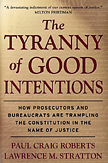
Great book: The Tyranny of Good Intentions

tyranny_good_intentions original hardcover image

“That which thy fathers bequeathed thee, earn it anew if thou woulds’t possess it.”  (old Anglo-Saxon maxim).  The English legal system we who now live in the United States of America inherited, historically reflected “a [very strong] tradition of the defense of individual rights against the state,” (at least since “The Glorious Revolution” in 1688).  You’ll have noticed by now, I am sure, that the far, radical Right has long referred to President Barack Obama as either “the Antichrist,” or “Hitleresque.”  They are in fact on to something, but not the right something.  A quick comparison of the status quo in effect currently, versus the situation in Germany when Hitler was “elected,” is highly illustrative.  In post-WWI Germany, “German law reflected the tradition of a strong state as the embodiment of the community by which individuals would be granted such rights as were considered compatible with its interests.”  (Jeremy Noakes & Geoffrey Pridham, eds., Documents on Nazism, 1919-1945 (New York:  Viking Press, 1975), at p. 226-27.)  Thus, Obama, even if he desired it, could not possibly have the kinds of powers Hitler wielded in the short-lived “Thousand Year Reich.”  Or whatever the hell that freaky, Hitler-moustachioed murderous asshole who ruled Germany for a while called his horrible regime — which regime is an undeserved stain on the beleaguered German people, who have since recovered that fumble neatly, and in fact probably have less economic inequality than those of us in these United States of America.

“The character of this [English-inspired, individual-oriented, American] legal system ensured that it would be revered.  In recent times, however, reverence for our legal system is being replaced by fear, distrust, and dissatisfaction.  For example, inner-city juries routinely refuse to convict criminal defendants on the basis of prosecutorial and police evidence alone.”  Witness O.J. Simpson!

“The twentieth century’s belief in government power as a force for good has encouraged the practice of chasing after devils.  Like a national emergency, a righteous cause can cut a wide swath through the law to more easily apprehend wrongdoers.  In recent decades, both conservatives and liberals cut swaths through the law as they pursued drug dealers, S&L crooks, environmental polluters, Wall Street insider traders, child abusers, and other undesirables.  Impatience, frustration, hysteria, political scapegoating, and greed have caused police, prosecutors, victims, and the plaintiffs’ bar to grow weary of laws that protect those accused of crimes and negligence.  The question is raised, “Why should the guilty have the benefit of law?”  Sir Thomas More’s answer (as presented in A Man for All Seasons) is that when the law is disregarded to better pursue the guilty, it is also taken away from the innocent.  What are we to do, he asks, if those chasing after devils decide to chase after us?  If the law is cast down, what protection do the innocent have?  A little liberty taken here, a precedent there, and the Rights of Englishmen become history, a clear-cut area where once mighty oaks stood.”

The Tyranny of Good Intentions, How Prosecutors and Bureaucrats are Trampling the Constitution in the Name of Justice, Paul Craig Roberts & Lawrence M. Stratton, authors, ISBN 0-7615-2553-X, FORUM press, an imprint of Prima Publishing, 3000 Lava Ridge Court, Roseville, CA  95661 (copyright, 2000).

the spookiest thing, for me, as a person??  this was all written & predicted well before 9/11 or the Patriot Act, or two bizarre wars which we are still sort of in but sort of not, before Obama, before the “Tea Party,” the current crop of mad hatters & dormice… before any of it.  why aren’t we calling these guys to hear what they have to say next??????

Leave a comment

Filed under legal writing, notes

the swiftness of dream-time, a poem

Taylor Swift Is A Paris Beauty

The Swiftness of Dream-Time

She confides unduly in strangers, asking
inappropriate, intimate questions. She has
startling, beautiful eyes, a pale luminous brown,

fringed by heavy black lashes. The fair skin
of her lids glistens like the wings of a moth,
and the expansive way she smiles makes her

delicate pink lips almost disappear. She lives
in the dream-time before marriage and children,
unschooled by the constant companionship of small

relentless demands, unaware of the eternal
ramifications of peeling herself raw
like a thick stalk of sweet cane, exposing her pithy

heart to people who don’t care to understand
the need to be loved, hidden warts and all.
Some people can never be trusted, she feels this

in her bones, yet she doesn’t want to believe it;
the ache of betrayal is like cancer of the marrow,
an oily red liquid pouring from her center

to drown the most fragile of her cells.
On personality tests, she engages in flights of fantasy:
happiness wings past just out of reach, grazing

her face with its sharp, heavy wings, ruffling her fine
hair with the remarkable swiftness of its passage.
Sitting in her green armchair, she becomes

engrossed in old forgotten novels, flipping
the tissue-thin paper with impatience,
sweeping the fallen crumbs of leather binding

off her taut, bony lap with fingers sticky
from futile perspiration. If the man she thinks
she loves asked her to marry him, she would say

yes without hesitation, but it wouldn’t make her
happy — nothing will ever satisfy her, for very long.
She doesn’t know what she wants and never will.

3 Comments

Filed under poetry

edward snowden & me

illustration Edward-Snowden and me

the act of confession benefits the penitent; not the confessor. it is not always appropriate to tell the truth, the WHOLE truth, and nothing BUT the truth. they crucify people for that, both then & now. just how brave am i? time will tell. was edward snowden being brave? or just being a criminal? time will tell. he needs clarence darrow to reappear on earth, i know that much. being a lawyer is in my DNA; it’s not what i do, it’s what i AM. sorry about that. it can’t be helped.

Leave a comment

Filed under notes

i have a high “negative capability”

illustration angels negative capability

i have a high “negative capability.”

“Negative capability describes the capacity of human beings to transcend and revise their contexts. The term has been used by poets and philosophers to describe the ability of the individual to perceive, think, and operate beyond any presupposition of a predetermined capacity of the human being. It further captures the rejection of the constraints of any context, and the ability to experience phenomena free from epistemological bounds, as well as to assert one’s own will and individuality upon their activity. The term was first used by the Romantic poet John Keats to critique those who sought to categorize all experience and phenomena and turn them into a theory of knowledge. It has recently been appropriated by philosopher and social theorist Roberto Mangabeira Unger to comment on human nature and to explain how human beings innovate and resist within confining social contexts. The concept has also inspired psychoanalytic practices and twentieth-century art and literary criticism.”

uh, i know that’s a mouthful. but it’s really accurate if you can bear to wade through all those long, long words!!!

for me, it was just a survival skill, really. how else does a fast racehorse survive being used only as a mule? what some people cannot see is that those in their lives were sent to help them heal.  sometimes, there are angels in our presence, and we can’t see it. the minute we do, we know exactly what to do.  this is what love looks like.

1 Corinthians 13:4-7
New International Version (NIV)

4 Love is patient, love is kind. It does not envy, it does not boast, it is not proud. 5 It does not dishonor others, it is not self-seeking, it is not easily angered, it keeps no record of wrongs. 6 Love does not delight in evil but rejoices with the truth. 7 It always protects, always trusts, always hopes, always perseveres.

3 Comments

Filed under notes

i wrote nancy pelosi the correct answer to the question about abortion

illustration nancy pelosiillustration kermit gosnell

Yet more hoopla (from the French, houp-là, interjection, first known use: 1877) for the radical, extremist right to mentally masturbate itself with (an activity also in the “news” the same extremists have so much fun ejaculating all over the rest of us normals): a reporter asked Nancy Pelosi, “What is the moral difference between what Dr. Gosnell did to a baby born alive at 23 weeks and aborting her moments before birth?”

Nancy Pelosi answered: “You obviously have an agenda. You’re not interested in having an answer.”

This was her error, and unfortunately has added even more fuel to a fire that should never have started to begin with. We reasonable, normal people need to start taking every opportunity to throw the water of common sense and reason over this extremist conflagration. I believe she should have answered the question this way: “Legal abortion in this country is by definition a medical procedure; a standardized series of actions, carefully dictated by medical textbooks and undertaken in a sterile environment, resulting in the termination of a woman’s unwanted pregnancy. You may not like it, you may not approve of it, but the practice of medicine is solely between a doctor and a patient and that relationship is privileged under every legal tradition currently existing in the United States of America; outsiders to that doctor/patient relationship need not apply for admission; it will never be granted. What criminal Defendant Gosnell did is, by stark and obvious contrast, not a medical procedure in any way, shape or form; rather, it is a random, bizarre, and dangerous series of actions which are not found in any medical text ever written in the history of the medical profession. If you are too uneducated or too biased to be able to understand the vast gulf between safe, legal, medical abortion and Gosnell’s illegal, nonmedical, chaotic actions, you need to go back to school and retake all the journalism courses you obviously slept through; so for the sake of your beloved country, stop engaging in ridiculous sensationalism simply for the sake of gaining publicity, get off the merry-go-round of insanity you have been placed upon by the radical, extreme right, and please stop soiling the reputation of honest journalism, one of the noblest professions ever invented.”

“He started out as a good practice doctor but eventually just became a money-generating machine,” [one of the citizens sitting on Gosnell’s trial jury] said. Money is usually at the root of most illegal conduct. Money or mental illness, or both.

Leave a comment

Filed under notes

in defense of lawyers, a prose poem

illustration defense of lawyers quote anton-chekhov

quote:  anton chekhov


In Defense of Lawyers

Inevitably, a person’s defense of an idea becomes most impassioned just before they cease to believe in it altogether. Passion comes to open the way for the loss of innocence: the world we once loved is lost. What does this say about the plight of lawyers? They shoulder the breach of your dreams for simple cash and nothing more. Everybody sympathizes with garbage men: well, somebody’s got to do it. Lawyers handle the garbage of the soul.

I myself had clients I believed in — false teeth and all, I took them to my heart; well, somebody’s got to do it. I wasn’t unusual in this regard; it’s a phase all of us go through. Granted, most people don’t understand our system of laws. We’re born into this web of relationships, whether we like it or not. No way to opt out, though I always kept one eye open in hopes of that promised loophole, wanting to wriggle away from society’s tight grip like a stray dog out of a stiff new collar. Nobody, not even a liar, wants to live in a cage; we all went to law school to figure out how to open the cage doors. What we found is that there is no way out, not ever. For all of us, the only sure finish is bankruptcy, or death.

Yet, there came the day I wanted only to crawl under my desk and stay there. My client had informed me he would lie to the judge. All the rules about keeping quiet were no comfort. I could no more allow him to lie than I could rip out my own intestines. I wept, in the ladies’ room, wanting to die of a broken heart and have it over that way. My client lost, no fault of mine. I’m sorry, I told him. He spit in my face, coming close, pointing his weathered index finger like a weapon. You being sorry doesn’t help me, he yelled. I feared he would strike me. That day was my last hearing ever. Everyone blames their lawyer for what happens later — no one talks about the price lawyers have paid, in dreams.

5 Comments

Filed under poetry, prose poetry

two summers after the divorce, a poem

illustration merry-go-round illustration playground climber_superdome
Two Summers After the Divorce
(originally published in Snakeskin)

I. Children

The greenness, and the cars whizzing faintly by
like Central Park. Drops of water plopping
from the trees above me, cooling.
Children squeaking on the swings.
Soothing noises. A ginger-haired dog
with beautiful green eyes. A ginger-haired little girl
with yellow socks. In a blue flowered dress,
she runs past, smiling. My ex-husband
already has a new baby.

II. Privacy

My daughter’s bangs fall into her eyes,
so I ask if she wants a trim. No, she says,
her hair over her eyes gives her privacy
and makes her feel like she’s never alone.
I exchange glances with a blonde curly-headed toddler
in a black stroller with leopard print cushions,
sucking on a pacifier. She blinks knowingly.
She’s seen her own future, but will forget it
by the time she can talk. She sees colors around
people’s heads, her eyes glaze over at the beauty.

III. Expectations

Berry juice drips on my paper — a hazard of writing
outside under trees, birds and squirrels.
A granny says to her grandson,
“That’s a big spider you’re climbing on.
See his eyeballs?” They argue about letting him have his toy cars —
she wants him to climb and run and swing.
Granny has a long red braid on one side,
fading to gray at the scalp. Did she quit dyeing it abruptly
six months ago? Just gave it up, it looks like.
She’s learned exactly what you can expect from men.

IV. Desires

A young man passing is shirtless, jeans and hair wet
from riding around on his bicycle in the gentle rain.
Barefoot. Almost a man, but not there yet. He looks
furtively at women’s bodies, wanting something
but not knowing what it is. I don’t know any more, myself.
The girls on the merry-go-round scream, “Faster, faster!”
Heads tilted full back, faces to the sky, yelling.
My baby says, “This is the twisty-turny insane asylum.”
She calls to me and waves. I wave back, nod and smile.

V. Hope

A black teenager dressed in shorts and a muscle shirt,
with his baggy football jersey tucked into the waist,
draped over his thighs like an apron.
He is lean and muscular, hanging out with two fat boys.
I wonder how many times he will attempt marriage.

VI. Rational Thinking

The sky is multiple shades of grey, the breeze puffy
in medium bursts. Some little girls climb on the spider-gym
and mine says, “We’re mites. And we sit on his eyeballs.”
Redheaded lady in blue jeans and a red gingham blouse,
white wrist brace with day-glo pink straps.
The ex-husband calling me a harlot is like blaming
the broken capillaries for the bruise.

VII. The Upper Middle Classes

One impeccably dressed woman who looks just like
his new wife walks by, with two-carat stud earrings
and three small children but at least four babysitters
at all times. I’ve seen her around town for years.
She’s always pregnant or nursing.
Her feet in black sandals with bright red toenails,
professionally painted, her gray tweed suit with trousers
and her dime-store fuzzy hair-tie.

VIII. Beauty

I can smell the fragrant candy-striped amaryllis
out in the grassy circle from 20 feet away.
Fog in the hills and over the river,
branching off, banks lined with thick green trees.
Hills of crumbling shale, flowers by the road, pink,
purple, white. Plaster bunnies and fawns on lawns.
Lavender stained glass windows in the church.
Queen Anne’s lace, orange-red daylilies.
Grasshoppers flinging themselves at me,
banana spiders wait in their enormous webs.

IX. Truth

I run through the park, getting scraped by tree branches
but laughing as I run. The smell of cut grass and weeds.
Huge, opalescent night crawlers burying themselves
in leaf mulch. Character is not made in a crisis,
dear ex-husband: it is revealed.


1 Comment

Filed under poetry

 dreams & wishes & the plain truth, a poem

Image

Dreams & Wishes & the Plain Truth

(originally published in Eclectica)

The man you dreamed up

was like an animal, a confused,

restless animal that didn’t know

what it was.  From one angle,

it looked graceful.  Other times,

it bobbled and bumped in the night

like a blind cow.  It had to be fed, and often.

You never knew what it would fancy–

sometimes plain mash, once in a while

something with a burnt sugar crust,

and lots of whipped cream.  It made noise

constantly.  Whistling, burring, keening,

but never in the same way twice.

You found yourself wishing

it would run away of its own accord–

since it was so unusual no one would take it

off your hands.  It would look at you

out of eyes so swollen and pale

you’d think it was dying,

then it would kick back its head

and bray and bray, music, ringing

through your ears like jittery strips of tin.

After a while, you wanted to kill it. 

Go play in traffic, you screamed,

don’t speak in metaphor, don’t scratch

until you make scars.  The shabby quilts

where it nested called out for mercy.

Still, you hissed, Do something with your life!

Leave a comment

June 1, 2013 · 4:19 am