Category Archives: legal writing

I was thirteen the first time I had to lie to the police to protect someone I loved, a short story

illustration mom hit the boy on the bike

I was Thirteen the First Time I Had to Lie to the Police to Protect Someone I Loved, a short story

I was thirteen, in my first year of high school, and one afternoon I was home watching TV by myself while my mother went to pick up my little brother from nursery school. The doorbell rang: a police officer stood outside, tall and broad and scary. He had gleaming handcuffs and an oily looking gun buckled to his belt; a long black stick with ominous scuffmarks hung at his side. “Your mother’s okay, but she’s been in an accident,” he said. Less than an hour ago I’d seen the way her whole body swayed as she went out the door. Her empty glass was sitting right behind me in the kitchen, unrinsed and still reeking of Scotch.

Even now I see my mother’s face, soft and drunk, pale and frightful, moving through the darkness, soaring over me as mysterious and unreachable as the moon. Her affection waxed and waned, never constant. When she’d had enough to drink, she loved me, but the way she went about her mother love, pulling at me with sorrowful, clumsy arms given unnatural strength by liquor, made my flesh wither under her touch.

“She hit a boy on a bicycle,” the policeman said. “Do you know if she’s been drinking?” he asked. He shifted his weight from one leg to both legs evenly, spread his feet wider on the cement walkway and moved his arms from his sides to his belly, holding his hands together down low at his belt.

“No,” I answered the policeman, looking unflinchingly into his eyes, which was excruciating but imperative, I knew, if I wanted him to believe me. “She hasn’t been drinking.”

My mother had skin like rose petals, eyes like a fawn’s. There were the rare times when she forgot to be sad, if only when some equally sad eyed man noticed her. If a man loved her to the point of obsession, to the point of contemplating suicide, she imagined she might find the strength within herself to survive, but she eventually rejected all such suitors, wanting only those who were hard nosed and cold blooded, as her father and, later, her husbands were. Remote, a source of funds and orders and criticism, the closest men in her life approved of her external beauty but not her soul. They didn’t care what she wanted: they wanted her to be like all the other girls and women, to be beautiful and obedient. They broke her will; she broke their hearts.

She was memorable for simple things: her rose garden and her Scotch and water, her menthol cigarettes and her Pucci nightgowns, her ladylike hands and her A cup breasts, her bitterness, her resignation, her unending string of sentimental, alcoholic boyfriends. She taught me how not to be. How not to live. A psychic once told me she was my one true soul mate in this life and that my heart had been broken the day I was born, that first hazy time I looked into her eyes and saw nothing there for me. One normal thing I remember is hanging clothes out to dry with her in the backyard when the dryer was broken. Once, she even took me out to the movies.

“Are you sure she’s not drunk?” the policeman said. His face was a smooth blank, revealing nothing, but then so was mine. “She’s acting pretty out of it.”

“She gets that way whenever she’s really upset,” I said.

“We need you to come take care of your brother,” he said. “While we decide what to do.”

The policeman herded me into his car, and we drove to the place Mom had the accident. They’d already taken the boy away in an ambulance; all that remained was his bright yellow bicycle, its frame horribly crooked, its front wheel bent almost in half, sprawled on the ground in front of my mother’s car, a powder blue Cutlass Supreme. I glanced offhand at the front of the car, afraid to look too long, afraid the policemen would be able to tell something from the way I acted, but I didn’t notice dents or blood or anything. Even without that, the bike, obviously brand new before the wreck, was as frightening as a dead body. Mom was sitting in the back of another patrol car, and her eyes were red, her face was wet.

My three year old brother sat beside her, and I could tell he hadn’t cried yet, but I could tell when he did it was going to last a very long time. Then I wanted to tell the police she was drunk, yes, she was drunk today and every single afternoon of my life, but the way she looked — her beautiful hands trembling as she smoked — temporarily severed the connection between my conscience and my voicebox. I couldn’t talk at all, because I knew I’d cry. I’d protect her from the police, make sure she wouldn’t end up in jail, but later, I would coldly steal money from her wallet, cigarettes from her purse, clothes from her closet. In the end, the boy on the bike died, and she died, too.

Toward the end, my mother said she was on fire from the neck down. Her arms and legs felt like they were glowing, orange red, molten. But her head felt like a block of ice. She was emotionally or spiritually paralyzed, she said, and worried about whether the condition was permanent. She felt like the nerves from her head down to her body were cut, and she didn’t know if they would ever grow back.

Right before the end, she said she could not distinguish life from dreams; she slept little, ate even less. She didn’t feel mad, she felt terribly, irrevocably sane. Everywhere she walked the ground seemed on the verge of opening up into blackness, into fire. If only she could go mad, she said. When I found her cold and stiff on the living room floor, she wore nothing but blue nylon panties and her white gold wristwatch, given to her by her own mother in 1958.

A watch which is in my jewelry box, upstairs, right this second, and which I wore to the Palm Sunday service, yesterday, at Holy Faith Catholic Church. I took Communion from Father John, even though I am not now, and have never been, and never will be, officially a Catholic. My friend Clyde, my dear friend, mentor, and fellow lawyer, told me that he thought I would still be eligible for Heaven, regardless of what the Catholic Church, as an institution, might determine.

Because of all this, and a couple of other things which I won’t bother to mention here, I had to hold myself very still, and open my eyes a bit wide, during the reading of Jesus’s betrayal in the Garden of Gethsemane in order not to allow the fucking tears to drop out of my eyes. Yes, I am a liar. So sue me. Good luck!

11 Comments

Filed under legal writing, mysterious, prose poetry, short stories

from my folder: defense lawyer’s greed: my lawyer made me do it, by steven lubet

Image

MY LAWYER MADE ME DO IT

Steven Lubet

05‑01‑2003

Sooner or later, nearly every lawyer has to confront some variant on the dilemma of zealous representation. How do we justify representing clients whose goals are morally questionable or even flatly offensive? The standard answer is that lawyers serve society by facilitating client autonomy, allowing individuals and corporations to make informed decisions about their legal rights. As Samuel Johnson explained nearly 250 years ago, “A lawyer is to do for his client all that his client might fairly do for himself.” Thus, corporate counsel (following each new accounting fraud) and public defenders (in almost every case) deliver the same ready reply to a relentlessly familiar question: How can you defend those people? Well, it isn’t always easy, but we are just doing our job.

Lawyers have come to expect skepticism, if not outright scorn, when representing, say, polluters or criminals. But until recently, it was a safe bet that no one had to be embarrassed about a client like the Catholic Archdiocese of Boston. In recent months, however, the litigation over clergy abuse has become so acrimonious that many parishioners are openly questioning the basic decency of the church’s legal strategy, going so far as to accuse the defense of inflicting new trauma on the abuse victims. Representatives of the archdiocese responded by blaming it all on their counsel ‑‑ “Our lawyers made us do it” ‑‑ as though the church has no control over the tactics employed in its name.

 More than 500 civil cases have been filed against the Boston archdiocese, alleging sexual abuse by priests and a decades‑long cover‑up by the local hierarchy. Last December, amid charges of stonewalling and complicity, Cardinal Bernard Law was forced to resign, replaced temporarily by an apostolic administrator, Bishop Richard Lennon. From the beginning, Bishop Lennon promised a new tone of reconciliation and healing. He announced his intention to settle the outstanding litigation, and promised to make therapy available to every victim who comes forward.

In the meantime, however, the church continued to mount a forceful defense in court, engaging in a level of trench warfare that would make Johnnie Cochran proud. For example, defense lawyers filed a breathtaking motion to dismiss all 500 cases on First Amendment grounds, arguing that the civil authorities could not interfere with the “bishop‑priest relationship.” It was claimed that the constant reassignment of known child molesters was beyond the reach of the law, because the supervision of priests was exclusively an ecclesiastical matter.

Predictably, the motion was denied, but not before Bishop Lennon explained that his attorneys had insisted on the hardball tactic because “failure to do this could very well result in the insurance companies walking away from us, saying that we have not exercised all of our avenues of defense.”

It was barely noticed at the time, but Bishop Lennon had actually adopted the classic lawyer’s excuse. Absolving himself of any moral responsibility for the maneuver ‑‑ much less the cost and anxiety it imposed on the injured plaintiffs ‑‑ he invoked the nature of the legal process as justification for an outrageous ploy. Attorneys routinely seek to escape the consequences of their actions by deferring to their clients’ instructions, but this was an entirely new twist on an old theme. The apostolic administrator washed his hands of his own decision, blaming the insurers and lawyers instead.

It gets much worse.

In January 2003 the church’s defense team began serving deposition subpoenas on plaintiffs’ psychotherapists, including some who had actually been hired by the archdiocese itself to provide treatment to abuse survivors. From a legal perspective, of course, this was not particularly out of the ordinary. The psychotherapist privilege is waived when a plaintiff claims damages for emotional trauma.

From a moral perspective, however, it was a disaster. The church had encouraged victims to come forward and had even set up a special Office of Healing and Assistance to facilitate therapy, as part of Bishop Lennon’s announced preference for settlement over litigation. Then the archdiocese turned around and insisted on invading the patient‑therapist relationship in a way that many victims regarded as jeopardizing their recovery.

The reaction was furious. A coalition of psychologists and victims’ rights activists denounced the depositions as “revictimization” and “reabuse” of patients who were “already broken members” of the church’s flock. Without disputing the church’s legal right to take the depositions, the group complained that the tactic was inconsistent with Lennon’s professed commitment to justice and healing. The victims’ therapy, they said, would be “permanently harmed by the intrusion of the legal system.”

One prominent psychotherapist, who had previously been invited to address the United States Conference of Catholic Bishops, put it even more bluntly: “I think that this is very despicable and deceitful. To say [that] ‘the church loves you’ and ‘we want to help you’ and then to invade your treatment is really just wrong. It may be legally okay, but it’s wrong.”

In response, an archdiocesan spokeswoman declared that the depositions were lawful and necessary: “If the victims choose to sue … we feel that we’re obligated to defend ourselves.”

Maintaining that the archdiocese still supported therapy for survivors, she insisted that the support stood “separate and distinct from the litigation process.” And lest there be any mistake, another church official remarked, “It’s a very tragic set of circumstances, but when you get to the litigation stage, there are certain things lawyers insist on doing to protect their clients.”

Thus, the Boston archdiocese inverted the very premise of the attorney‑client relationship, relying on the purported demands of counsel to justify its own moral blundering. Lawyers naturally recommend strategies that enhance the likelihood of success in litigation. To those who see themselves as legal technicians, the human toll is irrelevant so long as the tactic is lawful. The autonomous client is entitled to zealous representation, and the attorney is helpless to refuse.

But that same stricture never applies to the clients themselves. There is no conception of litigation in which a client can decline to be an independent moral actor. In fact, the American Bar Association’s Model Rules of Professional Conduct specifically call upon lawyers to “defer to the client” in regard to other “persons who might be adversely affected” by litigation. While any good lawyer would urge the archdiocese to authorize the depositions of victims’ therapists, no lawyer could compel it. That is why we call it “advice of counsel.”

The basic purpose of taking a therapist’s deposition, after all, is to undermine the plaintiff’s monetary claim for emotional distress. A good transcript ‑‑ filled with artfully extracted admissions and potential impeachment ‑‑ becomes a useful weapon in negotiation or at trial. An early deposition in the midst of settlement talks is an unmistakably aggressive move, especially in the case of a vulnerable plaintiff who has suffered clergy abuse. (In several hundred cases, all discovery has been stayed for 90 days pursuant to a “stand‑down” order intended to facilitate settlement; in other cases, however, the contentious litigation continues unabated, as the archdiocese recently moved for the entry of a gag order against a lead attorney for plaintiffs.)

The leaders of the Boston archdiocese may opt for compromise and settlement, or they may choose to litigate to the bitter end. As an outsider, I would defend their legal right to make either choice. But no client has the moral right to raise the flag of reconciliation while instructing counsel to scorch the earth.

Steven Lubet is a professor of law at Northwestern University. His most recent book is “Nothing but the Truth: Why Trial Lawyers Don’t, Can’t and Shouldn’t Have to Tell the Whole Truth.” E‑mail: slubet@law.northwestern.edu.

Leave a comment

Filed under health, legal writing, mysterious, notes, recommended reblogs

my tete a tete with officer charles owens, a nonfiction note

147

“What can I do for you, officer?”

“Why are you so hostile?”

He asked for my license and registration and proof of insurance, which I gave him. He walked back to his vehicle and did whatever police officers do, I suppose run my driver’s license number to make sure I wasn’t wanted for some crime or something. And to make sure the vehicle wasn’t stolen, I suppose. And to make sure I had insurance, because that was something else he could have given me a ticket for. I do give Ofc. Owens points for being thorough. Just not any points for being correct.

“I’m giving you a ticket for careless driving.”

“How was my driving careless?”

“I heard your tires squeal.”

“But the road is wet, it has been misting for at least the past hour, maybe two.”

“The road is perfectly dry.” The mist swirled around his head as he spoke those words. I thought to myself, doesn’t he notice it?

“Is this the best use of your valuable law enforcement time? Giving a woman driving home alone at one a.m. in a white Toyota minivan a ticket because you heard her tires squeal on the damp pavement?”

“I smell beer on your breath.”

“Well, I did have one with dinner, about four hours ago, I haven’t brushed my teeth yet. I suppose that’s it. Would you like to perform a field sobriety test?”

“No.”

“Would you like to do a breathalyzer?”

“I’d have to call the van. Do you want me to call the van?”

“Sure, let’s have a party! No, that’s okay, you don’t have to call the van.”

Further discussion, about the ramifications of the ticket, etc., how to contest it, etc.

“Oh, you have a dog? What’s his name?”

“Justice.”

“Can I meet him?”

“No.”

“Can I take your photograph?”

“Yes.” I did so. It wasn’t the greatest, as his eyes were closed, but under the circumstances I did not think it wise to ask to take another. Ofc. Owens was clearly having a bad night.

When I first saw Officer Charles Owens, he was sitting inside his police vehicle, parked in the Lloyd Clarke’s parking lot, apparently conferring with another officer in another police vehicle. They were both inside their vehicles, each with the driver’s window rolled down, the vehicles thus facing in opposite directions. I am not certain, but the other officer may have been a female, as it seems I remember seeing a ponytail.

When Ofc. Owens first noticed me, I was turning left on to 13th Street from 16th Avenue. I had been hauling heavy vanloads of farm equipment earlier in the day, from Gainesville to Micanopy, and now my van was empty, and much lighter. After all the farm transportation, I had taken a friend to dinner and then dropped him off at his home and stood in his carport talking with him for half an hour or so, and the entire time I watched mist coming down.

I was very tired, and traveling by myself, back to an empty house, a situation I had not found myself in, in decades. Due to the mist, when I pressed on the accelerator, the wet road caused a slight squeal from my tires. I did not veer from my carefully steered path, I did not speed, nor was there any other car in the intersection, or even anywhere near the intersection. At that hour on a Wednesday, the roads were practically empty.

Officer Owens’ car was the one pointed with its nose facing south, the direction in which I was traveling, so he immediately pulled out of the parking lot and followed me, his lights flashing. I pulled over as soon as I realized it was me he was following, and turned right, on to 10th Avenue.

I was then two blocks or so from home. I rolled down the window of my car after he approached my vehicle, and asked him, in what I thought was my nicest and most cooperative voice, what I could do for him. I was exhausted and getting divorced in two days, but I did my best to be polite.

The first thing he said to me was why was I so “hostile.” I told him I wasn’t feeling hostile in the slightest, but that I was very, very tired and just wanted to get home, and being a female driving across town, alone at 1 a.m., was not something I enjoyed. I was, however, annoyed, because I thought his stopping me was entirely unnecessary and a waste of valuable taxpayer resources.

I started to tell Ofc. Owens a couple of pertinent facts that might have affected his decision-making processes, such as the fact that I was being divorced in two days, by my husband of ten years, after almost dying from a brain tumor the previous April, a tumor which had been wrapped around my optic nerve and the major aorta in my brain and had been in that site for between 17 to 34 years, and had made me feel horrible for at least the prior 5 years. I was getting divorced, as far as I could tell, because my husband preferred me half-dead and didn’t like the fact that I was not in that state anymore, and actually wanted him to get off the couch once in a while.

“I don’t want to hear any of your personal information,” he said as soon as I said my first word on those topics. I complied, and did not insist to be heard.

I live at the corner of 8th Avenue and 15th Street, and I am well aware of the driving skills usually displayed on 13th Street. Careless driving is not what I do. I am an excellent driver, and the only accident on my record was one in which my then-teenaged daughter’s car was parked in the driveway of my home, and a drunken college student plowed into it, and into the tree next to the driveway, and sped off with such haste that the smell of burning rubber could be smelt for hours afterwards.

The insurance company told me that even though my car was unoccupied and parked, I was being charged with an at fault accident because the vehicle was in my name. I was told there was nothing I could do about it. I live in an extremely loud, noisy and “party” neighborhood, which I nonetheless love and tolerate because I like to be in the middle of town. Needless to say, I know the value of the police force and respect what they do highly. However, Ofc. Owens made a bad call. It happens. Everyone makes mistakes. One was made here. I was not driving carelessly. End of story.

3 Comments

Filed under humor, legal writing, mysterious, notes, science

desiderata, in french, hopefully an OK translation, not by me

illustration desiderata in french

Desiderata

Aller tranquillement au milieu du bruit et la hâte et n’oubliez pas quelle paix il peut être dans le silence. Aussi loin que possible sans cession être en bons termes avec toutes les personnes. Parler de ta vérité calmement et clairement ; et écouter les autres, même le mat et l’ignorant ; ils ont aussi leur histoire. Éviter des personnes forts et agressifs, ils sont des déboires à l’esprit. Si vous comparez vous-même avec les autres, vous pouvez devenir vaniteux et amère ; pour toujours, il y aura une plus grande et la petite personnes que vous-même.
Profitez de vos réalisations ainsi que vos plans. Garder intéressés par votre propre carrière, si humble ; C’est une véritable possession dans les fortunes changeantes du temps. Faire preuve de prudence dans vos relations d’affaires; pour le monde est plein de fourberies. Mais cela laisse ne pas vous aveugler sur quel virtue est là; beaucoup de personnes recherchent de grands idéaux ; et partout la vie est pleine d’héroïsme.

Soyez vous-même. En particulier, ne pas feindre d’affection. Ni être cynique sur l’amour; pour face à l’aridité et le désenchantement, il est aussi vivace que l’herbe.

Prenez avec bonté le conseiller des années, remise gracieusement les choses de la jeunesse. Nourrir de force de l’esprit pour vous protéger d’infortune soudaine. Mais ne pas vous affliger avec dark imaginings. Beaucoup de craintes naissent de la fatigue et la solitude. Au-delà d’une discipline saine, soyez doux avec vous-même.

Vous êtes un enfant de l’univers, pas moins que les arbres et les étoiles ; vous avez le droit d’être ici. Et s’il est clair pour vous, sans doute, l’univers se déroule comme il se doit.

Par conséquent, être en paix avec Dieu, tout ce que vous lui faire concevez et quel que soit vos labeurs et aspirations, dans la bruyante confusion de la vie, maintenir la paix avec ton âme. Avec toutes ses trompe-l’œil, corvées et rêves brisés, c’est toujours un monde merveilleux. Être de bonne humeur. S’efforcer d’être heureux.

Max Ehrmann, (1927)

1 Comment

Filed under for children, health, humor, legal writing, mysterious, notes, poetry, prose poetry, recommended reblogs

Jack, the Triple War Veteran, a nonfiction

illustration triple war veteran

Jack, the Triple War Veteran, a nonfiction

I met Jack, the 91-year-old, 52-years-of-service-including-3-wars, Army veteran on May 31st, 2013, approximately two months after I “woke up” from what was [then] my life, when I went to go fill my mom-mobile (white minivan) with mid-grade gasoline products (it may be only a mom-mobile, but i have a NEED FOR SPEED) at the Gate convenience store/gas station two blocks or so from my house.  I saw him sitting over by the vacuum/air/water station, on the round, concrete base of a streetlamp, his sleek, black, wheeled walker/chair thingie so piled up with odds and ends of clothes, shoes, and bags of snacks that it looked more like a shopping cart from across the parking lot.  His hair and beard were striking:  long, silvery white, shiny and silky and clean.  He looked like a very trim, fit Santa Claus, and when I first saw him, I would never have guessed he was 91 years old.  I approached him because I am what some people call a “bleeding heart liberal,” that is, my heart sort of sags and melts when I am confronted with people having needs that, to them, loom insolvable, and in actuality can be solved with a couple of $5 or $10 bills.

“Sir,” I said, “I don’t want to offend you in any way, but do you need anything?  Can I do anything for you?  Anything at all?  Do you need a few bucks, maybe?”

“Honey,” he said.  “I’ve been saving my money all my life!”  He took his wallet out, showed me a bunch of folded bills, and pulled a big stack of quarters out of his shorts’ pocket.  Jack was born in West Virgina, called himself a good, old hillbilly.

“Jack’s a great name,” I said.  “One of my grandpas was named Jack.”

“They named me after the dog!” he said.

“Well, they must have loved that dog,” I said.  “It must have been a terrific dog!”

“They still named me after the dog,” he said.  I have named pets after people, and wanted to do the reverse, just never had the actual opportunity.  (Wait for it!)

“I went to West Virginia once,” I said.  “I was in Morgantown.”

“The University of West Virginia!” he said.

“I know, it’s a beautiful town,” I said.  “And the state is beautiful, all those green hills.”

Turns out, he’s hanging out at the convenience store to get away from his daughter.  “She wants me to be the child, and her to be the parent, now,” he said.  “I’m too old for that!”

“I hear you,” I said.  “Does she know where you are?”

“I don’t really want her to,” he said.  “She lives right down the street, in a house I bought her back in 1972.”

He named his first rifle Miss Betty….

He was with Patton in N. Africa, at just 18 yrs. old, he was for a brief time Patton’s assistant?  Patton’s army was chasing Rommel, he and Jack started arguing over which way Rommel should to go; they disagreed (he & Patton) but Jack turned out to be right.  In a rage, Patton grabbed his (Jack’s) rifle once & shot into the air with it.  Yes, I could see General Patton doing such a thing.  Hahaha.

His daughter, whom he is on the lam from, is nicknamed BooBoo:  she got that nickname because as a baby she’d hide behind cabinets, furniture, poke her head out & say Boo, Daddy, Boo!

He is not married now, he likes it that way, nobody telling him what to do.

When I told him how nice he looked, how he didn’t look 91 at all:  “I take care of myself!  I’ve got to!  People say I’m a loner, but it’s three of us:  me, myself and I.”

God’s on his right shoulder, sometimes God tells him things, what to do or not to do:  sometimes he doesn’t listen, does what he wants, not what God says.  Later, he hears God saying, I told you so.  God has blessed him.  Every time we shook hands, me trying to exit stage right because my own 15 year old BooBoo was at home waiting for me to get back, he said, “God bless you,” and I said, thank you so much.  His eyes, the pale clear blue of a child’s, the twinkle of a child’s, the mischievous, rascally soul shining out of them.  But a good, good man.  Stationed all over the world and the United States of America.  The state of Florida was the site of his last posting.  He got misty-eyed thinking about one of his predeceased children, another daughter, however, he did not mention her name, and because of aforementioned misty-eyed-ness, I did not ask.

They once had a terrible episode of anthrax on the farm, when he was a child?  The cow had to get shots from the vet, they couldn’t use the cow’s milk for 6 weeks, then it was OK.  That cow gave so much milk, she had to be milked three times a day, not just two.

He wore dog tags, wouldn’t let me look at them:  “the last person that sees these is the one who’s supposed to bury me.”

“Well, I certainly don’t want to be the last to see them, then,” I said.

A student buying beer stopped & handed him a tall cold water bottle.  Jack thanked the boy warmly, saying “God bless you,” then after the boy walked off, he handed me the bottle.

“Aren’t you going to need this?” I asked him, concerned.

“I’ve got everything I need right here,” he said, pointing to his loaded “sulky,” a plastic grocery bag hanging:  was that the water?  “Besides,” he said, “that’s too cold.  And besides, I really like beer.”

“But you might need this water later,” I protested.

“Look,” said Jack, “he gave it to me, I’m giving it to you.  I’m just in the middle.”  I had to accept, gracefully, so I did, but I still felt a bit guilty.  The gift was Jack’s, but he wouldn’t keep it, he had to pass it along to me.

The store clerk, a young African American lad, came out to check on us; I think he wanted to make sure I wasn’t endangering Jack.  Jack handed him a huge pile of quarters, asked if he’d bring him out some beer.

“What kind?” the young man asked.

“O.P.,” Jack answered.

The clerk was confused.  “What’s that?” he said?

“Other people’s,” laughed Jack.

“I think he means it really doesn’t matter what kind of beer you bring him,” I said to the young man.  So he went inside with the money, came back out with a boxed six-pack & Jack’s excess change.

A woman, with a hard-lived look, came over to talk to us.  She knew Jack already, addressed him by name.  She was also a veteran, Operation Desert Storm.  She asked me if I could spare some gas money.  “It’s the end of the month,” she explained, “and I’m coming up short.  I just have to make it a few more days.”

“Sure,” I said, relieved that I could at least give her something, fulfill the impulse that had brought me over to Jack.  I went to my purse, grabbed a ten dollar bill.  While I was doing that, I saw Jack getting his money out to give her some, too.  He brought out a fiver.  Jack and I handed her the money, she shook my hand & thanked us both, and went to pump her gas.

Jack was dressed like a cool surfer guy; shorts with a nice braided belt, no shirt, his dog tag necklace, a pinky ring carved out of some sort of jade on his right hand, a couple of funky/hipster/hippy bracelets on his left wrist.  Quite fashionable looking, and I couldn’t get over the condition of his hair; silky & clean & shiny & sparkling silver, and the same with the beard, it grew to a natural point just below his breastbone.  The only long beard I’ve ever seen that looked beautiful!  His skin was amazingly smooth & healthy looking, considering the amount of sun exposure he must’ve seen!  I mean, he was 91 and he had very little sun damage, not many wrinkles, though of course a bit of sagging around the jowls.  No frown lines!  His only physical flaw was some missing teeth; it was apparent he could have had dentures or a bridge if he’d wanted them, but I think he was more comfortable without.

When I was leaving, I blew him a kiss.

“I’d rather have the real thing,” he chuckled.

“I can’t,” I said, “I’m married.”  We both laughed then.  If I had known that day, May 31st, that my husband was going to dump me, unceremoniously, in front of the yard man, in the side driveway, I certainly would have kissed him (Jack!), full on the lips!  Like, a billion times!

[If he’d had all his own teeth, not only might I have given him a closed-mouth smooch, but I probably would have tried somehow to fix him up with my former mother-in-law who live[d] in my attached guest house (that I built for her & her husband, who died 3 years ago, but who would be 91 now) (who was the only decent person in THAT entire FUCKING FAMILY).  Said former “mother in law”
was, and is still, an ignorant idiot and would have been put off by Jack’s missing teeth.  Plus, she is, as we used to say in middle school, “mental.”]  *ahem*  NO FURTHER COMMENT PERMITTED, BY LAW.  Did you know, that for IRS purposes, you can NEVER GET RID OF AN IN-LAW?  Once an “in law” for tax purposes, always an “in law.”  The law presupposes that divorced persons might still have attachments to one another’s family members.  Hahahahaha.  Isn’t that FUNNY?????

Oh, P.S.  I, myself, now have a dog named… wait for it… JACK, a rescue from the Dixie County, Florida animal rescue organization, a sweet one-year-old weimaraner/yellow lab mix!  Jack the dog’s eyes are yellow/green & deep….

Oh, and P.P.S.  And you’re not going to believe this!  On the way to present this piece at an “open mic” at Coffee Culture on 13th Street in Gainesville, Florida, the fabulous Tristan Harvey, emcee & manager of the joint, in any case, ON THE WAY TO THE FUCKING OPEN MIC, i ran in to jack, on the way!  it was raining, i pulled over & asked him if he needed a ride.  he said no, i said, isn’t your name jack, and HE LIED BECAUSE HE THOUGHT I WAS THERE CAPTURING HIM to take him back to his daughter!!!!!!

GODDAMNED TRUE STORY.  BELIEVE IT, OR NOT.

um, but if you know what’s good for you, you’ll take my written words as GOSPEL TRUTH.

5 Comments

Filed under health, humor, legal writing, mysterious, notes, poetry, prose poetry, science, short stories

Our Villain, a short story

illustration our villain

Our Villain

Back when these events transpired, we consisted of three lawyers representing two plaintiffs against one defendant.  We were, then as now, made up of two males and a female, the female of medium height, one male taller than average, one male shorter.  Both the male lawyers were older than the female lawyer by in one case, seven, and in the other case, ten years.  Only one of us, however, had blue eyes.  And only one of us was in love with the other two simultaneously, to her great consternation and guilt, as all three of us were married, but none to the other.  Hence, once possible source of difficulty for her.

The case was ponderous and slow-moving though not terribly complicated, legally speaking.  The theory of liability was straightforward; even a child could comprehend it, and in actuality two children already had.  No, in our case it was not the law that was causing our increasingly troubling reliance on several rounds of stiff drinks in the early evening and several rounds of antacids later on.  It was rather, the facts.  In the end, had any one of us been asked if we felt we had done the right thing, the answer would have been not yes, but a glare of outrage that the question had even been asked, and perhaps a violent cuff or two to the side of the questioner’s head.  On our way this morning to the small, cold and windowless room we now sat in, we had driven together, singing long-memorized childhood standards to relieve the tension we all felt.  We had, by way of example, upon arrival at the designated meeting place, arm in arm, skipped across the underground parking lot while whistling “We’re Off to See the Wizard.”

Thus fortified by silly notions of camaraderie and invincibility, we sat across from the villain, whom we only in public termed “the defendant.”  We were there on that heartbreakingly beautiful late spring morning — the kind of morning when even had we been working on a less distasteful set of facts, we would rather have been anywhere else — to ask him questions about what he’d done to two little girls, our clients, aged 9 and 12 when he started, aged 11 and 14 now.  The natural beauty outside — redbuds and Japanese magnolias, falling camellias — was to us that morning like a knife in the chest.  We had just the night before come back from a visit to the girls’ current home, a grim apartment in Little Havana, furnished with a couch and chairs upholstered in bright gold plastic, molded to resemble brocade and velvet.  The girls’ mother sat out in the kitchen while we talked to them, then the girls went to the bedroom they shared with their mother while we talked to her.  Our talk was intended to help them feel that what they were going through now, the legal system, was not as bad as what the villain had taken them through.  But the villain’s lawyers, also three in number, were trying to convince both girls and their mother that what the villain had taken them through was, in fact, the best of all possible worlds, and that the uncertain future they now faced was simply a result of their own stupidity and greed.

After the psychic shoring-up session at our clients’ sad, ill-lit lodgings, we had departed hastily for the bar at our hotel.  One of us, as it turned out, was unable to handle her drink as well as the other two — though all three of us drank more than the AMA preaches, though not, perhaps, more than the AMA actually practices when faced with the sort of evening we had just experienced and were trying to bury in the way a dog buries a nasty, rotting piece of meat that said dog knows will be needed the following day for its very sustenance.  Indeed, one of us was so incompetent at the art of self-medication by drinking she made inappropriate remarks to the other two of us, remarks involving her shameful, growing adulterous sentiments toward the other two, and though the eyes of the second two softened and grew misty and mutually receptive to the first’s silly, childish emotional exuberance — and one laid a tender hand on her wrist while the other stroked her cheek — they nonetheless raised to her as gently as they could the issue of how negatively our spouses might react to such sentiments, fully realized in all their permutations.  Besides, the possible effects on our case loomed, immeasurable and frightening.

From the beginning we’d agreed that if we’d been casting directors for a Hollywood movie, we couldn’t have found a better physical type to play our villain.  He was tall, well over 6 feet, and hulking, with a belly that strained the buttons on his shirt and spilled over the waist of his trousers.  His skin was pale and so were his eyes, a faint blue behind thick lenses.  Even his hair helped us — thinning, the color of burnt toast, combed greasily back off his forehead and swirled neatly behind his ears, but curled up in the back as if it couldn’t bear to be a part of him and would have jumped off at the first chance.

He’d met the girls’ mother when she was on the verge of becoming homeless.  He discovered later, to his satisfaction, that she was always perched on that edge, that he could forever hold her in his hand as long as that hand was gentle and lined with cash.  He moved them into his fine house, a low-slung, four-bedroom ranch in the suburbs of Miami.  His family home was far, far north, and he’d long ago fled the harsh winters for our near-tropical climate.  The brief, almost nonexistent winters we enjoyed led to the closets of young girls such as he favored being full of short-shorts and tank tops, and in, say, February, when his mother and his brother and sister (his father was dead) shivered inside their wools and furs, and drove haltingly along just-plowed, still-icy roads, he could climb into his Corvette convertible, top down, his thin, lank hair fluttering gaily as he drove, usually humming, to find his favorite sights at any city park.  For free.  He could look as long as he liked, newspaper over his lap, and no one had any idea what he was really thinking.

As lawyers, we thought we were familiar with how most people, even people not as far off the beaten path of normal human desire as our villain, are nonetheless filled with bizarre, inappropriate, even disgusting impulses.  We believed we understood how everyone is, underneath the legally complex bounds of civilized adulthood, in many respects still the naked, screaming, bloody baby ejected suddenly and not altogether politely from mama’s throbbing womb.  As lawyers, we possessed staid, naïve notions that because we had already experienced myriad cool, appraising looks in boardrooms and courtrooms, (in combination with startling internal questions of our own, seemingly unrelated, sudden pulsing engorgement), nothing could truly touch us, make us feel, by mere legal contact, soiled.  How wrong we were.

The day he met our girls and their mother, he’d spent the afternoon pursuing one of his favorite hobbies.  Top down, cruising in his car, trolling for the bright yellow buses that never failed to stir his loins.  He’d follow behind one, fly unzipped, smiling at the young faces gesturing frantically to him behind the glass windows marked “Emergency Exit.”  The kids loved his car.  He loved the kids, and that was what nobody else seemed to understand.  He loved them more than anything.  Their clear eyes and bright, uncomplicated peals of laughter were what drew him to wake up each morning, were what made life not a chore but a gift from God.

The day we sat across from the villain, what appeared to offend him most was the nervous gaze of the court reporter.  Maybe dressing the way he always did, in an open-throated shirt, his neck, wrists and fingers hung with heavy, 18-carat gold ornaments, had been a mistake in judgment.  He met our eyes shyly — trying to use his best manners.  Had he used that shy, hesitant gaze the first time he approached our girls?  Had he, by reason of blushes and stutters, brought out their still-developing maternal instincts?  Had they seen him as nothing more than a big, rubbery doll of a man?  Had he clasped his wrists the way he hung on to himself now?  For dear life?  What part of his life was dearest at this moment?

We, in our turn, met his eyes with blankness, hiding our feelings, our ultimate goal — we wanted to inspire in him only trust.  We were, for the next few hours, dedicated to convincing him we had no malice toward him, no, simply the same heartfelt weight of concern for his girls — our girls now — that he’d always maintained.  We differed only in how we wished him to express his deepest feelings toward his beloveds.  We simply wanted to redirect his fingers from the clasp of his own member to the clasp of an ink pen.  All he had to do, to satisfy us, was sign a check representing a sum equivalent to all he now possessed.  It was no more or less than the great love he’d always felt for them, for all of them, all the dear children who’d brought such golden light into his otherwise empty days.  He was worth millions.

Our girls had been shocked when he first made his desires known to them.  Shocked not in the sense one is shocked by a car accident, but shocked in the way one is shocked the first time it is made plain that one will be required to someday provide food, clothing and shelter for oneself.  His desires for them quickly brought material comfort to their mother and to them.  At first, the knowledge of their importance to him brought them a sort of heady pride, a child’s pride at having found in the soil a shiny gold coin.  For a while, there was no great weariness at his requests.  For a while, our girls still felt it was worthwhile to each day shower, brush their teeth, and comb their hair.  It was, at its best, a game, a stage play, a dream.  They would feel something click over in their heads, and suddenly the hands on their bodies would be outside the real.  What happened against the skin of their bodies in the villain’s king-sized bed atop his black sheets happened in another country; a parallel universe.

We knew their seduction had been a gradual procession from blushes, hesitations and startlement to coy fumblings undertaken first under cover of a cheerily false, overgrown childish abandon, then beneath a camouflage of compliments and toys, shopping expeditions to the nearest air-conditioned mall wherein nothing was refused, nothing.  If our villain refused them nothing, how weakened became their own ability to refuse!  He had become quite skilled at fulfilling the ache that seemed to start in his toes and rise up to his scalp.  His entire body loved those girls — his kisses covered them like a fine mist of semi-tropical rain.

When the teachers at school sent home notes advising the girls’ mother to assist in ensuring their personal hygiene, how delighted he was to purchase fine soaps and bathing salts, sponges and silken wash mitts.  Neither he nor their mother, busy in front of her TV, saw the circles under the girls’ eyes, the listlessness which every day crept deeper into their skins, as symptomatic of anything other than transient sleep deprivation or chronic growing pains.  The girls were, despite the recent flimsiness of their appetites, growing like kudzu vines after a good hard rain.  All was well in the quiet house.

The villain and our girls’ mother were, as a result, quite alarmed when the child welfare worker showed up one afternoon unannounced. Our villain was napping in his dark, cool cave of a bedroom, covered only from the knees down by the sheet which yet retained a certain pleasant odor and stiffness from the previous night’s adventure.  Mother was engrossed in a particularly compelling news broadcast of the Pope’s South American tour when the doorbell rang.  She was stout and somewhat put out at having to leave her seat as she huffed her way to the door.  Those Jehovah’s Witnesses could be such an annoyance.

The social worker stood on the doorstep in the bright afternoon sunlight, mopping her forehead with her bare hand, and then drying her hand on the side of her slacks.  As soon as the girls’ mother answered the door, the social worker felt something hard to describe, something which she would, with great reluctance when pressed later by the district attorney, label nausea.  She felt nausea as she stood looking at the girls’ overweight, unkempt mother, but she could not be sure if it was due to the heat, the greasy chicken sandwich she’d wolfed on her way to this visit, or the physical presence of the mother herself, a short, stocky, large-breasted, flat-footed creature with no discernible joie de vivre.

Now, in our tiny deposition room, our villain began to perspire as we questioned him.  He remained of good cheer, evidenced by an easy, toothy smile and an absence of muscle tremors.  We asked many things which in ordinary onlookers might have produced discomfort.  We asked hundreds of detailed questions involving the breasts, buttocks, mouths, hands and genitals of both the villain and our girls.  Every possible mathematical combination of the body parts mentioned had to be imagined, catalogued, and inquired into.

But our villain’s lawyers, though he had already been criminally prosecuted and sentenced under a plea-bargain, instructed him after the very first question to invoke his rights against self-incrimination under the Fifth Amendment, using those simple, nearly poetic words we had studied in school and grown to love — but would never love again — hiding behind those words as behind a hideous, absolute shield.  His lawyers stared at the table, unable to meet our eyes.  Surely their job was worse than ours, at that moment.  Because the villain wanted so badly to tell us, he wanted to explain that he had never, ever done anything to harm those beautiful children.  He only wanted to tell us how much he had, and would always, love them.  His body trembled as his lawyers touched his arms to keep him in his seat.  Our bodies trembled as we continued our litany of questions, preserving for the record his only defense.

We couldn’t, as we had imagined, pierce the villain upon our lance of questions like knights on chargers, and thus protect our girls from exposure to cross-examinations by his white-glove law firm’s most skillful roster of evil, carrion-eating dragons.  We could not keep him — by virtue of the Constitution — from further harming the children we sought only to recompense for the harm he’d already inflicted.  We might now be forced, if he would not voluntarily settle the case, to put his victims upon the witness stand only to be reminded in excruciating detail once more of the very things we wanted them most to forget.  What we didn’t know, at that moment, was he would the following week agree to settle the case, not, unfortunately, for every cent he possessed, but for enough of his funds to cut short his career as lethal sugar-daddy.  What we heard, we heard only from our girls.  In private.

Please, he had said, the first time, when he made “love” to them both within a half-hour.  Please.  His words flayed the girls open like a rawhide bullwhip across their chests.  I need to, he had said, curled up on the bed next to them like a baby.  His hands reached, grasped, fumbled, and then grasped again.  He unbuttoned their shirts, unzipped their pants.  The sensation was at once terrifying, sickening and pleasurable.  Our girls turned their eyes away, looking out the windows, down the hall.  Their dread and revulsion butted up against his sickness, his addiction.  He left the door open, the curtains flung wide.  It was a beautiful spring day outdoors that day — full-blown white camellias fell off their perches with heavy, helpless plops at short intervals just on the other side of the window-screen next to the bed.  The flowers had to bloom, had to engorge each formerly folded petal, to force themselves open toward the light, the slow-moving caressing wind.  The girls tried to see him as a bee forcing its way into a closed flower, a male bee burdened by his own desire, his own weakness, and his own ignorance.

After the villain’s deposition was over that day, he somehow made it to the door before any of us did.  He stood in the doorway waiting, his hand out, as if a greeter in a department store.  His palm was soft-looking, glistening with perspiration and as we glanced at it we saw not a hand, but a weapon carrying the stain of everything we already knew he’d done with it.  Ladies first, the villain said with a smile.  Then, while that unfortunate member of our trio shook hands with the villain, the other two slipped by him with relief and gratitude toward the first.  His flesh turned out to be hotly moist, unpleasantly springy, and what we found out later, as the three of us walked arm in arm to the bar on the corner — the two who hadn’t shaken the villain’s hand supporting the weight of the one in the middle who had — it seemed his touch (no matter how much scrubbing with soap and water so hot it seared the flesh had taken place immediately afterward in the washroom of the courthouse) his touch had made all of us feel irrevocably soiled.  Like we’d shaken hands with the Devil.

3 Comments

Filed under legal writing, short stories

hypocrisy in america

hypocrisy the american way

There is an interesting case which was argued in front of the Supremes on January 14th:  a Wyoming man is suing to prevent the Forest Service from building a rails-to-trails trail section, 28 miles in length, on his land.

The man’s parents were “granted” the land by the federal government in 1976, subject to the federal government’s previous grant of a right of way for a railroad, which in fact operated on the property from 1904 to 2003.

The man’s lawyers argue — so very poignantly! — that even money isn’t enough to compensate the man for his loss:  “Just compensation, however, is cold comfort for having to endure the disruption and inconvenience of having essentially a ‘linear park’ on one’s property:  [I]t appears beyond cavil that use of these easements for a recreational trail – for walking, hiking, biking, picnicking, Frisbee playing, with newly-added tarmac pavement, park benches, occasional billboards, and fences to enclose the trail way – is not the same use made by a railroad, involving tracks, depots, and the running of trains.”

In a newspaper interview, one of the lawyers calls the federal rails-to-trails program “a massive land grab.”  Hmmm.

Let me get this straight.  The land in question was granted to the family by the federal government, which had already granted a railroad company a right of way, which railroad tracks operated actively across the property for about 100 years.  Now the family doesn’t want the feds to make a rails-to-trails segment on their land.

So, there’s this “non-profit foundation” involved in the case.  RIGHT!  Nonprofit sounds good, right?  WRONG!

Their statement about their “tax-exempt” purpose states:  “NARPO is a non-profit, tax exempt foundation dedicated to principles that private property ownership must be maintained in the hands of citizens and not the government. NARPO’s major goal is to assist property owners in maintaining their complete land ownership and resisting government confiscation. We hope to keep you up to date on the latest court cases and federal and state law changes that effect the property rights of reversionary property owners to railroad rights-of-way.”

SO, when people were homesteaded property by the federal government, AND THE FEDERAL GOVERNMENT RESERVED RIGHTS OF WAY ACROSS THAT VERY SAME HOMESTEADED PROPERTY, THEIR DESCENDANTS, who profited and prospered by the federal government’s actions in “homesteading” property to their ancestors in order to “encourage the development of this nation,”  SHOULDN’T BE MADE TO HONOR THOSE RIGHTS OF WAY?  Oh, I see!  You got the land from your government, your government told you it was maintaining some rights over that land, but now, when the government wants to USE those rights, you don’t want to let it!

Oh, this seems legit.

Leave a comment

Filed under legal writing

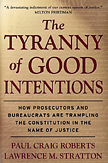
Great book: The Tyranny of Good Intentions

tyranny_good_intentions original hardcover image

“That which thy fathers bequeathed thee, earn it anew if thou woulds’t possess it.”  (old Anglo-Saxon maxim).  The English legal system we who now live in the United States of America inherited, historically reflected “a [very strong] tradition of the defense of individual rights against the state,” (at least since “The Glorious Revolution” in 1688).  You’ll have noticed by now, I am sure, that the far, radical Right has long referred to President Barack Obama as either “the Antichrist,” or “Hitleresque.”  They are in fact on to something, but not the right something.  A quick comparison of the status quo in effect currently, versus the situation in Germany when Hitler was “elected,” is highly illustrative.  In post-WWI Germany, “German law reflected the tradition of a strong state as the embodiment of the community by which individuals would be granted such rights as were considered compatible with its interests.”  (Jeremy Noakes & Geoffrey Pridham, eds., Documents on Nazism, 1919-1945 (New York:  Viking Press, 1975), at p. 226-27.)  Thus, Obama, even if he desired it, could not possibly have the kinds of powers Hitler wielded in the short-lived “Thousand Year Reich.”  Or whatever the hell that freaky, Hitler-moustachioed murderous asshole who ruled Germany for a while called his horrible regime — which regime is an undeserved stain on the beleaguered German people, who have since recovered that fumble neatly, and in fact probably have less economic inequality than those of us in these United States of America.

“The character of this [English-inspired, individual-oriented, American] legal system ensured that it would be revered.  In recent times, however, reverence for our legal system is being replaced by fear, distrust, and dissatisfaction.  For example, inner-city juries routinely refuse to convict criminal defendants on the basis of prosecutorial and police evidence alone.”  Witness O.J. Simpson!

“The twentieth century’s belief in government power as a force for good has encouraged the practice of chasing after devils.  Like a national emergency, a righteous cause can cut a wide swath through the law to more easily apprehend wrongdoers.  In recent decades, both conservatives and liberals cut swaths through the law as they pursued drug dealers, S&L crooks, environmental polluters, Wall Street insider traders, child abusers, and other undesirables.  Impatience, frustration, hysteria, political scapegoating, and greed have caused police, prosecutors, victims, and the plaintiffs’ bar to grow weary of laws that protect those accused of crimes and negligence.  The question is raised, “Why should the guilty have the benefit of law?”  Sir Thomas More’s answer (as presented in A Man for All Seasons) is that when the law is disregarded to better pursue the guilty, it is also taken away from the innocent.  What are we to do, he asks, if those chasing after devils decide to chase after us?  If the law is cast down, what protection do the innocent have?  A little liberty taken here, a precedent there, and the Rights of Englishmen become history, a clear-cut area where once mighty oaks stood.”

The Tyranny of Good Intentions, How Prosecutors and Bureaucrats are Trampling the Constitution in the Name of Justice, Paul Craig Roberts & Lawrence M. Stratton, authors, ISBN 0-7615-2553-X, FORUM press, an imprint of Prima Publishing, 3000 Lava Ridge Court, Roseville, CA  95661 (copyright, 2000).

the spookiest thing, for me, as a person??  this was all written & predicted well before 9/11 or the Patriot Act, or two bizarre wars which we are still sort of in but sort of not, before Obama, before the “Tea Party,” the current crop of mad hatters & dormice… before any of it.  why aren’t we calling these guys to hear what they have to say next??????

Leave a comment

Filed under legal writing, notes

Petition for a Writ of Certiorari to the U.S. Court of Appeals for the Second Circuit (to the United States Supreme Court), a legal writing sample

supreme_court_building

“Certiorari (/ˌsɜrʃⁱəˈrɛəraɪ/, /-ˈrɛəri/, or /-ˈrɑri/) is a type of writ seeking judicial review, recognized in Roman, U.S., English, Canadian, Philippine, and other law, meaning an order by a higher court directing a lower court, tribunal, or public authority to send the record in a given case for review.

Certiorari is the present passive infinitive of the Latin verb certioro (“to inform, apprise, show”)”

(from 2006. non-attorney black box warning: do not read this in bed. you will lose consciousness immediately)

QUESTIONS PRESENTED

In this antitrust class action, the Second Circuit held Appellant Leonardo’s, unnamed class member and objector to terms of the proposed settlement, did not preserve for purposes of appeal, its objections to Appellee Class Counsel’s fee request. The questions presented are:

1. Whether the Ninth Circuit correctly held Appellant Leonardo’s did not preserve its objections to Appellee Class Counsel’s fee request.

2. Whether risk enhancement fee-multipliers are appropriate in cases brought under federal fee-shifting statutes, specifically antitrust cases.

PARTIES TO THE PROCEEDING

All parties are listed in the caption.

RULE 29.6 STATEMENT

Petitioners 710 Corporation and Leonardo’s Pizza By the Slice, Inc. are privately held Florida corporations. There are no corporate parents, affliates or publicly held companies that own 10% or more of its stock.

TABLE OF CONTENTS

TABLE OF AUTHORITIES

PETITION FOR A WRIT OF CERTIORARI

TO THE UNITED STATES COURT OF APPEALS FOR THE SECOND CIRCUIT

710 Corporation and Leonardo’s Pizza By the Slice, Inc, petitioners herein, respectfully petition this Court for a writ of certiorari to review the judgment of the United States Court of Appeals for the Second Circuit, entered in the above-titled case on January 4, 2005.

OPINIONS BELOW

The opinion of the court of appeals is reported at 396 F.3d 96. The opinion of the district court is reported at 297 F.Supp.2d 503.

JURISDICTION

The judgment of the court of appeals was entered on January 4, 2005. The jurisdiction of this Court is invoked under 28 U.S.C. §1254(1).

STATUTES INVOLVED

This class action case arises under Sections 1, 2, 4 and 15 of the Sherman Antitrust Act, 15 U.S.C. §§1, 2, 4 and 15. Exclusive jurisdiction within the United States courts is granted by 28 U.S.C. §1331 and §1337.

STATEMENT OF THE CASE

This class action arises under Sections 1, 2, 4 and 15 of the Sherman Antitrust Act, 15 U.S.C. §§1, 2, 4 and 15. Exclusive jurisdiction within the United States courts is granted by 28 U.S.C. §1331 and §1337. This appeal concerns the Second Circuit’s Opinion issued January 4, 2005, affirming the district court’s Memorandum and Order entered December 19, 2003, approving the proposed class action settlement and the plan of allocation, and awarding attorneys’ fees to lead counsel and 29 other law firms. In re Visa Check/Mastermoney Antitrust Litigation, 297 F.Supp.2d 503, 507 (E.D.N.Y. 2003).

Named Plaintiffs representing a class of approximately five million merchants filed this antitrust action on October 25, 1996, against defendants Visa and Mastercard alleging the existence of a tying arrangement in violation of Section 1 of the Sherman Act, based upon defendants’ requirements that any merchant honoring their credit cards must honor their debit cards as well. In re Visa Check/Mastermoney Antitrust Litigation, 297 F.Supp.2d 503, 507 (E.D.N.Y. 2003); and In re Visa Check/Mastermoney Antitrust Litigation, 280 F.3d 124, 129-30 (2nd Cir. 2001). Named Plaintiffs also alleged that the defendants conspired and attempted to monopolize the debit card industry, in violation of Section 2 of the Sherman Act. Id. A class was certified on February 22, 2000, and the Second Circuit affirmed that class certification on October 17, 2001. In re Visa Check/Mastermoney, 280 F.3d 124 (2nd Cir. 2001). Summary judgment motions were heard on January 10, 2003. In re Visa Check/ Mastermoney, 297 F.Supp.2d at 507-508. Defendants’ motions were denied in full; the class’ motions were granted in part.

In its summary judgment opinion, the district court found that there were no issues of material fact as to four of the elements of the per se antitrust analysis with respect to Defendant Visa, and no issues of material fact for all but the fourth with respect to Defendant Mastercard, as follows: “(1) that the tying arrangement affects a substantial amount of interstate commerce; (2) the two products are distinct; (3) the defendant actually tied the sale of the two products; and (4) the seller has appreciable market power in the tying market.” In re Visa Check/Mastermoney Antitrust Litigation, 2003 WL 1712568 at *2-*5 (E.D.N.Y. 2003). The court also determined there was no issue of material fact regarding the relevant product market. Id. at *7.

Trial of this case began April 28, 2003, but was suspended when Defendant Mastercard agreed to settle. Id. All parties entered a proposed settlement on April 30, 2003. Id. Unnamed Class Members and Objectors, 710 Corporation and Leonardo’s Pizza By The Slice, filed their Preliminary Objections to Proposed Settlement on September 5, 2003, and appeared at the fairness hearing held on September 25, 2003. The trial court issued its Memorandum and Order on December 19, 2003, approving the proposed settlement and plan of allocation, and awarding attorneys’ fees to lead counsel and 29 other law firms representing class members. In re Visa Check, supra, 297 F.Supp.2d at 507.

REASONS FOR GRANTING THE PETITION

The Second Circuit’s Ruling on Preservation of Issues for Appeal
Is Clearly Erroneous and an Error of Law

The first question presented is whether Appellant Leonardo’s preserved its objections, at the district court level, to Appellee Class Counsel’s fee request. In its opinion issued January 5, 2005, the Second Circuit held Appellant Leonardo’s “did not preserve” its objections to class counsel’s fee request at the district court level, stating in its opinion at footnote 29, “[a]t the district court, Leonardo’s failed to contest class counsel’s fee petition. […] The record is clear: Leonardo’s did not preserve for appeal its challenge to the fee award.” Wal-Mart v. Visa/Mastercard, Appellees v. Leonardo’s Pizza by the Slice, Appellant, 2005 WL 15056 (2nd Cir. 2005) at *21, n. 29. This assertion is factually and legally contradicted by the record as well as the district court’s prior rulings. Appellee/Class Counsel’s own Brief in Opposition admits that Appellant Leonardo’s both objected to the Fee Petition, and incorporated all other unnamed class members fee objections, including those objections based on fee-shifting arguments. Appellee/Cross Appellant-Class Counsel’s Brief (i) in Opposition to the Appeal of Objectors 710 Corp. and Leonardo’s Pizza By the Slice, Inc. and (ii) in Support of Class Counsel’s Cross-Appeal from the District Court’s Award of Attorneys’ Fees, at pp. 52-53.

In addition, the district court specifically told all objectors at the fairness hearing, “[l]et me emphasize at the outset that I have read these objections. It is not useful simply to repeat them. I am going to give you an opportunity to be heard, but don’t feel constrained to get up and repeat what is in your papers as though nobody has read them. I have. So you don’t need to speak if you don’t want to.” Transcript of Proceedings, Settlement Fairness Hearing, September 25, 2003, p. 8. Appellant Leonardo’s counsel, Edward Cochran, was permitted “up to five minutes” to present argument. Id. at 12. On the subject of class counsel’s fee award, Mr. Cochran complied with the trial court’s request for brevity, stating clearly, “our objections contain matters as to the fee. I will not speak on that at all fully. I will incorporate the comments of other objectors so that they are not repeated.” Id. at 58.

The Second Circuit claimed there was only “one sentence addressing the fee petition in Leonardo’s ten-page brief objecting to the Settlement.” Wal-Mart, supra, at *21, n. 29. In fact, at least seven of the 13 separate paragraphs, contained in Appellant Leonardo’s brief objecting to the Settlement, refer to the issue of Class Counsel’s fee request, as follows:

7. The June 13, 2003 Notice specifically fails to inform class members what the amount of the attorney’s fees in this matter are, or will be, or will be requested and the relationship, in terms of a percentage, of the amount of the attorney fees to the rest of the settlement.

8. The June 13, 2003 Notice specifically fails to inform class members as to whether the attorney’s fees are based on the present value of the settlement or the potential payout over time, and whether the attorney fees are to be paid up front or over time in synchronization with the payout to class members.

9. The June 13, 2003 Notice deprives unnamed class members of Due Process of Law by allowing the Class Counsel to file for a specific amount of attorney’s fees over a month later on August 18, 2003, without re-notice to, or publication to, the class of the specific amount requested.

10. The June 13, 2003 Notice deprives unnamed class members of Due Process of law by requiring unnamed class members to calendar the August 18, 2003 date and then search on-line to find Class Counsel’s fee request.

11. The June 13, 2003 Notice deprives unnamed class members of Due Process of law by allowing class counsel to effectively shorten the time period for objecting to their requested fees to 18 days, i.e. from August 18, 2003 until September 5, 2003.

12. Objectors respectfully request to reserve the right to adopt and incorporate in their Preliminary Objections to the Proposed Settlement all other timely filed objections that are not inconsistent with these Objections.

13. Objectors request the Court carefully consider the amount of attorneys’ fees and expenses requested by class counsel, an issue which Objectors expressly reserve for further argument when the matter of fees is considered.

Appellants 710 Corp. and Leonardo’s Pizza By the Slice, Inc. Preliminary Objections to Proposed Settlement, pp. 8-9 (emphasis added). This utterly refutes Appellee Class Counsel’s assertion, “Leonardo’s barely objected to the fee petition.” Appellee’s Opening Brief, supra at 52.

The Second Circuit did not rule in accord with the record below. An issue is reviewable on appeal if it was “pressed or passed upon below.” United States v. Williams, 504 U.S. 36, 41 (1992) (internal citations omitted). “A claim is ‘pressed or passed upon’ when it fairly appears in the record as having been raised or decided.” United States v. Harrell, 268 F.2d 141, 146 (2nd Cir. 2001). Here, the Second Circuit ignored both the record and the district court’s specific factual finding that Appellant Leonardo’s objected to the Fee Petition.

The district court here below, in In re Visa Check/Mastermoney Antitrust Litigation, 297 F.Supp.2d 503, 522, n. 27 (E.D. N.Y. 2003), clearly and unmistakably found that Appellant preserved its objections to class counsel’s fee request, stating, “[a]s noted earlier, 17 merchants filed objections to the fee request. They are: Round House, Inc. d/b/a Smuggler’s Cove; Ron Fred, Inc. d/b/a Bailey’s; Ron Jen., Inc. d/b/a The Boathouse; Preston Center Personal Training, Inc.; Roman Buholzer d/b/a The Continental Garden Restaurant; Rent Tech, Inc.; Rental Solutions, Inc.; Thomas McMackin (as President of Wagner’s Bakery, Inc.); Beaches N Cream; Kickers Corner of the Americas, Inc.; Leonardo’s Pizza by the Slice; 710 Corp.; Sounds Deals, Inc.; Digital Playroom, Inc.; Southern Network Services, Inc.; Duke Products, Inc.; and Village Fabrics and Furnishings, Inc.” Thus, the record is clear that at the district court level, Appellant Leonardo’s contested class counsel’s fee petition, and in so doing, preserved its rights to appeal.

Further, the cases cited by the Second Circuit for the proposition that “where a party has shifted his position on appeal and advances arguments available but not pressed below, … waiver will bar raising the issue on appeal,” are criminal cases which all refer specifically to Federal Rules of Criminal Procedure, Rule 12(b)(3) and Rule 41(h), which concern motions to suppress evidence. “Rule 12(f) of the Federal Rules of Criminal Procedure clearly states that ‘[f]ailure by a party to raise . . . objections . . . shall constitute waiver thereof, but the court for cause shown may grant relief from the waiver.’” United States v. Singh, 628 F.2d 758, 762 (2nd Cir. 1980).

Appellant Leonardo’s has not in any way shifted its position on appeal. Appellee Class Counsel was fully informed of all legal arguments at issue in this appeal at the time of trial. Thus, the “waiver” rationale used by the Second Circuit is simply inapplicable.

This Court is the Only Source of Guidance to the Circuits on Whether Risk Enhancement
Fee Multipliers are Inappropriate in Cases Brought Under Federal Fee-Shifting Statutes, Specifically Antitrust Cases

The second question presented here is whether risk enhancement fee-multipliers are appropriate in cases brought under federal fee-shifting statutes, specifically antitrust cases. This Court has previously indicated, in City of Burlington v. Dague, 505 U.S. 557 (1992), that contingency risk fee enhancements for any and all cases brought under federal fee-shifting statutes are impermissible. In Dague, this Court determined “that enhancement for contingency is not permitted under the [federal] fee-shifting statutes at issue.” Dague, supra, at 567. This ruling is applicable to all federal fee-shifting statutes regardless of their subject matter. This Court explicitly stated that “our case law construing what is a ‘reasonable’ fee applies uniformly to all of them [federal fee-shifting statutes].” Dague, supra, at 562. Consequently, a reasonable fee is to be determined without regard for contingent risks. Id. at 566.

The instant case is by nature, as are all private antitrust actions, a statutory fee-shifting case. 15 U.S.C. §15 states: “[A]ny person who shall be injured in his business or property by reason of anything forbidden in the antitrust laws may sue therefor […] and shall recover threefold the damages by him sustained, and the cost of suit, including a reasonable attorney’s fee.” If the instant case had not settled but proceeded to trial and was concluded by judgment, the possible recovery for the class would have been trebled, but the attorneys’ fees would have been limited to the unenhanced lodestar under the holding of Dague, supra. This is one reason why it is important that antitrust class action “[s]ettlements do not come too early to be suspicious nor too late to be a waste of resources.” In re Vitamins Antitrust Litigation, 305 F.Supp.2d 100, 105 (D.D.C. 2004).

Under the antitrust laws, attorneys’ fees to the injured party are compulsory. “Section 4 of the Clayton Act states, in pertinent part, that ‘any person who shall be injured in his business or property by reason of anything forbidden in the antitrust laws may sue therefor … and shall recover threefold the damages by him sustained, and the cost of suit, including a reasonable attorney’s fee.’ 15 U.S.C. § 15(a).” United States Football League v. National Football League, 887 F.2d 408, 411 (2nd Cir. 1989). In USFL, the plaintiff was awarded damages of $1, trebled to $3, and attorneys’ fees of $5.5 million. “What is important is encouraging the detection and cessation of anticompetitive behavior, not the amount of damages found.” Id. at 412. Thus, if attorneys pursuing antitrust cases are allowed full, reasonable fees in the face of nominal damages, it stands to reason that attorneys should be awarded full (lodestar), presumptively reasonable fees in the face of a higher judgment or settlement.

The Third Circuit, though not faced with this precise issue, recently warned of this danger in Brytus v. Spang, 203 F.3d 238, 247 (3rd Cir. 2000), stating “there remains the possibility that in some cases counsel for a class of plaintiffs may receive a higher fee award upon settlement than they would have received had the case proceeded to judgment.” However, in Brytus, the court declined to rule on “some hypothetical situation that might be presented in the future.” This formerly “hypothetical” situation has presented itself to this Court. Class counsel here received more upon settlement than they would had the case been concluded by judgment favorable to the affected class. To enhance antitrust fees in the settlement context, but not the judgment context, puts the interests of class counsel and class members fundamentally, and irremediably at odds.

This is an issue of critical importance and first impression in the law of fee awards. “Although the Supreme Court has not addressed whether this prohibition [against risk enhancements] also applies in common fund cases, […] ‘the Court’s reasoning for excluding risk enhancements in fee-shifting cases applies equally to common fund cases.’ […] [J]urisdictions are split as to the application of risk enhancements in the common fund context.” In re Prudential Ins. Co. of America Sales Practices Litigation, 148 F.2d 283, 341 at n. 121 (3rd Cir. 1998) (quoting In re Prudential Fee Opinion, 962 F.Supp. 572, 581 n.24 (D.N.J. 1997)). Recently, in Staton v. Boeing, 327 F.3d 938, 966 (9th Cir. 2003), the court stated, “[w]ere the amount of fees Boeing agreed to pay in the settlement agreement distinctly higher than the fees class counsel could have been awarded by the district court using the lodestar method, the court would almost surely have had to find the fees unreasonable.” Although that particular situation was not before the Ninth Circuit in Brytus, the court nonetheless warned, “courts have to be alert to the possibility that the parties have adopted [their particular settlement agreement] precisely because the fee award is in fact higher than could be supported on a statutory fee-shifting basis[…].” Id. at 970.

This Court has “established a ‘strong presumption’ that the lodestar represents the ‘reasonable’ fee.” City of Burlington v. Dague, 505 U.S. 557, 562 (1992). In Dague, this Court determined “that enhancement for contingency is not permitted under the [federal] fee-shifting statutes at issue.” Dague, supra, at 567. This ruling is applicable to all federal fee-shifting statutes regardless of their subject matter. This Court explicitly stated that “our case law construing what is a ‘reasonable’ fee applies uniformly to all of them [federal fee-shifting statutes].” Dague, supra, at 562. Consequently, a reasonable fee is to be determined without
regard for contingent risks. Id. at 566.

Further, this Court found that if contingency enhancement were to be used in any contingent fee cases (brought under fee-shifting statutes), it would have to be applied to all such cases. Dague, supra, at 565. This result would, this Court reasoned, encourage non-meritorious claims to be brought, which is against public policy and Congressional intent. Dague, supra, at 563. This Court therefore concluded that “just as the statutory language limiting fees bars a prevailing plaintiff from recovering fees relating to claims on which he lost, so should it bar a prevailing plaintiff from recovering for the risk of loss.” Dague, supra, at 565.

This Court was especially concerned with the fact that “[t]o award a contingency enhancement under a fee-shifting statute would in effect pay for the attorney’s time (or anticipated time) in cases where his client does not prevail.” Dague, supra, at 565. Thus, this Court concluded, “[i]t is neither necessary nor even possible for application of the fee-shifting statutes to mimic the intricacies of the fee-paying market in every respect.” Dague, supra, at 566-67.

The instant case is definitely unique, since it is, in all likelihood, the largest settlement in class action history, with the value of the compensatory relief to the class approximated at $3.383 billion. In re Visa Check/Mastermoney, 297 F.Supp.2d at 508. This is due entirely to the size of the affected class, which is approximated at five million members. Id. at 506. The set of circumstances presented here has resulted in a “distortion of the equitable fund theory,” warned against in City of Detroit v. Grinnell Corp., 560 F.2d 1093, 1098 (2nd Cir. 1977) (“Grinnell II”).

Extremely large “megafund” cases involve fee-calculation hazards not present in smaller cases. For example, in a securities class action case involving a settlement of approximately $687 million, the judge observed,“the immense size of the settlement fund in this action far exceeds the amount of settlement funds in virtually all similar cases that counsel have cited and/or that the Court has reviewed. Just one percent of the settlement in this action is the equivalent of nearly seven million dollars. Every adjustment of .1% (1/10 th of one per cent) in an applied percentage would result in a fee variance amounting to approximately $700,000.” In re Washington Public Power Supply System Securities Litigation, 779 F.Supp. 1063, 1085 (D.Ariz. 1990); vacated in part, 19 F.3d 1291 (9th Cir. 1994). An even greater potential for fee-calculation error exists in the instant case. One-tenth of one per cent (0.1%) here is approximately $3,383,400.

CONCLUSION

The petition for a writ of certiorari should be granted.

Leave a comment

Filed under legal writing

PMI Brief, a legal writing sample, wherein atty. KTP nails the opposing party to the wall

illustration down in florida swarm of sharks

needless to say, the opposing party settled before the appellate court could make its ruling. talk about dead in the water! i am one of the sharks you see floating effortlessly in that incoming wave. atlantic ocean, needless to say. non-lawyers, black box warning: your eyes will glaze over & you may suffer permanent mental injury from attempting to read the following:

I. STATEMENT OF SUBJECT MATTER AND APPELLATE JURISDICTION

This case arises under Section 207(a) of the Real Estate Settlement Procedures Act (“RESPA”), 12 U.S.C. section 2601 et seq., which provides in pertinent part that:

No person shall give and no person shall accept any fee, kickback, or thing of value pursuant to any agreement or understanding … [in order] that business incident to or part of a real estate settlement service involving a federally related mortgage loan shall be referred to any person.

Along with RESPA, federal antitrust laws, federal administrative, regulatory and common law claims are involved. In addition to these federal law claims, various state statutory and common law provisions are at issue, including state antitrust laws, insurance statutes and regulations, anti-rebate and anti-inducement statutes and regulations, and consumer protection laws. The district court had jurisdiction of this action under 12 U.S.C. section 2614 and 28 U.S.C. sections 1331 and 1367.

This appeal concerns the district court’s Order dated June 8, 2001, denying Appellants’ Ernest and Debra Kelley’s Motion to Intervene (Appendix, p. ??); its Orders dated June 22, 2001, granting final approval of the settlement and certification of the settlement classes (Appendix, p. ??), awarding attorney’s fees and expenses (Appendix, p. ??), and entering its injunction (Appendix, p. ??); its Order dated June 26, 2001, approving the settlement and dismissing the action (Appendix, p. ??); and its Order dated September 19, 2001, denying Objectors’ Motion for New Trial or to Amend Judgment (Appendix, p. ??).

Class Members, Proposed Intervenors, and Settlement Objectors Ernest and Debra Kelley filed a notice of appeal with this Court on October 18, 2001. This Court has jurisdiction pursuant to 28 U.S.C. section 1291.

II. STATEMENT OF ISSUES

A. Whether the district court breached its fiduciary duty to the members of the putative class by denying the Kelleys’ Motion to Intervene, despite their status as class claimants and settlement objectors, where their only means of receiving the benefit of appellate review of the terms of settlement was by such intervention.

B. Whether the district court forfeited its jurisdiction over the nationwide class of claimants for settlement purposes after granting summary judgment in favor of defendant against the named plaintiffs/putative class representatives solely on issues of Georgia law as being inversely preemptive of RESPA; or, alternatively,

Whether the district court breached its fiduciary duty to members of the putative class by defining the class for settlement purposes in such a way as to treat claimants with differing state legal and equitable claims as identical.

C. Whether the district court breached its fiduciary duty to the plaintiff class by finding the terms of the proposed class action settlement, which amounted to only approximately 10% of claimants’ potential damages, did not differentiate between class members with substantively distinguishable state law claims, and provided little meaningful equitable relief, to be fair.

D. Whether class certification was an abuse of discretion in this case, even for settlement purposes, in light of the February 5th, 2003 Order issued by the district court below in the companion cases, Barnes v. Republic Mortgage Insurance and Patton v. Triad Guaranty Insurance Co. (Appendix, p. ??)

III. STATEMENT OF THE CASE

This case was filed in federal District Court for the Southern District of Georgia as a national class action on December 17, 1999, by the named plaintiffs/putative class representatives, who are residents of the State of Georgia, against Defendant.

Named plaintiffs/putative class representatives filed a motion for class certification on May 31, 2000. Defendant filed a motion for summary judgment on June 9, 2000. Defendant was granted summary judgment on August 14, 2000, against the named plaintiffs/putative class representatives, by the district court based on Defendant’s argument that the McCarran-Ferguson Act, 15 U.S.C. sections 1011-1015, barred all claims brought under RESPA, in Georgia, because RESPA had the effect of indirectly regulating the business of insurance in that state.

Thereafter, the named plaintiffs/putative class representatives and the defendant entered into a settlement agreement. On December 15, 2000, named plaintiffs/putative class representatives filed a motion to preliminarily approve the settlement, and the district court granted that motion on December 20, 2000. Notice of the pending settlement was given in March, 2001, to class members, with a deadline to object or opt-out by April 24, 2001. Appellants filed their objections to the settlement on April 24. The fairness hearing was scheduled on June 15, 2001, and Appellants moved to intervene in the action on June 6, 2001. The district court held a hearing on that motion on June 7, and denied same.

The district court approved the settlement as binding on the entire class of claimants, after the fairness hearing, by Order dated June 22, 2001. Appellants, Ernest and Debra Kelley, are unnamed members of the class, attempted intervenors, and objectors to the overall fairness of the settlement.

This appeal challenges (1) the district court’s Order denying Objectors’ Motion to Intervene, dated June 8, 2001, (2) its Order granting Plaintiff’s Motion for Final Approval of Settlement and Certification of the Settlement Classes, dated June 22, 2001, (3) its Final Order Approving Settlements and Certifying Settlement Classes, dated June 22, 2001, (4) its Injunction entered June 22, 2001, (5) its Final Judgment Approving Settlement and Dismissing Action, dated June 26, 2001, (6) its Final Judgment Awarding Attorney’s Fees and Reimbursement of Expenses, dated June 26, 2001, and (7) its Order denying Objector’s Motion for New Trial Pursuant to F.R.C.P. 59(a) or to Amend Judgment Pursuant to F.R.C.P. 59(e), dated September 19, 2001.

IV. STATEMENT OF FACTS

A. Background

Defendant issues mortgage guaranty insurance covering loans made by various lenders, loans secured by the residences of the members of the class of borrowers. Mortgage insurance is typically required by lenders when the amount of down payment from the borrower is less than 20% of the purchase price of the real property. The mortgage insurance is designed to protect the lender in the event of the borrower’s default on the loan. Although the borrower pays the premiums, the contract of insurance is between the lender and the mortgage guaranty insurer.

The allegations in the complaint were to the effect that Defendant had provided kickbacks to numerous lenders involved in loan transactions with members of the class of mortgage borrowers, kickbacks prohibited under RESPA, in order to secure referrals to Defendant of the lenders’ mortgage guaranty insurance business. The kickbacks were alleged to have been provided by Defendant’s offering other insurance products to lenders, at below-market rates. Thus, mortgage guaranty insurance premiums, ultimately paid by the borrower on behalf of the lender, were inflated to the extent unearned kickbacks were transferred to the lender. This is exactly the type of harm RESPA was designed to prevent.

B. Settlement Negotiations

Both before and after the named plaintiffs/putative class representatives lost on summary judgment, they engaged in settlement negotiations with the defendant. See Declaration of James F. McCabe in Support of Motion for Approval of Settlement Involving PMI Mortgage Insurance Co. (Declaration, pp. 1-2, Appendix, p. ??) The first settlement discussions took place in March, 2000. In July 2000, settlement discussions took place again. In August, 2000, the summary judgment in favor of Defendant was entered. In November, 2000, the named plaintiffs/putative class representatives reached a settlement agreement with Defendant.

In its Order approving the settlement dated June 22, 2001, with respect to the summary judgment in favor of Defendant, the district court stated, “Defendants understood their victory would be short-lived because it only bound named Plaintiffs and the actions could be easily refiled using other named representatives in other jurisdictions. Accordingly, the court concludes when the settlement was reached is not dispositive of the fairness, adequacy and reasonableness of the settlement.” (Order, pp. 26-27, Appendix, p. ??)

However, the actions hypothesized by the district court never occurred. Other representatives were not substituted for the named plaintiffs, and the action was not refiled in another jurisdiction. The named plaintiffs, at the time of settlement, were without a meritable claim and were consequently without proper authority to negotiate a settlement on behalf of a nationwide class whose claims were still “alive.”

C. Proposed Settlement

The settlement provides for payment of $35.47 per class member. Average individual damages for each class member are estimated at $300. See Order of June 22, 2001, p. 10. (Appendix, p. ??) The total amount of the proposed payment to the class is $40 million, plus attorney’s fees and costs. Order, p. 8. (Appendix, p. ??) Attorney’s fees and costs of $10.8 million are awarded to named plaintiff’s counsel. Order, p. 17. (Appendix, p. ??)

D. Ernest and Debra Kelley’s Objections to the Settlement’s Fairness

The notice of pendency to the class members was inadequate to inform them as to the true nature and severity of the violations of federal and state law alleged.

The damage award is insufficient to the point of being violative of due process.

Requiring the members of subclass A to file claim forms is unfair to the point of being violative of due process.

Subclass A’s unclaimed funds do not revert to members of the other subclasses, but are distributed to charity.

The injunction is valueless and meaningless since it dissolves after approximately 2 years.

There was inadequate representation by counsel for named plaintiffs for the class as a whole.

The size of the award of attorney’s fees to counsel for named plaintiffs is excessive.

See Appendix, p. ??, for the complete brief in support of Appellant’s objections.

E. Final Approval

The district court held a hearing on June 15, 2001 and, over the objections of numerous class members, approved the terms of the proposed settlement by Order dated June 22, 2001. (Appendix, p. ??)

V. STATEMENT OF RELATED CASES & PROCEEDINGS

A. Appellate Proceedings, Current

Downey v. Mortgage Guaranty Insurance Corp., Michael B. and Robin H. Hopkins, Movants-Appellants, Appeal Nos. 01-13663-TT & 02-11064-TT (11th Cir.).
Pedraza v. United Guaranty Corporation, United Guaranty Residential Insurance Co., Ernest H. and Debra J. Kelley, Movants-Appellants, Appeal No. 01-13895-TT (11th Cir.).
Baynham v. PMI Mortgage Insurance Co., Elizabeth F. Savage, Movant-Appellant, Appeal No. 01-13897-TT (11th Cir.).

B. Appellate Decisions, Reported

Baynham v. PMI Mortgage Insurance Co., 313 F.3d 1337 (11th Cir. 2002).

C. Trial Proceedings, Current

Barnes v. Republic Mortgage Insurance Co., No. CV199-240 (S.D. Ga.).
Patton v. Triad Guaranty Insurance Co., No. CV100-132 (S.D. Ga.).

D. Trial Decisions, Reported

Pedraza v. United Guaranty Corp., 114 F.Supp.2d 1347 (S.D. Ga. 2000)

VI. STANDARD OR SCOPE OF REVIEW

The legal basis for the district court’s decision on intervention as of right is reviewed de novo. The factual basis for the district court’s determination regarding the timeliness of the motion for intervention is reviewed for an abuse of discretion. Meeks v. Metropolitan Dade County, 985 F.2d 1471-77 (11th Cir. 1993).

Whether the defeated named plaintiffs/putative class representatives had standing, on behalf of the national class of claimants, to negotiate and enter into a settlement with defendant and whether the district court had jurisdiction over that settlement is reviewed de novo. See Griffin v. Dugger, 823 F.2d 1476, 1482 (11th Cir. 1987) (“Only after the court determines the issues for which the named plaintiffs have standing should it address the question whether [they] have representative capacity, as defined by Rule 23(a)….”), cert. denied, 486 U.S. 1005 (1988).

The trial court’s grant of class certification and refusal to consider subclasses is reviewable for an abuse of discretion. Andrews v. American Telephone & Telegraph Co., 95 F.3d 1014 (11th Cir. 1998). The decision approving the settlement is reviewed for an abuse of discretion. Sterling v. Stewart, 158 F.3d 1199 (11th Cir. 1998).

The district court’s decisions concerning Rule 59 Motions are reviewed de novo with regard to legal determinations, such as standing, and for an abuse of discretion with regard to factual determinations. Lockard v. Equifax, Inc., 163 F.3d 1259 (11th Cir. 1998).

VII. SUMMARY OF ARGUMENT

Settlements of class actions are to be encouraged as a matter of sound public policy, but not at the sacrifice of due process considerations. The district court in this case has not served the interests of the absent class members. The trial judge is in a fiduciary capacity with regard to absent class members, and must properly exercise this duty. There is a difference between promoting the desirability of settlements as a general proposition, and promoting them above any and all other considerations, including the consideration of due process and fairness to absent class members.

Adequate representation must be demonstrated by more than self-serving, congratulatory representations by counsel for both sides. The named class representatives below should have been substituted after a summary judgment fatally unfavorable to them. A putative class representative having no remaining stake in the case due to missing elements of his/her claim cannot adequately represent the class. Settlements procured prior to the certification of a class require special scrutiny, and settlements procured under conditions of undue pressure as a result of rulings fatally adverse to all named plaintiffs/putative class representatives deserve even more intense scrutiny. At a minimum, state-law determined subclasses should have been certified. The trial judge is in a fiduciary capacity with respect to absent class members. The district court’s overall fairness evaluation was the result of incorrect application of law, and was also factually an abuse of discretion.

Judicial economy is not served by the senseless denial of motions to intervene for the limited purposes of appeal of a class action settlement approval. Nor is judicial economy served by Appellants/Objectors/Proposed Intervenors being required to bring collateral actions under the trial court’s heavily advocated opting-out route. The improper denial of intervention below has led to four long years of delay in Appellants receiving their due process rights, and this settlement receiving the benefit of appellate review.

VIII. ARGUMENT & CITATION OF AUTHORITY

A. The district court breached its fiduciary duty to the members of the putative class by denying the Hopkins’ and Kelleys’ Motion to Intervene, despite their status as class claimants and settlement objectors, where their only means of receiving the benefit of appellate review of the terms of settlement was by such intervention.

At the time this appeal was filed, there was a disagreement among Circuit Courts of Appeal as to whether a nonnamed class member who had not formally intervened could appeal the approval of a class action settlement. The Supreme Court had not yet decided Devlin v. Scardelletti, 122 S.Ct. 2005, (2002), which holds that nonnamed class members who object in a timely manner to the approval of a settlement at a fairness hearing may bring an appeal, without first intervening. The discussion ensuing below does not reflect the effect Devlin may have upon the instant appeal.

In the district court’s Order Granting Plaintiff’s Motion for Final Approval of the Proposed Settlement and Certification of Settlement Class, dated June 22, 2001, at pp. 8-9, the court explicitly found the following facts, thus determining the appropriateness of class action status for this case: “[T]he range of recovery available to the individual claimant is small and circumscribed. […] There is no dispute that damages, even for the larger mortgage insurance policies, would amount to hundreds of dollars at most. In fact, these cases were brought as class actions because the small amount of damages per violation meant that individual actions were economically impractical given the litigation costs.” (Appendix, p. ??) The court went on to state that potential damages for violations under RESPA consist of three times the amount of any proscribed kickback. (Order, p. 8, Appendix, p. ??)

With that ruling in place, how, then, could the district court later determine, in its Order of September 19, 2001, p. 8-9, the following: “Of great weight is the fact that all Objectors were given an opportunity to opt-out of the proposed class settlement, but did not. Objectors appeared at the fairness hearing where the Court reiterated the availability of opting-out if they were not satisfied with the terms of the proposed settlement, yet Objectors still chose not to opt-out.” (Appendix, p. ??) The district court gives “great weight,” in its repudiation of proposed intervenors’ Objections to settlement, to the “decision” by them not to bring individual opt-out actions, yet that “decision” was as a result of the acknowledged impracticability of the costs of such litigation. However, in the district court’s holding a scant three months earlier, that economic impracticability was the factual basis for the instant case’s class action status.

The district court below (1) denied objectors’ motions to intervene as untimely, even though they were filed before the hearing on the settlement’s fairness, and even though they were filed for the limited purpose of preserving objectors’ right to appellate review of the settlement’s fairness, (2) denied objectors’ standing to appeal its approval of the settlement, (3) denied all fairness objections to the settlement, and (4) denied objectors’ Rule 59 Motions for New Trial on the basis that, as unnamed class members who “had not intervened,” they had no standing to bring such motions, nor to appeal his fairness determination. The district court’s rulings are as nonsensical as those of Alice in Wonderland’s Red Queen, a clear violation of its fiduciary duty to the absent class members, and as such, constitute an abuse of discretion.

Grilli v. Metropolitan Life Insurance Co., 78 F.3d 1533 (11th Cir. 1996) is of little help in resolving the issue here. The specific issue this Court answered in that appeal is: “Whether […] the district court (a) erred in denying the Coulters’ motion for leave to intervene in the action as a matter of right for the purpose of representing their interests and those of the Pennsylvania members of the settlement class, or (b) abused its discretion in denying the Coulters permissive intervention.” (Emphasis added.) Id. at 1538. What is being sought here is not the type of general intervention as of right as was being sought in Grilli. The type of intervention being sought here is solely for the limited purpose of gaining the benefit of appellate review of the fairness of the settlement approved by the district court. Appellants in Grilli argued they should be allowed to intervene to represent the class of claimants residing in Pennsylvania, and had actually filed suit in Pennsylvania, but had not yet been appointed representatives of any class of purchasers of MetLife products. Id.

Nor does Purcell v. BankAtlantic Financial Corp., 85 F.3d 1508 (11th Cir. 1996) help resolve this issue. This Court held that “ABC’s [attempted intervenor] interest in the collateral estoppel effect of the jury’s verdict in this case is too collateral, indirect and insubstantial to support intervention as of right.” Id. at 1513. ABC’s interest in the litigation was not as a party. It had no direct stake in the outcome of the case below, and its only concern was issues it might later have to litigate in another action. This Court determined that ABC’s interests in any separate action would not be adversely affected nor barred by collateral estoppel by the result in the case before it. Id. That situation is clearly distinguishable from the facts here. The Kelleys are unnamed members of the plaintiff class. They will be forever bound by the settlement and will have no other opportunity to proceed with their claims.

B. The district court forfeited its jurisdiction over the nationwide class of claimants for settlement purposes after granting summary judgment in favor of defendant against the named plaintiffs/putative class representatives solely on issues of Georgia law as being inversely preemptive of RESPA; or, alternatively,

The district court breached its fiduciary duty to members of the putative class by defining the class for settlement purposes in such a way as to treat claimants with differing state legal and equitable claims as identical.

Amchem Products, Inc. v. Windsor, 521 U.S. 591 (1997), discusses, among other issues, the careful analysis trial courts must undertake when considering the fairness of class action settlements negotiated and entered into before a class has been officially certified: settlement-only class certifications. The Supreme Court stated, “proposed settlement classes sometimes warrant more, not less, caution on the question of certification.” Id. at 620, FN 16. The important issue for consideration is “whether a proposed class has sufficient unity so that absent members can fairly be bound by decisions of class representatives.” Id. at 621.

If, after the summary judgment in favor of Defendant, the named plaintiffs/putative class representatives had no meritable claim, then by what authority could they negotiate a settlement? Unity between the named plaintiffs and the remainder of the plaintiff class was nonexistent. This is far worse than simply a settlement entered into before class certification: this is a settlement entered into before any plaintiff with a then-sustainable claim had come to the table.

As the Supreme Court stated, “[c]lass counsel confined to settlement negotiations could not use the threat of litigation to press for a better offer […] and the court would face a bargain proffered for its approval without benefit of adversarial investigation.” Id. It is unfair under the facts of this case, and legally incorrect under the requirements of Amchem, to bind absent plaintiffs to a deal negotiated by someone who could no longer represent them, who had no remaining unity with their interests, due to having lost their own claim, on the merits.

For exactly whose interests, at the time this settlement was being discussed, was the “class counsel” negotiating? Issues of basic contract law arise – by what authority did the “class representative” purport to act? Adequacy of representation in class actions is a fundamental due process right. While the McCarran-Ferguson ruling adverse to the plaintiffs may not be jurisdictional as to the court’s essential power over the actual named parties before it, the fact is undisputed that the named plaintiffs had lost on the merits — therefore the rest of the class, who had not yet lost, was unrepresented. The named plaintiffs, having lost on the merits of their claims, at that point represented no one. The court’s summary judgement decision against the named plaintiffs must be looked at with respect to the basic class action issues of typicality and adequacy of representation, under Rule 24, as enunciated in Amchem.

Nor can the named plaintiffs/putative class representatives pending Rule 59 motion suffice to give them authority over a nationwide class of millions of persons who would be forever bound by their present inability to threaten further litigation. The position of named plaintiffs was no longer typical nor representative of the other class members, and the court’s certification of them as class representatives was an error of law and as such must be overturned. A conflict of interest existed between named plaintiffs/putative class representatives, and the rest of the national class. See Cox v. American Cast Iron Pipe Co., 784 F.2d 1546,1557 (11th Cir. 1986) (“The claims actually litigated in the suit must simply be those fairly represented by the named plaintiffs.”), cert. denied, 479 U.S. 883 (1986). The claims actually litigated in this suit were, at the time of the settlement negotiations and achievement, barred and thus nonexistent. Adequate representation under Rule 24 cannot be so achieved. At a minimum, subclasses should have been certified.

In the case of Ramirez v. DeCoster, 203 F.R.D. 30 (D.Maine, 2001), the named individual plaintiffs, as class representatives, had lost some, but not all of their claims, on partial summary judgment – as to those defeated claims, the district court stated they had no authority to proceed on behalf of the class. Id. at 33, FN 3. The named plaintiffs in DeCoster fortunately possessed other “live”claims, which had survived summary judgment, and as to those claims they could proceed, thus the settlement they entered into on behalf of the rest of the class was enforceable. Id. at 34. The named plaintiffs’ defeated claims were ruled to have been an insignificant part of the lawsuit, and the retention of the other, more important “live” claims would allow the settlement to go forward. Id. at 37.

By contrast, the named plaintiffs here had one claim, which was defeated at summary judgment. There was no “live” claim in existence when the settlement negotiations were concluded and the settlement entered into on behalf of the class. The district court in DeCoster relied heavily on the Supreme Court’s reasoning in Amchem. The judge stated, “Amchem’s concern was to protect absentees by blocking unwarranted or overbroad class definitions and to ensure that a settlement class has sufficient unity so that absent class members can fairly be bound.” Id. The specifications of Rule 23 “demand undiluted, even heightened, attention in the settlement context. Such attention is of vital importance, for a court asked to certify a settlement class will lack the opportunity, present when a case is litigated, to adjust the class, informed by the proceedings as they unfold.” Amchem at 620.

If class certification were permitted “despite the impossibility of litigation, both class counsel and court would be disarmed.” Id. at 621. The requirement that the court approve class action settlements “protects unnamed class members ‘from unjust or unfair settlements affecting their rights when the representatives become fainthearted before the action is adjudicated or are able to secure satisfaction of their individual claims by a compromise.’” Amchem at 623 (quoting 7B Wright, Miller & Kane section 1797, at 340-341).

By refusing to divide the larger class into subclasses based on applicable state law, the district court abused its discretion. In re General Motors Corporation Pick-Up Truck Fuel Tank Products Liability Litigation, 55 F.3d 768 (3rd Cir. 1995) addresses this very issue. “[T]he district court’s failure to distinguish between groups of plaintiffs that did and those that did not confront difficult state law defenses constitutes an abuse of discretion.” Id. at 816.

The district court, in its Order Granting Plaintiff’s Motion for Final Approval of the Proposed Settlement and Certification of Settlement Class, dated June 22, 2001, stated “the [c]ourt cannot accept the legal proposition that an independent evaluation of other possible applicable law – an evaluation that could mean examining the legal framework in the 50 states and foreign jurisdictions – is necessary prior to approval of any multi-jurisdiction class settlement. Such a legal proposition is not supported by any legal authority of which the Court is aware[….]” Order, p. 25 (Appendix, p. ??) Let the district court, then, be made aware of Phillips Petroleum Co. v. Shutts, 472 U.S. 797 (1985).

In Phillips, the Supreme Court stated that “a particular set of facts giving rise to litigation could justify, constitutionally, the application of more than one jurisdiction’s laws.” Id. at 819. In Phillips, the Court decided that the law of jurisdictions other than Kansas, (the jurisdiction where the suit was brought) must be applied to claims by persons residing outside the State. “Given Kansas’ lack of ‘interest’ in claims unrelated to that State, and the substantive conflict with jurisdictions such as Texas, we conclude that application of Kansas law to every claim in this case is sufficiently arbitrary and unfair as to exceed constitutional limits.” Id. at 821. “We make no effort to determine for ourselves which law must apply to the various transactions involved in this lawsuit, and we reaffirm our observation in Allstate that in many situations a state court may be free to apply one of several choices of law. But the constitutional limitations laid down in cases such as Allstate and Home Ins. Co. v. Dick must be respected even in a nationwide class action.” Id. at 823. See Andrews v. AT&T, 95 F.3d 1014, 1024 (11th Cir. 1996) (“The appellants cite the need to interpret and apply the gaming laws of all fifty states to assess the legality of each 900-number program as foremost among the difficulties in trying the gambling claims on a class basis, and we agree.”)

In its ruling, the district court here below did not consider the application of the laws of any other jurisdictions, except perhaps fleetingly, that of Texas. Order, p. 25 (Appendix, p. ??) Thus, vacating the district court’s order “is demanded by the failure to assess the interests of the categories of plaintiffs and whether the settlement was fair, adequate and reasonable as to each.” (Emphasis in original) Piambino v. Bailey, 610 F.2d 1306, 1329 (5th Cir. 1980). See Heaven v. Trust Company Bank, 118 F.3d 735, 738 (11th Cir. 1997) (“Where the named plaintiff has no real opportunity to request certification of subclasses after his proposed class is rejected, an obligation arises for the district court to consider subclassification.”) (Citing United States Parole Comm’n v. Geraghty, 445 U.S. 388, 408 (1980)).

Recently, in the factually similar companion case, Patton v. Triad Guaranty Insurance Corp., 277 F.3d 1294, 1300 (11th Cir. 2002), this Court ruled that McCarran-Ferguson did not bar the type of RESPA claims as in the instant case, finding that RESPA “specifically relates” to the business of insurance, including mortgage insurance. This Court did not, however, “consider whether allowing Patton’s RESPA claim to proceed here would ‘invalidate, impair, or supercede’ the provisions of the Georgia Insurance Code.” Id.

C. The district court breached its fiduciary duty to the plaintiff class by finding the terms of the proposed class action settlement, which amounted to approximately 10% of claimants’ potential damages, did not differentiate between class members with substantively distinguishable state law claims, and provided little meaningful equitable relief, to be fair.

The trial court relied on the six factors enunciated in Bennet v. Behring Corp., 737 F.2d 982, 986 (11th Cir. 1984): “Specifically, the court made findings of fact that there was no fraud or collusion in arriving at the settlement and that the settlement was fair, adequate and reasonable, considering (1) the likelihood of success; (2) the range of possible recovery; (3) the point on or below the range of possible recovery at which a settlement is fair, adequate and reasonable; (4) the complexity, expense and duration of litigation; (5) the substance and amount of opposition to the settlement; and (6) the stage of proceedings at which the settlement was achieved.”

The important question unasked by the district court is, did putative class counsel adequately represent the interests of the class as a whole? This seems unlikely, especially in light of the fact that as far as class counsel knew, at the time of negotiation of the settlement, the members of the class residing in Georgia would take nothing in any action under RESPA. Panic may have set in as to how much time and effort counsel had devoted to the case already. This does not mean there was fraud or collusion, simply that counsel are, after all, human beings, subject to both the “joy of victory” and the “agony of defeat.” See In re General Motors, at 801 (“[E]ven honorable counsel – like class counsel here – may be compromised by the possibility of a large fee.”)

“[T]he district court over-emphasized the importance of defenses applicable to only some class members under certain state laws and incorrectly discounted a significant body of evidence pertinent to proving liability.” In re General Motors Corporation Pick-Up Truck Fuel Tank Products Liability Litigation, 55 F.2d 768, 816 (3rd Cir, 1995). “The settling parties, in sum, achieved a global compromise with no structural assurance of fair and adequate representation for the diverse groups and individuals affected.” Amchem at 627.

The district court based its fairness determination in large part on what it saw as the substantial barriers to the suit, including its own summary judgment in favor of defendant. This was not actually a barrier at all, since it was reversed on appeal. The district court’s holding was incorrect. Thus, its estimation of the probability of success of the suit was wrong. The suit was much more likely to succeed than the district court thought.

Settlement-only classes provide special concerns for trial courts, and those special concerns were enunciated clearly by the opinion rendered in In re General Motors at 799. There, the Third Circuit stated, “pre-certification settlement may raise the adequacy of representation standard. Since this inquiry must ascertain ‘whether there has been any collusion or undue pressure by the defendants on would be class representatives,’ […] it must carry greater weight in the settlement class context where there is an enhanced potential for those evils. […] Reliance, for the class requisites analysis, on the settlement’s terms and process also increases the importance of an independent conclusion of adequate representation (i.e., one not derived solely by reference to the nature of the negotiations).”) (Quoting First Comm. Corp. of Boston Consumer Accts. Litig., 119 F.R.D. 301, 308 (D. Mass. 1987))

Self-serving affidavits by class counsel and counsel for defendant which describe the settlement negotiations as “adversarial” and “arms’ length” mean little or nothing when named plaintiffs’ arms had already been broken – not simply fractured but well-nigh amputated – by the adverse summary judgment. (Appendix, p. ??)

D. Class certification is an abuse of discretion in this case, even for settlement purposes, in light of the February 5th, 2003 Order issued in the companion cases, Barnes v. Republic Mortgage Insurance and Patton v. Triad Guaranty Insurance Co.

The Supreme Court has outlined the requirements for settlement-only class certifications. “[A]lthough a class action may be certified for settlement purposes only, Rule 23(a)’s requirements must be satisfied as if the case were going to be litigated.” Amchem at 609. “In addition to satisfying Rule 23(a)’s prerequisites, parties seeking class certification must show that the action is maintainable under Rule 23(b)(1), (2), or (3).” Id. at 614.

The trial court below has recently issued an Order, dated February 5, 2003, Denying Motions to Certify a Class in two companion cases, factually related to the instant case: Barnes v. Republic Mortgage Insurance and Patton v. Triad Guaranty Insurance Co. (Appendix, p. ??) In that Order, the court states, “[t]he yield spread premium cases cited by Defendants involved transactions that were substantially different from the structured transactions at issue in this case, and Plaintiffs seek to distinguish them. However, the [c]ourt finds that the underlying rationale of those cases applies here with equal force.” (Order, p. 6, Appendix, p. ??)

The district court based its ruling on an unclear comparison it drew between mortgage guaranty insurance premiums and an unrelated HUD statement of policy regarding another subject entirely, that of yield spread premium payments to mortgage brokers. However, the clear text of the regulation reveals no such analogous intent on the part of HUD to generalize its policy from yield spread premium payments to any other types of payments within the ambit of RESPA. HUD published its Policy Statement II specifically to “eliminate any ambiguity concerning the Department’s position with respect to those lender payments to mortgage brokers characterized as yield spread premiums […] as a result of questions raised by two recent court decisions, Culpepper v. Irwin Mortgage Corp. and Echevarria v. Chicago Title and Trust Co., respectively.” HUD Policy Statement II, at 53052.

This Court has recently decided issues involving yield spread premiums, in the case of Heimmermann v. First Union Mortgage Corp., 305 F.3d 1257 (11th Cir. 2002). Upon close analysis, it is clear the district court overreached with regard to applying the HUD statement of policy — which explicitly and specifically referred only to yield spread premium cases — to the dissimilar situation of mortgage guaranty insurance premiums. The HUD statement was a definition of unlawful kickbacks with direct reference only to yield spread premium payments. The district court said the “underlying rationale” of that regulation applied here with equal force. But the fact is, the court is usurping the legislative role by applying a regulation which on its face applies only to yield spread premium situations to completely different transactions it was not meant to cover. The language of the statement of policy is unambiguous. Apparently, HUD feels yield spread premiums have reasonable utility to the borrower, however, in the instant set of facts there is no utility to the borrower, there are merely inflated costs which are shared between the parties who artificially inflated them, an ill-gotten bounty.

But, given the district court’s recent ruling in these companion cases, how then is it possible that court found class action treatment appropriate in the instant cases? This is, at best, inconsistent reasoning, legally flawed and an abuse of discretion.

IX. CONCLUSION

Appellants Ernest and Debra Kelley respectfully request this Court reverse the district court’s denial of intervention as of right. Appellants request this Court reverse the class certification, the approval of the class action settlement, the injunction, and all other orders and judgments entered below due to errors of law and abuses of discretion. Appellants request they be awarded their costs and that the case be remanded to the district court with appropriate instructions.

3 Comments

Filed under legal writing