Monthly Archives: March 2014

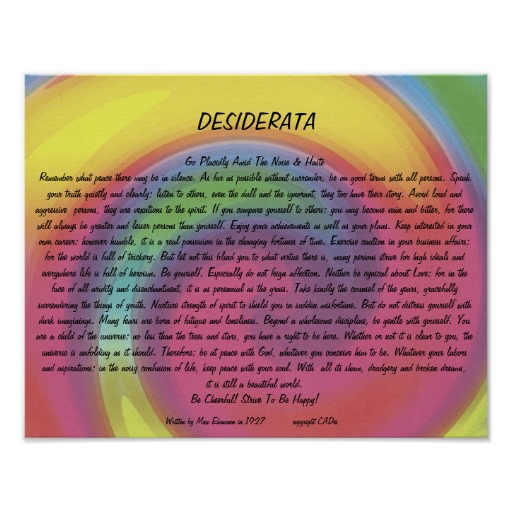
desiderata, in french, hopefully an OK translation, not by me

illustration desiderata in french

Desiderata

Aller tranquillement au milieu du bruit et la hâte et n’oubliez pas quelle paix il peut être dans le silence. Aussi loin que possible sans cession être en bons termes avec toutes les personnes. Parler de ta vérité calmement et clairement ; et écouter les autres, même le mat et l’ignorant ; ils ont aussi leur histoire. Éviter des personnes forts et agressifs, ils sont des déboires à l’esprit. Si vous comparez vous-même avec les autres, vous pouvez devenir vaniteux et amère ; pour toujours, il y aura une plus grande et la petite personnes que vous-même.
Profitez de vos réalisations ainsi que vos plans. Garder intéressés par votre propre carrière, si humble ; C’est une véritable possession dans les fortunes changeantes du temps. Faire preuve de prudence dans vos relations d’affaires; pour le monde est plein de fourberies. Mais cela laisse ne pas vous aveugler sur quel virtue est là; beaucoup de personnes recherchent de grands idéaux ; et partout la vie est pleine d’héroïsme.

Soyez vous-même. En particulier, ne pas feindre d’affection. Ni être cynique sur l’amour; pour face à l’aridité et le désenchantement, il est aussi vivace que l’herbe.

Prenez avec bonté le conseiller des années, remise gracieusement les choses de la jeunesse. Nourrir de force de l’esprit pour vous protéger d’infortune soudaine. Mais ne pas vous affliger avec dark imaginings. Beaucoup de craintes naissent de la fatigue et la solitude. Au-delà d’une discipline saine, soyez doux avec vous-même.

Vous êtes un enfant de l’univers, pas moins que les arbres et les étoiles ; vous avez le droit d’être ici. Et s’il est clair pour vous, sans doute, l’univers se déroule comme il se doit.

Par conséquent, être en paix avec Dieu, tout ce que vous lui faire concevez et quel que soit vos labeurs et aspirations, dans la bruyante confusion de la vie, maintenir la paix avec ton âme. Avec toutes ses trompe-l’œil, corvées et rêves brisés, c’est toujours un monde merveilleux. Être de bonne humeur. S’efforcer d’être heureux.

Max Ehrmann, (1927)

1 Comment

Filed under for children, health, humor, legal writing, mysterious, notes, poetry, prose poetry, recommended reblogs

Mockingbird (Mimus Polyglottos), a poem

illustration mockingbird mimus polyglottos

Mockingbird (Mimus Polyglottos)

I had to draw you in third grade —
a report on Florida, my home state then.
Looked in books, didn’t like the flatness,
lack of color, so sought you in the yard,
rewarded by sudden vocal flourish,

clean as the sun’s flaming disc
in the tropical sky. No one can
trap your beauty on paper. Graceful twists,
curious angled head, feather flutter soft.
White stripe of wing. Sly copyist,

copycat, derivative virtuoso
elegantly arrayed in gray and white —
au fait like the nun who taught me,
her voice hung in the air like yours.
Secret messages from God.

I knew all birds once I knew you,
uberbird, condensed history of music,
your knowing lentil eye. You knew me.
Stared at me, saucy songster, head cocked,
more brilliant and beautiful than I would ever be.

A bird aptly chosen and laughing
for this land which also mocks us —
the sun’s burning rays, the leaden air,
the flood of migratory bodies from duller climes…
you are wiser, don’t have to travel

with your pearly gray and white, never
tiring slender leg and so
quick, quick on the wing.
Your song — who needs other birds,
you can do them all, I listen for you still.

Sing to me sister, brother, mother,
father, friend — you have my gratitude.
Take me away with you…
give me some of your wildness,
give me your voice, your bright eye.

You know what you like,
you can hear something once
and sing about it forever. Your music helped
when Mommy reeked of whiskey
and tried to snuggle in bed with me.

Where does an eight-year-old
learn to send that kind of love away?
I cried that night but you sang to me
in the morning. You watched me swing
from the holly tree, you were there

when everything happened,
you saw it all and sang your tunes,
gave me the comfort of lovely noise
to fill my head when all around was ugly.
You were nursemaid to my heart.

11 Comments

Filed under poetry

Ojai is the Chumash Word for Moon, a prose poem

illustration ojai is the chumash word for moon

Ojai Is the Chumash Word for Moon

1. When I See the Moon She Comes Back to Me

Everyone else has something good to tell. This is what I have. This is what she gave me. Even now I see my mother’s face, soft and drunk, pale and frightful, moving through the darkness, soaring over me as mysterious and unreachable as the moon. Her affection waxed and waned, never constant. When she’d had enough Scotch, she loved me, but the way she went about her mother-love, pulling at me with sorrowful, clumsy arms given unnatural strength by liquor, made my flesh wither under her touch.

2. Possessions

My mother and father lived in a solidly built house, outer walls nearly two feet thick, in the oldest and grandest neighborhood in their town. They lived where people like them had lived for hundreds of years. My father felt comfortable with his mahogany furniture, his linen upholstery, his hand-woven Orientals. He collected, among other things, antique, cut-crystal decanters. They were displayed in a case in the living room, unfilled, sparkling, sharply defined edges, here and there a tiny chip but that only added to their elderly charm. Things weren’t supposed to be new; he took satisfaction in the fact he’d inherited most of the contents of his house. His life, its outward details — wife, child, home, furniture, and car, standing in the community, salary, and immediate circle of peers — had functioned for many years like a brick wall, and he found himself hiding behind that wall even as it started getting chipped away.

3. Fathers and Mothers are Our First Lovers

My mother had skin like rose petals, eyes like a deer’s. Too needy for most men, she could not be promiscuous — she was not strong enough for that. There were times when she forgot to be sad, if only when some equally sad-eyed boy noticed her. If a boy loved her to the point of obsession, to the point of contemplating suicide, she imagined she might find the strength within herself to survive, but she eventually rejected all such suitors, only wanting those who were unattainable, as her father and later her husband, my own father, were. Remote, a source of funds and orders and criticism, the two closest men in her life approved of her external beauty but not her soul. They didn’t care what she wanted — they wanted her to be like all the other girls and women, to be beautiful and obedient and never talk to dead Indian spirits. They broke her will; she broke their hearts. Distance was how they both managed her. If she could have hardened herself on the inside, if she could have seen either one of them as just another man she could conquer with her flesh, it would have helped.

4. Intimacy

My father and my mother were having sex one night, and my mother was on top of him and she got that silly, dreamy-eyed look, like when she read a romance novel. “Remember when you were little?” she said, still sitting on top of him, him inside her.

“What do you mean?” he asked. He and my mother were aliens to each other anymore.

“Don’t you remember sitting on your mother’s lap, in her arms?”

“My mother?” he asked.

“Wasn’t it good to feel her arms around you, as a little boy?”

He was inside her still and he felt his penis start to shrivel. His mother! What had she got to do with anything? “What on earth are you talking about?” he asked.

“Your mother, holding you in her arms, when you were a tiny little boy. It must have felt so good.”

“You’re sick,” he said, pushing her off him.

“Sick?” she said. “What do you mean, sick?”

“Asking me about my mother at a time like that, it’s sick.”

She rolled over and was silent, and then he heard her start to cry.

“Oh, Christ,” he said. “I’m going to sleep downstairs.”

“No,” she said, bolting out of the bed. “I’ll sleep downstairs.”

“That’s it, after this I don’t owe you anything,” he said to the ceiling after she was gone.

5. The Coastal Mountains Cut Off the Sight of the Sea

My mother was sent away at 14 to boarding school in Ojai, where she refused to eat. She wanted to turn back the years already. The moon drew her, she felt herself drawn to its inaccessible height, its untouched opalescent skin. Looking back as if from a far distance, she mourned her own childhood while it was still happening. Her eyes rolled back in her skull, the whites looking like two small moons. She howled at the moon without making a sound. Though she began menstruating at age 9, for years she shaved her pubic hair off in secret with an old, dull razor because she did not want to become a woman. Dreaming of the ocean, hidden behind the coastal mountains, she wanted only to be clean. She felt how the spirit of a Chumash Indian warrior possessed her. As she grew thinner, harder against the world, she rejoiced that there would be less of her to feel pain, less of her to bury. The other girls at school were as mysterious to her as stars. They sparkled while she could only reflect sadness. Her clothes hung on her bones and she was sent to a psychiatrist — that very night the moon was full and blue. They don’t understand me at all, she thought. In her own way, she was a visionary, a trend-setter. Doctors didn’t have a name, then, for what was wrong with her.

6. Anger

Finally, after 15 years of marriage the wall between my mother and my father fell. Then my mother wanted to figure out who she was. She wanted her own personal growth; she wasn’t able to focus on anything else. She needed space and time. At first, it was only the beginning of the process, and then it became the end. She couldn’t suffer any more, so she killed those feelings that brought her pain. She didn’t want to try to sort them out just yet, maybe not ever. In the end my mother’s feelings for my father were dead, gone. She didn’t know where they went.

7. She Owed Me that Much, Didn’t She?

She and my father lost their virginity with each other. Much later, when I knew her, she was memorable for simple things: her rose garden and her Scotch & water, her menthol cigarettes and her Pucci nightgowns, her ladylike hands and her A-cup breasts, her bitterness, her resignation, her unending string of sentimental, alcoholic boyfriends. She taught me how not to be. How not to live. A psychic told me she was my soul-mate, that my heart had been broken on the day I was born, that first hazy time I looked into her eyes and saw nothing there for me. One normal thing I remember is hanging clothes out to dry with her in the backyard when the dryer was broken. Once, she even took me out to the movies. Darker engrams always swamp whatever happy little memory-boat I manage to stow away in — like when she drove drunk for the umpteenth time and hit a kid on a bicycle, breaking his arm. I remember protecting her from the police, making sure she wouldn’t end up in jail, but later coldly stealing money from her wallet, cigarettes from her purse, clothes from her closet. In the end, she drank too much, and that killed her.

8. Madness

Toward the end, my mother said she was on fire from the neck down. Her arms and legs felt like they were glowing, orange-red, molten. But her head felt like a block of ice. She was emotionally or spiritually paralyzed, and worried about whether the condition was permanent. She felt like the nerves from her head down to her body were cut, and she didn’t know if they would ever grow back.

Right before the end, she said she could not distinguish life from dreams — she slept little, ate even less. She didn’t feel mad, she felt terribly, irrevocably sane. Everywhere she walked the ground seemed on the verge of opening up into blackness, into fire. If only she could go mad, she said. When they found her cold and stiff on the living room floor, she wore nothing but blue nylon panties and a wristwatch.

Leave a comment

Filed under prose poetry

Under the Stars, a poem

illustration under the stars

Under the Stars

My daughter and I are in a tent. We’re sweaty and tired, trying to sleep. Her father & I divorced two years back. This is my daughter’s second camping trip without him. The first, last year, was a disaster… pelting rain & wet dogs, and the fiancé I ended up hating.

All this afternoon, other parents kept joking, Is it time to turn in yet? A lot of times I feel I’ve ruined her life. It’s been a long, long day — hiking, cooking, comforting children.  They are so excited to be in the woods until the sun goes down. Married or single, my misery remains about the same.

My stomach hurts, my beautiful daughter says. My head hurts. I can’t get comfy. Was it a bad idea to come here? Was it a bad idea to marry her father? A screech owl calls, breaking the quiet with startling beauty. Of course not. I have my daughter.  I just don’t ever want to be that miserable & that alone again.

What’s that? she says, scared. Her fears appear and disappear just like that owl’s voice.

Just an owl, I tell her. I’m not a good mother. She’s eight, she can’t stay awake forever.

That wasn’t so bad after all, my beautiful little girl says in the morning. I am the opposite.  I dream of peace but wake to fear.

5 Comments

Filed under poetry

Life: It’s all about finding your Tribe

*love*

Amy's avatarYours Truly, Amy

Life, when it’s boiled down, it comes to one ultimate goal…to fit in, to BELONG!

From the playpen to playground and beyond in the big, wide grown-up world we strive to find that group, however big or small, that makes us feel accepted, loved, understood, appreciated and that we matter: Our Tribe.

For most of us our tribe starts with family, who else really can make you laugh like them, I for one, haven’t come across many who can make me laugh til I make no sound quite like my nearest and dearest.

They know your story and you know theirs. They have your back (most of the time) and when life throws you a curb ball they pick you back up, dust you off and smack you on the bottom to play another day.

Some of us, however, do not care to be members of their family’s tribe and…

View original post 752 more words

Leave a comment

Filed under recommended reblogs

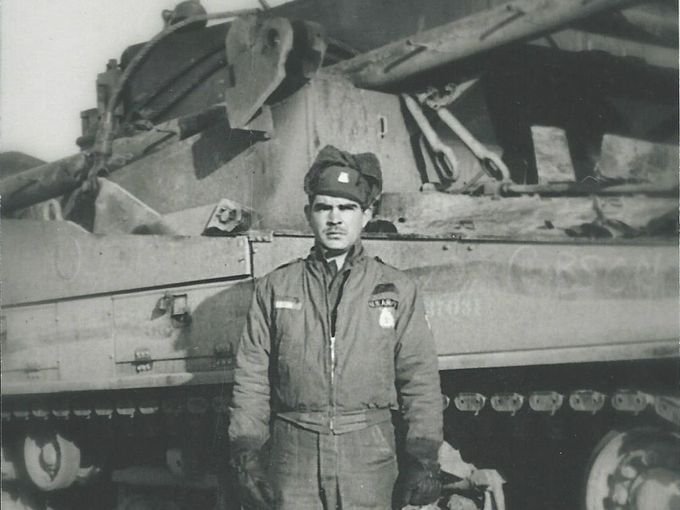
Jack, the Triple War Veteran, a nonfiction

illustration triple war veteran

Jack, the Triple War Veteran, a nonfiction

I met Jack, the 91-year-old, 52-years-of-service-including-3-wars, Army veteran on May 31st, 2013, approximately two months after I “woke up” from what was [then] my life, when I went to go fill my mom-mobile (white minivan) with mid-grade gasoline products (it may be only a mom-mobile, but i have a NEED FOR SPEED) at the Gate convenience store/gas station two blocks or so from my house.  I saw him sitting over by the vacuum/air/water station, on the round, concrete base of a streetlamp, his sleek, black, wheeled walker/chair thingie so piled up with odds and ends of clothes, shoes, and bags of snacks that it looked more like a shopping cart from across the parking lot.  His hair and beard were striking:  long, silvery white, shiny and silky and clean.  He looked like a very trim, fit Santa Claus, and when I first saw him, I would never have guessed he was 91 years old.  I approached him because I am what some people call a “bleeding heart liberal,” that is, my heart sort of sags and melts when I am confronted with people having needs that, to them, loom insolvable, and in actuality can be solved with a couple of $5 or $10 bills.

“Sir,” I said, “I don’t want to offend you in any way, but do you need anything?  Can I do anything for you?  Anything at all?  Do you need a few bucks, maybe?”

“Honey,” he said.  “I’ve been saving my money all my life!”  He took his wallet out, showed me a bunch of folded bills, and pulled a big stack of quarters out of his shorts’ pocket.  Jack was born in West Virgina, called himself a good, old hillbilly.

“Jack’s a great name,” I said.  “One of my grandpas was named Jack.”

“They named me after the dog!” he said.

“Well, they must have loved that dog,” I said.  “It must have been a terrific dog!”

“They still named me after the dog,” he said.  I have named pets after people, and wanted to do the reverse, just never had the actual opportunity.  (Wait for it!)

“I went to West Virginia once,” I said.  “I was in Morgantown.”

“The University of West Virginia!” he said.

“I know, it’s a beautiful town,” I said.  “And the state is beautiful, all those green hills.”

Turns out, he’s hanging out at the convenience store to get away from his daughter.  “She wants me to be the child, and her to be the parent, now,” he said.  “I’m too old for that!”

“I hear you,” I said.  “Does she know where you are?”

“I don’t really want her to,” he said.  “She lives right down the street, in a house I bought her back in 1972.”

He named his first rifle Miss Betty….

He was with Patton in N. Africa, at just 18 yrs. old, he was for a brief time Patton’s assistant?  Patton’s army was chasing Rommel, he and Jack started arguing over which way Rommel should to go; they disagreed (he & Patton) but Jack turned out to be right.  In a rage, Patton grabbed his (Jack’s) rifle once & shot into the air with it.  Yes, I could see General Patton doing such a thing.  Hahaha.

His daughter, whom he is on the lam from, is nicknamed BooBoo:  she got that nickname because as a baby she’d hide behind cabinets, furniture, poke her head out & say Boo, Daddy, Boo!

He is not married now, he likes it that way, nobody telling him what to do.

When I told him how nice he looked, how he didn’t look 91 at all:  “I take care of myself!  I’ve got to!  People say I’m a loner, but it’s three of us:  me, myself and I.”

God’s on his right shoulder, sometimes God tells him things, what to do or not to do:  sometimes he doesn’t listen, does what he wants, not what God says.  Later, he hears God saying, I told you so.  God has blessed him.  Every time we shook hands, me trying to exit stage right because my own 15 year old BooBoo was at home waiting for me to get back, he said, “God bless you,” and I said, thank you so much.  His eyes, the pale clear blue of a child’s, the twinkle of a child’s, the mischievous, rascally soul shining out of them.  But a good, good man.  Stationed all over the world and the United States of America.  The state of Florida was the site of his last posting.  He got misty-eyed thinking about one of his predeceased children, another daughter, however, he did not mention her name, and because of aforementioned misty-eyed-ness, I did not ask.

They once had a terrible episode of anthrax on the farm, when he was a child?  The cow had to get shots from the vet, they couldn’t use the cow’s milk for 6 weeks, then it was OK.  That cow gave so much milk, she had to be milked three times a day, not just two.

He wore dog tags, wouldn’t let me look at them:  “the last person that sees these is the one who’s supposed to bury me.”

“Well, I certainly don’t want to be the last to see them, then,” I said.

A student buying beer stopped & handed him a tall cold water bottle.  Jack thanked the boy warmly, saying “God bless you,” then after the boy walked off, he handed me the bottle.

“Aren’t you going to need this?” I asked him, concerned.

“I’ve got everything I need right here,” he said, pointing to his loaded “sulky,” a plastic grocery bag hanging:  was that the water?  “Besides,” he said, “that’s too cold.  And besides, I really like beer.”

“But you might need this water later,” I protested.

“Look,” said Jack, “he gave it to me, I’m giving it to you.  I’m just in the middle.”  I had to accept, gracefully, so I did, but I still felt a bit guilty.  The gift was Jack’s, but he wouldn’t keep it, he had to pass it along to me.

The store clerk, a young African American lad, came out to check on us; I think he wanted to make sure I wasn’t endangering Jack.  Jack handed him a huge pile of quarters, asked if he’d bring him out some beer.

“What kind?” the young man asked.

“O.P.,” Jack answered.

The clerk was confused.  “What’s that?” he said?

“Other people’s,” laughed Jack.

“I think he means it really doesn’t matter what kind of beer you bring him,” I said to the young man.  So he went inside with the money, came back out with a boxed six-pack & Jack’s excess change.

A woman, with a hard-lived look, came over to talk to us.  She knew Jack already, addressed him by name.  She was also a veteran, Operation Desert Storm.  She asked me if I could spare some gas money.  “It’s the end of the month,” she explained, “and I’m coming up short.  I just have to make it a few more days.”

“Sure,” I said, relieved that I could at least give her something, fulfill the impulse that had brought me over to Jack.  I went to my purse, grabbed a ten dollar bill.  While I was doing that, I saw Jack getting his money out to give her some, too.  He brought out a fiver.  Jack and I handed her the money, she shook my hand & thanked us both, and went to pump her gas.

Jack was dressed like a cool surfer guy; shorts with a nice braided belt, no shirt, his dog tag necklace, a pinky ring carved out of some sort of jade on his right hand, a couple of funky/hipster/hippy bracelets on his left wrist.  Quite fashionable looking, and I couldn’t get over the condition of his hair; silky & clean & shiny & sparkling silver, and the same with the beard, it grew to a natural point just below his breastbone.  The only long beard I’ve ever seen that looked beautiful!  His skin was amazingly smooth & healthy looking, considering the amount of sun exposure he must’ve seen!  I mean, he was 91 and he had very little sun damage, not many wrinkles, though of course a bit of sagging around the jowls.  No frown lines!  His only physical flaw was some missing teeth; it was apparent he could have had dentures or a bridge if he’d wanted them, but I think he was more comfortable without.

When I was leaving, I blew him a kiss.

“I’d rather have the real thing,” he chuckled.

“I can’t,” I said, “I’m married.”  We both laughed then.  If I had known that day, May 31st, that my husband was going to dump me, unceremoniously, in front of the yard man, in the side driveway, I certainly would have kissed him (Jack!), full on the lips!  Like, a billion times!

[If he’d had all his own teeth, not only might I have given him a closed-mouth smooch, but I probably would have tried somehow to fix him up with my former mother-in-law who live[d] in my attached guest house (that I built for her & her husband, who died 3 years ago, but who would be 91 now) (who was the only decent person in THAT entire FUCKING FAMILY).  Said former “mother in law”
was, and is still, an ignorant idiot and would have been put off by Jack’s missing teeth.  Plus, she is, as we used to say in middle school, “mental.”]  *ahem*  NO FURTHER COMMENT PERMITTED, BY LAW.  Did you know, that for IRS purposes, you can NEVER GET RID OF AN IN-LAW?  Once an “in law” for tax purposes, always an “in law.”  The law presupposes that divorced persons might still have attachments to one another’s family members.  Hahahahaha.  Isn’t that FUNNY?????

Oh, P.S.  I, myself, now have a dog named… wait for it… JACK, a rescue from the Dixie County, Florida animal rescue organization, a sweet one-year-old weimaraner/yellow lab mix!  Jack the dog’s eyes are yellow/green & deep….

Oh, and P.P.S.  And you’re not going to believe this!  On the way to present this piece at an “open mic” at Coffee Culture on 13th Street in Gainesville, Florida, the fabulous Tristan Harvey, emcee & manager of the joint, in any case, ON THE WAY TO THE FUCKING OPEN MIC, i ran in to jack, on the way!  it was raining, i pulled over & asked him if he needed a ride.  he said no, i said, isn’t your name jack, and HE LIED BECAUSE HE THOUGHT I WAS THERE CAPTURING HIM to take him back to his daughter!!!!!!

GODDAMNED TRUE STORY.  BELIEVE IT, OR NOT.

um, but if you know what’s good for you, you’ll take my written words as GOSPEL TRUTH.

5 Comments

Filed under health, humor, legal writing, mysterious, notes, poetry, prose poetry, science, short stories

People Like You, a poem

illustration people like you

People Like You

I’ve known a lot of people over the years, hundreds

in fact, and I’ve made it my serious business to know them

extremely well, both inside and out; it’s what I do,

it’s what I like to do, quite possibly it’s what I do best —

but in all this time, I’ve only stumbled across two people

like you in my entire life, there’s just you and him,

two truly dangerous human beings, two walking disasters,

two men obviously wounded so deep inside

that even after it was over, even after

examining all the mixed-up feelings I’d coaxed

out of us both; shoveling and pouring them

into the leaky jar formed from all our human needs;

even after the feelings had settled into pretty layers

of sand and sediment organized by density;

even after I poured over that the shimmering crystal

water of my tears, (not just the real ones I cried,

but the ghost ones you always wished you were able to shed)

I did not hold you responsible for your actions.

Not a bit.  I had my eyes open from the very first

moment I heard your voice.  I freely allowed you

to hurt me, I asked for the pain to be given to me,

then I made excuses, I made allowances, I forgave you,

and I am not very often a forgiving person.

Ask anyone who knows me well.  Rather, I hold a grudge;

it is how women are as a race, I am told;

and I am told I am a woman.  Do you think I am a woman?

Do I look like one?  The private physics of our bodies

differs — does that create a real disparity in power

or just a real disparity in perception?  You point always

to the internal risk of damage women carry within them.

You say, men do not have to fear women the same way

women have to fear men.  With good reason, you have helped me

to learn this — now there is nothing left to do but file

your memory away forever, attach the bright red warning

stickers that proclaim for all to see: hey, wake up,

look twice, look close, look long, we all know

people like this exist, they exist for a reason.

Do you mind if I ask again, if I pry one last time

where I am not wanted?  Oh, dear heart, what is your reason,

your sweet reason, your sweet reason for existing?

1 Comment

Filed under mysterious, poetry

Our Villain, a short story

illustration our villain

Our Villain

Back when these events transpired, we consisted of three lawyers representing two plaintiffs against one defendant.  We were, then as now, made up of two males and a female, the female of medium height, one male taller than average, one male shorter.  Both the male lawyers were older than the female lawyer by in one case, seven, and in the other case, ten years.  Only one of us, however, had blue eyes.  And only one of us was in love with the other two simultaneously, to her great consternation and guilt, as all three of us were married, but none to the other.  Hence, once possible source of difficulty for her.

The case was ponderous and slow-moving though not terribly complicated, legally speaking.  The theory of liability was straightforward; even a child could comprehend it, and in actuality two children already had.  No, in our case it was not the law that was causing our increasingly troubling reliance on several rounds of stiff drinks in the early evening and several rounds of antacids later on.  It was rather, the facts.  In the end, had any one of us been asked if we felt we had done the right thing, the answer would have been not yes, but a glare of outrage that the question had even been asked, and perhaps a violent cuff or two to the side of the questioner’s head.  On our way this morning to the small, cold and windowless room we now sat in, we had driven together, singing long-memorized childhood standards to relieve the tension we all felt.  We had, by way of example, upon arrival at the designated meeting place, arm in arm, skipped across the underground parking lot while whistling “We’re Off to See the Wizard.”

Thus fortified by silly notions of camaraderie and invincibility, we sat across from the villain, whom we only in public termed “the defendant.”  We were there on that heartbreakingly beautiful late spring morning — the kind of morning when even had we been working on a less distasteful set of facts, we would rather have been anywhere else — to ask him questions about what he’d done to two little girls, our clients, aged 9 and 12 when he started, aged 11 and 14 now.  The natural beauty outside — redbuds and Japanese magnolias, falling camellias — was to us that morning like a knife in the chest.  We had just the night before come back from a visit to the girls’ current home, a grim apartment in Little Havana, furnished with a couch and chairs upholstered in bright gold plastic, molded to resemble brocade and velvet.  The girls’ mother sat out in the kitchen while we talked to them, then the girls went to the bedroom they shared with their mother while we talked to her.  Our talk was intended to help them feel that what they were going through now, the legal system, was not as bad as what the villain had taken them through.  But the villain’s lawyers, also three in number, were trying to convince both girls and their mother that what the villain had taken them through was, in fact, the best of all possible worlds, and that the uncertain future they now faced was simply a result of their own stupidity and greed.

After the psychic shoring-up session at our clients’ sad, ill-lit lodgings, we had departed hastily for the bar at our hotel.  One of us, as it turned out, was unable to handle her drink as well as the other two — though all three of us drank more than the AMA preaches, though not, perhaps, more than the AMA actually practices when faced with the sort of evening we had just experienced and were trying to bury in the way a dog buries a nasty, rotting piece of meat that said dog knows will be needed the following day for its very sustenance.  Indeed, one of us was so incompetent at the art of self-medication by drinking she made inappropriate remarks to the other two of us, remarks involving her shameful, growing adulterous sentiments toward the other two, and though the eyes of the second two softened and grew misty and mutually receptive to the first’s silly, childish emotional exuberance — and one laid a tender hand on her wrist while the other stroked her cheek — they nonetheless raised to her as gently as they could the issue of how negatively our spouses might react to such sentiments, fully realized in all their permutations.  Besides, the possible effects on our case loomed, immeasurable and frightening.

From the beginning we’d agreed that if we’d been casting directors for a Hollywood movie, we couldn’t have found a better physical type to play our villain.  He was tall, well over 6 feet, and hulking, with a belly that strained the buttons on his shirt and spilled over the waist of his trousers.  His skin was pale and so were his eyes, a faint blue behind thick lenses.  Even his hair helped us — thinning, the color of burnt toast, combed greasily back off his forehead and swirled neatly behind his ears, but curled up in the back as if it couldn’t bear to be a part of him and would have jumped off at the first chance.

He’d met the girls’ mother when she was on the verge of becoming homeless.  He discovered later, to his satisfaction, that she was always perched on that edge, that he could forever hold her in his hand as long as that hand was gentle and lined with cash.  He moved them into his fine house, a low-slung, four-bedroom ranch in the suburbs of Miami.  His family home was far, far north, and he’d long ago fled the harsh winters for our near-tropical climate.  The brief, almost nonexistent winters we enjoyed led to the closets of young girls such as he favored being full of short-shorts and tank tops, and in, say, February, when his mother and his brother and sister (his father was dead) shivered inside their wools and furs, and drove haltingly along just-plowed, still-icy roads, he could climb into his Corvette convertible, top down, his thin, lank hair fluttering gaily as he drove, usually humming, to find his favorite sights at any city park.  For free.  He could look as long as he liked, newspaper over his lap, and no one had any idea what he was really thinking.

As lawyers, we thought we were familiar with how most people, even people not as far off the beaten path of normal human desire as our villain, are nonetheless filled with bizarre, inappropriate, even disgusting impulses.  We believed we understood how everyone is, underneath the legally complex bounds of civilized adulthood, in many respects still the naked, screaming, bloody baby ejected suddenly and not altogether politely from mama’s throbbing womb.  As lawyers, we possessed staid, naïve notions that because we had already experienced myriad cool, appraising looks in boardrooms and courtrooms, (in combination with startling internal questions of our own, seemingly unrelated, sudden pulsing engorgement), nothing could truly touch us, make us feel, by mere legal contact, soiled.  How wrong we were.

The day he met our girls and their mother, he’d spent the afternoon pursuing one of his favorite hobbies.  Top down, cruising in his car, trolling for the bright yellow buses that never failed to stir his loins.  He’d follow behind one, fly unzipped, smiling at the young faces gesturing frantically to him behind the glass windows marked “Emergency Exit.”  The kids loved his car.  He loved the kids, and that was what nobody else seemed to understand.  He loved them more than anything.  Their clear eyes and bright, uncomplicated peals of laughter were what drew him to wake up each morning, were what made life not a chore but a gift from God.

The day we sat across from the villain, what appeared to offend him most was the nervous gaze of the court reporter.  Maybe dressing the way he always did, in an open-throated shirt, his neck, wrists and fingers hung with heavy, 18-carat gold ornaments, had been a mistake in judgment.  He met our eyes shyly — trying to use his best manners.  Had he used that shy, hesitant gaze the first time he approached our girls?  Had he, by reason of blushes and stutters, brought out their still-developing maternal instincts?  Had they seen him as nothing more than a big, rubbery doll of a man?  Had he clasped his wrists the way he hung on to himself now?  For dear life?  What part of his life was dearest at this moment?

We, in our turn, met his eyes with blankness, hiding our feelings, our ultimate goal — we wanted to inspire in him only trust.  We were, for the next few hours, dedicated to convincing him we had no malice toward him, no, simply the same heartfelt weight of concern for his girls — our girls now — that he’d always maintained.  We differed only in how we wished him to express his deepest feelings toward his beloveds.  We simply wanted to redirect his fingers from the clasp of his own member to the clasp of an ink pen.  All he had to do, to satisfy us, was sign a check representing a sum equivalent to all he now possessed.  It was no more or less than the great love he’d always felt for them, for all of them, all the dear children who’d brought such golden light into his otherwise empty days.  He was worth millions.

Our girls had been shocked when he first made his desires known to them.  Shocked not in the sense one is shocked by a car accident, but shocked in the way one is shocked the first time it is made plain that one will be required to someday provide food, clothing and shelter for oneself.  His desires for them quickly brought material comfort to their mother and to them.  At first, the knowledge of their importance to him brought them a sort of heady pride, a child’s pride at having found in the soil a shiny gold coin.  For a while, there was no great weariness at his requests.  For a while, our girls still felt it was worthwhile to each day shower, brush their teeth, and comb their hair.  It was, at its best, a game, a stage play, a dream.  They would feel something click over in their heads, and suddenly the hands on their bodies would be outside the real.  What happened against the skin of their bodies in the villain’s king-sized bed atop his black sheets happened in another country; a parallel universe.

We knew their seduction had been a gradual procession from blushes, hesitations and startlement to coy fumblings undertaken first under cover of a cheerily false, overgrown childish abandon, then beneath a camouflage of compliments and toys, shopping expeditions to the nearest air-conditioned mall wherein nothing was refused, nothing.  If our villain refused them nothing, how weakened became their own ability to refuse!  He had become quite skilled at fulfilling the ache that seemed to start in his toes and rise up to his scalp.  His entire body loved those girls — his kisses covered them like a fine mist of semi-tropical rain.

When the teachers at school sent home notes advising the girls’ mother to assist in ensuring their personal hygiene, how delighted he was to purchase fine soaps and bathing salts, sponges and silken wash mitts.  Neither he nor their mother, busy in front of her TV, saw the circles under the girls’ eyes, the listlessness which every day crept deeper into their skins, as symptomatic of anything other than transient sleep deprivation or chronic growing pains.  The girls were, despite the recent flimsiness of their appetites, growing like kudzu vines after a good hard rain.  All was well in the quiet house.

The villain and our girls’ mother were, as a result, quite alarmed when the child welfare worker showed up one afternoon unannounced. Our villain was napping in his dark, cool cave of a bedroom, covered only from the knees down by the sheet which yet retained a certain pleasant odor and stiffness from the previous night’s adventure.  Mother was engrossed in a particularly compelling news broadcast of the Pope’s South American tour when the doorbell rang.  She was stout and somewhat put out at having to leave her seat as she huffed her way to the door.  Those Jehovah’s Witnesses could be such an annoyance.

The social worker stood on the doorstep in the bright afternoon sunlight, mopping her forehead with her bare hand, and then drying her hand on the side of her slacks.  As soon as the girls’ mother answered the door, the social worker felt something hard to describe, something which she would, with great reluctance when pressed later by the district attorney, label nausea.  She felt nausea as she stood looking at the girls’ overweight, unkempt mother, but she could not be sure if it was due to the heat, the greasy chicken sandwich she’d wolfed on her way to this visit, or the physical presence of the mother herself, a short, stocky, large-breasted, flat-footed creature with no discernible joie de vivre.

Now, in our tiny deposition room, our villain began to perspire as we questioned him.  He remained of good cheer, evidenced by an easy, toothy smile and an absence of muscle tremors.  We asked many things which in ordinary onlookers might have produced discomfort.  We asked hundreds of detailed questions involving the breasts, buttocks, mouths, hands and genitals of both the villain and our girls.  Every possible mathematical combination of the body parts mentioned had to be imagined, catalogued, and inquired into.

But our villain’s lawyers, though he had already been criminally prosecuted and sentenced under a plea-bargain, instructed him after the very first question to invoke his rights against self-incrimination under the Fifth Amendment, using those simple, nearly poetic words we had studied in school and grown to love — but would never love again — hiding behind those words as behind a hideous, absolute shield.  His lawyers stared at the table, unable to meet our eyes.  Surely their job was worse than ours, at that moment.  Because the villain wanted so badly to tell us, he wanted to explain that he had never, ever done anything to harm those beautiful children.  He only wanted to tell us how much he had, and would always, love them.  His body trembled as his lawyers touched his arms to keep him in his seat.  Our bodies trembled as we continued our litany of questions, preserving for the record his only defense.

We couldn’t, as we had imagined, pierce the villain upon our lance of questions like knights on chargers, and thus protect our girls from exposure to cross-examinations by his white-glove law firm’s most skillful roster of evil, carrion-eating dragons.  We could not keep him — by virtue of the Constitution — from further harming the children we sought only to recompense for the harm he’d already inflicted.  We might now be forced, if he would not voluntarily settle the case, to put his victims upon the witness stand only to be reminded in excruciating detail once more of the very things we wanted them most to forget.  What we didn’t know, at that moment, was he would the following week agree to settle the case, not, unfortunately, for every cent he possessed, but for enough of his funds to cut short his career as lethal sugar-daddy.  What we heard, we heard only from our girls.  In private.

Please, he had said, the first time, when he made “love” to them both within a half-hour.  Please.  His words flayed the girls open like a rawhide bullwhip across their chests.  I need to, he had said, curled up on the bed next to them like a baby.  His hands reached, grasped, fumbled, and then grasped again.  He unbuttoned their shirts, unzipped their pants.  The sensation was at once terrifying, sickening and pleasurable.  Our girls turned their eyes away, looking out the windows, down the hall.  Their dread and revulsion butted up against his sickness, his addiction.  He left the door open, the curtains flung wide.  It was a beautiful spring day outdoors that day — full-blown white camellias fell off their perches with heavy, helpless plops at short intervals just on the other side of the window-screen next to the bed.  The flowers had to bloom, had to engorge each formerly folded petal, to force themselves open toward the light, the slow-moving caressing wind.  The girls tried to see him as a bee forcing its way into a closed flower, a male bee burdened by his own desire, his own weakness, and his own ignorance.

After the villain’s deposition was over that day, he somehow made it to the door before any of us did.  He stood in the doorway waiting, his hand out, as if a greeter in a department store.  His palm was soft-looking, glistening with perspiration and as we glanced at it we saw not a hand, but a weapon carrying the stain of everything we already knew he’d done with it.  Ladies first, the villain said with a smile.  Then, while that unfortunate member of our trio shook hands with the villain, the other two slipped by him with relief and gratitude toward the first.  His flesh turned out to be hotly moist, unpleasantly springy, and what we found out later, as the three of us walked arm in arm to the bar on the corner — the two who hadn’t shaken the villain’s hand supporting the weight of the one in the middle who had — it seemed his touch (no matter how much scrubbing with soap and water so hot it seared the flesh had taken place immediately afterward in the washroom of the courthouse) his touch had made all of us feel irrevocably soiled.  Like we’d shaken hands with the Devil.

3 Comments

Filed under legal writing, short stories

After the Shortcut, a short story

illustration after the short cut

After the Short Cut

I’m a pretty woman, at least so the men tell me. “Andrea, you are some woman,” they say. They say that, and then I don’t know if I ever want to see them again. Anybody who would think I’m something special must have a hole in his head. I’m spreading a little in the rear now, after two kids — I’ve got a bit of cellulite on my thighs. It’s all gravy, that’s what I say.

Since I was 14, my life’s been one big bowl of gravy. I’ve tried to learn a little bit about a lot of things — I’ve tried to learn about learning, about how it’s done. It doesn’t matter what fate dishes out to me to go with it, whether I get the tough meat or the tender, the fat or the lean, my life all tastes better because of that gravy. My mom will tell you I blame her for every mistake I’ve ever made, but I don’t, not really. I don’t blame her any more than I blame myself. I blame Katie. I remember Katie in her perfection, the last moment before she got hit, the smile on her lips, and the sparkle in her eyes. That’s how she’ll live forever in heaven. It was her idea, all of it, the boy, the interstate, everything. I blame her, but she paid for her mistake. Sometimes I think she got the easy way out.

I believe everybody’s religion is a way to get to God. I don’t get nervous about having the right one. Why would God shut people out that way? The notion of original sin seems like the most fundamental sort of self-hatred. How is a newborn human baby any more sinful than a kitten? I was in the hospital the morning after my daughter Barbara was born, watching her sleep in her clear plastic bassinet, and I felt like we were both innocent, both trying as hard as we could to do the right thing.

I don’t believe in sin, I believe only in foolishly going against God’s tide, but nobody can keep that up forever, God’s too strong. I try to think right — feelings are another thing, there are no such things as right feelings, or wrong ones. God won’t give up; He’ll pull you up to Heaven no matter how badly you think you want to stay out. Can salmon keep from getting called upstream? Do you think the salmon that get caught by bears along the way are failures? Of course not. Katie and I were like salmon going upstream, going to meet this boy at his house, this boy she had a crush on, the kind of boy that made her heart beat faster — I didn’t get there, neither did she, but she got to see God before I did. I’m waiting for my time. Will he look like my first lover? Is that what Katie saw first and last, the boy she loved, the boy with the brown eyes that made both of us dizzy but gave Katie the most specific intentions?

I sure as Hell didn’t want to cross the interstate on foot. It was Katie’s idea. Do you think that makes me feel any better about what actually happened? I wonder how I’d feel if it had been my idea. Would I feel better, or worse? I suffer when I think about how dumb it was. We acted foolishly, and we’ve both ended up paying. She was brave, I was a coward. I lived, though, I found uncertainty, never knowing which way to go after that moment — I found both cowardice and bravery while she found certainty and sudden death. After I saw her get hit, nothing much mattered until my daughter Barbara was born four years later.

Barbara’s ten now, and she’s got the same powers I have, she can see what’s wrong with people without even talking to them. She can feel where they suffer; she can feel the pins and needles in her own hand when she passes it over their sorest places. She can hear me in her head; I can hear her in mine, without either of us saying anything out loud. Everybody can speak without using their mouth, but very few of us can hear what they say. I run into a few, now and then.

Katie and I were crossing the interstate on foot. We wanted to go to this boy’s house from the mall, and it was a short cut. Without the crossing, it would take 45 minutes to walk there, with the crossing it would take 15 minutes. We wanted to get there faster. We didn’t know we would never make it. If we had known, we would have taken the long way around. We thought that long walk would be boring. We were so impatient, so full of life, giddy with the thought of kisses. We wanted to see that boy — rather, Katie wanted to see him and I wanted to watch them watching each other. But no one could come pick us up from the mall; everyone was too busy to give us a ride. It was wintertime, dark early. That night was so dark, even the sky was clouded over so you couldn’t see the stars. The pavement was like black velvet from the side of the road, an endless ribbon of black velvet and the cars going by were like jeweled bugs, busy on their secret business, their buggy errands.

I had on a jacket. As soon as I saw her get hit I tore it off my body, I used the jacket like a signal flag to wave over her body to try and stop the oncoming cars. I knew she was already dead, I felt her spirit go through me, entering the top of my head, leaving through the soles of my feet. I saw her draw her last breath — even with all the noise, all the cars zipping by on the other side of the road and around us, the wind and the fear and the hiss of burning tires and brake linings, I heard her last gasp, through her cracked ribs, I heard the air leaking through her perforated lungs, I heard the last breath bubbling through her blood. I saw her laying there, her black hair spread over the road like a wet curtain, and I knew.

I rode in the ambulance; they worked and worked on her body, probably just to comfort me. I knew she was dead, but they wouldn’t actually tell me until my mom got to the hospital. My mom, who was even at a moment like that more interested in her bottle of Scotch and her dying friend and her rising fever than in me. She wanted to know why we hadn’t called her. Did she forget we did? We did call, all we got, all we ever got was the machine, and she was in bed nursing her hangover, nursing her sorrows, nursing her case of the flu.

Mom wasn’t perfect, but wasn’t a total screw-up either. She’ll never forgive herself. Thank God we were supposed to be in the care of Katie’s mom. Katie was an only child then. Her mom had another child after Katie died, a boy — she didn’t want another daughter, that would have been too painful. That second child was an accident — just like my oldest — Katie’s mom was so grief stricken for a while she’d go out to bars and pick up strange men, and forget to wear her diaphragm. Or maybe it was the pills she forgot to take. Either way, we were both on the same train after Katie.

Does Katie see me now? Does she forgive me? Will she help me forgive myself? Katie was in love with that boy — she sat behind him in math class. She worshipped him from afar, she was obsessed. After my friend died, I slept with him, for her. He never knew why I came on to him or why I broke it off — I never told him. One time after we’d made love I asked him to tell me about her, he didn’t know anything. I felt sorrier for that than for anything. Katie died a virgin; I’ve made up for her in that way. The joy of knowing what is true can be dampened by the pain of knowing you’re not going to be able to live in the truth, yourself. I don’t care, it’s all gravy now.

Since I was 14, it’s been gravy. I’m not any better or worse than Katie. I say that to myself, but I don’t really believe it. She was good, she died. I lived. Clear enough? When I feel like I haven’t gotten what there was to get out of my life, when I feel how much I’ve missed from inattention or carelessness, Katie comes back to me with a still wind, rushing through my ears like she did the night she died. I’m waiting for my time to come.

Hope it’s not on the interstate. Not like that, not with my hair spread out on the wet pavement like a pretty, pretty fan. Not with my ribs sounding like popcorn when I breathe. The driver of the car cried for days. I suppose his situation might have been the worst of all. Thinking he could have stopped in time. But he couldn’t have. I wonder if it made him a better father to his own kids. I tell my own daughter, Barbara, honey, don’t ever be afraid to take the long, safe way to wherever it is you’re going. You’ll get there, even though you don’t think you will and you’ll see things you never would have seen otherwise. I don’t want her to miss out; I don’t want her to have to live off gravy for the rest of her life like me. Please, God, anything but that. Patience, I tell her when I kiss her goodnight, smelling the hair right in front of her ears, the place she can never manage to reach with the shampoo, the place that smells of sweat and tears and dreams, just like mine did. Patience, my beautiful girl — I tell her every chance I get — patience is a virtue.

4 Comments

Filed under short stories

Do Something

1 Comment

Filed under recommended reblogs